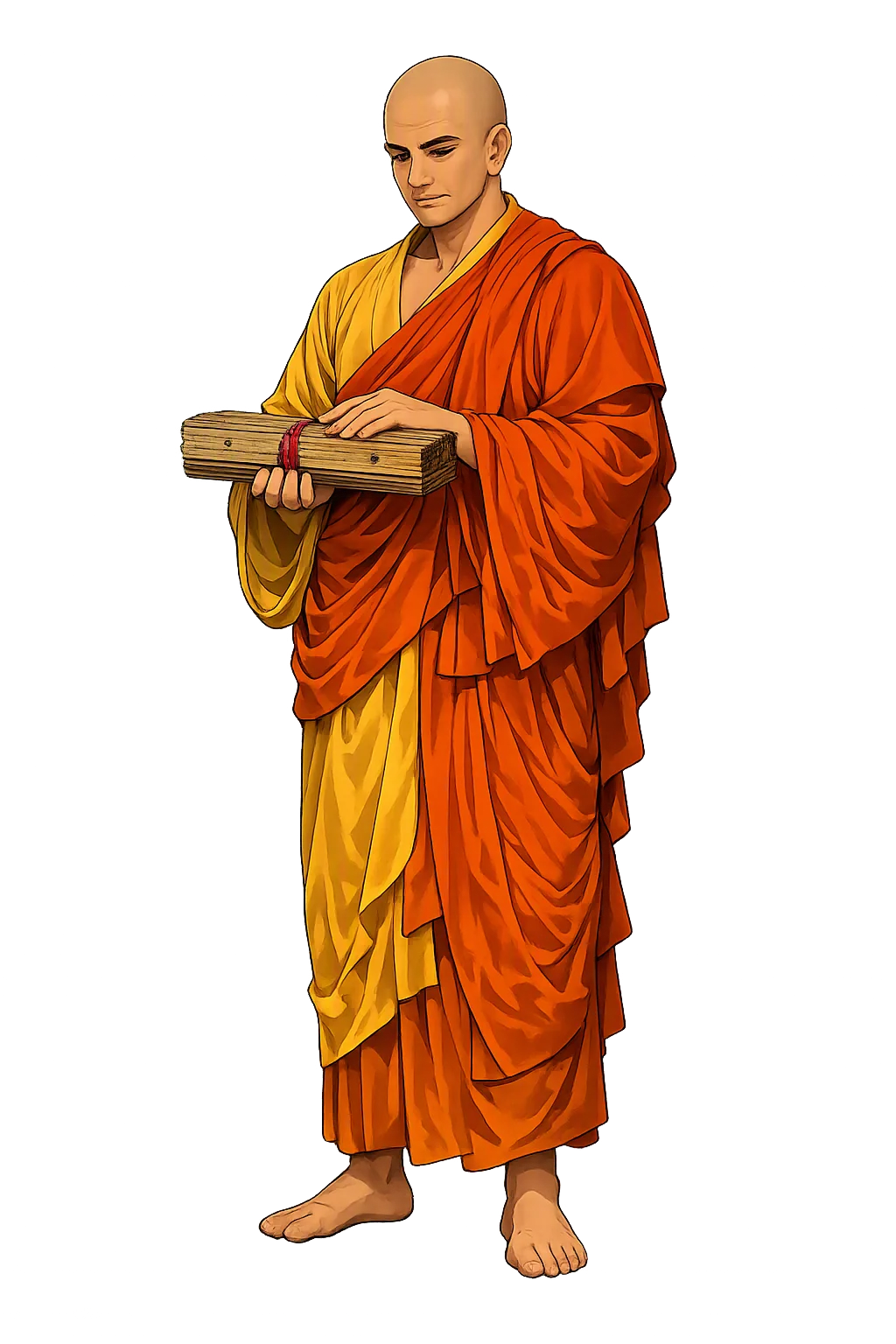
Stories of Asanga
Asanga's mythology is the hagiography of a psychologist: the vision that founded his school came through compassion for a dog, and his school's charter texts were, by tradition, dictated by the future Buddha — scholarship's verdict is that Asanga wrote them himself, which changes nothing about the parable.
Asanga and his younger half-brother Vasubandhu — arguably the two most consequential Buddhist philosophers after Nāgārjuna — were born, the story runs (Xuanzang preserves it in his Great Tang Records of the Western Regions), to a brahmin of Kauśika lineage; their mother, the legend adds, resolved that one son should master the Mahāyāna and the other its rival, the analytical Abhidharma of Kaśmīr. Vasubandhu became the encyclopedist of the Abhidharmakośa; Asanga wandered and meditated until he founded Yogācāra. Then the elder brother executed the gentlest ambush in the history of ideas: feigning a mortal illness, he had disciples read him a Mahāyāna sūtra and plant objections that only the Mahāyāna could answer — until the great critic recanted on the spot and joined the school he had spent his career refuting. Vasubandhu's conversion doubled the school's firepower: the Viṃśikā and Trimśikā became its core. The myth explains a real fact: half of the Indian Mahāyāna was written by one family — brotherly love as the engine of a philosophical revolution.
The founding vision of Yogācāra is a story about compassion first. Asanga, the tradition says (Xuanzang; the Tibetan historians Bu ston and Tāranātha repeat it), spent twelve years in solitary retreat awaiting a vision of the future Buddha Maitreya — and saw nothing. Despairing on his way down the mountain, he met a dog dying in the road, its open wounds alive with maggots; to save both creature and worms he cut flesh from his own thigh and reached to lift the maggots with his tongue. The dog vanished: it was Maitreya. The bodhisattva then carried Asanga bodily to Tuṣita heaven, where he received the five great treatises — Abhisamayālaṃkāra, Mahāyānasūtrālaṃkāra, Madhyāntavibhāga, Dharmadharmatāvibhāga, Ratnagotravibhāga. Modern scholarship — Frauwallner most forcefully — argues Asanga wrote them himself. The interpretive point survives either way: a philosophy of mind founded by a man whose breakthrough came through the gut — the dying dog was the last rung of the ladder.
What Asanga built — with Vasubandhu and their lineage — the tradition called Yogācāra, "practice of yoga," and its opponents called cittamātra, "mind-only." Its masterworks, the Mahāyāna-saṃgraha ("Compendium of the Mahāyāna") and the Abhidharmasamuccaya, set out a psychology of awakening: the store-consciousness (ālayavijñāna), a deep repository in which the seeds of deeds and habits sleep, waiting to sprout as the world; the three natures — the imagined (the snake), the dependent (the rope), the perfected (the seeing); and the radical claim that the "external world" is a construction of consciousness, no more independent than a dream is independent of the dreamer. The Saṃdhinirmocana Sūtra supplied the school's scriptural charter, with its doctrine of the three turnings of the wheel. The interpretive meaning: suffering was re-described from metaphysics into psychology — and liberation as a rewiring of perception, perception seen at last as the whole stage.
Yogācāra conquered China by land and sea. Paramārtha carried its first full synthesis in the 6th century; then Xuanzang, after his epochal pilgrimage of 629–645, studied it at Nālandā under Śīlabhadra — Asanga's doctrinal great-grandson across five generations of masters — and brought back hundreds of manuscripts by pack animal. His synthesis, the Cheng weishi lun ("Discourse on the Establishment of Consciousness-Only," completed 659), founded the Chinese Faxiang school; carried to Japan it became Hossō, the school of Kōfukuji, and its Kegon cousin built the great Huayan systems on Yogācāra bones. The line then looped home: Tibetan translators rendered Asanga and Vasubandhu entire, and every Tibetan debate courtyard still argues their three-nature scheme. The interpretive lesson: a school born in a retreat hut on the Ganges plain became the common grammar of the Asian philosophy of mind — the one Buddhist system a modern cognitive scientist can read with almost no translation.
Without Attachment — Founder of Yogācāra, the Practice of Mind Only
Asanga (c. 4th–5th century CE) is the founder of Yogācāra, the Buddhist school that analyzed consciousness itself — the ālayavijñāna store-mind, the three natures, the construction of the world by perception — and the man who, by tradition, received the future Buddha Maitreya's five treatises on a visit to Tuṣita heaven.
The 'practice of yoga' school — Abhidharma rewritten as psychology: suffering located in the structure of consciousness itself.
Twelve years of retreat, a dying dog, and transport to Tuṣita heaven — where the future Buddha dictated the five great treatises.
He and his half-brother Vasubandhu wrote half the Indian Mahāyāna — the gentle ambush that converted the greatest critic of the Mahāyāna.
The world as construction of consciousness — 'mind-only,' his opponents' nickname, became the school's thesis and modern cognitive science's ancestor.
From the original script to the living URL
असन्ग
The name in its original Buddhist form. Asanga (असन्ग) is attested in the source tradition — “Without attachment”. Its original diacritics and script distinctions carry the full phonetic and orthographic weight of the source tradition.
asanga
The plain asanga form is identical to the Unicode restoration. Because this name is already written in Latin letters, no diacritics, stress, or script information were lost — only capitalization differs.
Asanga
The Unicode restoration does not need to recover lost marks for Asanga. Its value is canonical spelling and consistent cataloguing, not the reconstruction of erased orthography. The domain is readable as-is to both DNS and humanity.
Asanga.com
This restoration is written entirely in ASCII letters — no Punycode encoding stands between Asanga and the DNS. The domain reads identically to machines and to human eyes.
Owned, ideal, and ASCII forms of Asanga
Asanga
Restores असन्ग. The full Unicode restoration. asanga.com is not in the PuniCodex collection — it is watched for release; if it drops, this temple upgrades to an owned flagship.
How Asanga was spoken
How Asanga travels from ancient script to the modern URL
The lore you have read is the living myth. Extended Lore opens the scholarly vault beneath it: the cult and its material remains, a history of the image, the name after antiquity, a meditation on what the name still means, and the full scholarly apparatus — etymology, orthography, sources.
Enter Extended Lore