PuniCodex

Extended Lore

असन्ग Asanga

Etymology · Orthography · Cult · Iconography · Reception · Sources

Tier 2 Asanga
Asanga — Yogacara, Mind-Only
01

Quick Facts

Essential information about Asanga, Yogacara, Mind-Only

Original Scriptअसन्ग
Unicode RestorationAsanga
Reconstructed Pronunciation/ˈɐ.sɐŋ.ɡɐ/
PantheonBuddhist
DomainYogacara, Mind-Only
MeaningWithout attachment
ClassificationTier 2
Primary DomainAsanga
Sacred SymbolsThe wounded dog, Maitreya's tower, The mirror, The storehouse (ālaya), The three natures
02

Etymology & Word Family

From original script to Unicode restoration

Original Script असन्ग Asanga — "Without attachment"
Unicode Restoration Asanga Canonical scholarly spelling — ASCII-identical
Modern ASCII asanga Plain-ASCII fallback

The name Asanga reaches the modern world through scholarly transliteration of the buddhist tradition. Because the conventional spelling uses only Latin letters, its Unicode and ASCII forms coincide — the tradition it carries is in the name itself, not in diacritics.

03

Unicode Character Breakdown

Character-by-character philological analysis

CharacterUnicodeNameBlockPhonetic Role
AU+0041Latin Capital Letter ABasic LatinSame, capitalized
sU+0073Latin Small Letter SBasic LatinSame
aU+0061Latin Small Letter ABasic LatinSame
nU+006ELatin Small Letter NBasic LatinSame
gU+0067Latin Small Letter GBasic LatinSame
aU+0061Latin Small Letter ABasic LatinSame

The Tier 2 classification here reflects fidelity to the attested tradition, not recovered diacritics: every character of Asanga already survives in ASCII. What the restoration preserves is the canonical spelling itself — the form scholarship standardised.

04

Cult & Worship

How the sacred was kept — rites, sanctuaries, remains

The Cult

Asanga founded no cult, but his school created one of the most durable institutions in Buddhist history — the monastic university. Nālandā, where Yogācāra lineage masters taught for centuries, was organized around precisely the curriculum he built: Abhidharma as psychology, debate as method. The daily cult of Asanga is doctrinal and textual. Tibetan monasteries open their philosophy course with his Abhisamayālaṃkāra, memorized line by line; East Asian Yogācāra lineages — Faxiang in China, Hossō in Japan — honor him in their lineage rites. His hagiography supplies the devotional element: the wounded dog whose maggots he moved with his tongue, the vision of Maitreya in Tuṣita — a parable recited as scripture's equal. Pilgrims now honor him at Nālandā's excavated ruins, where his name anchors the modern revival of the ancient university.

In the Earth

Asanga left no monument of his own, and his century left few datable ones — the 4th–5th-century Buddhist world of northern India is known mostly through the pilgrim accounts (Faxian, then Xuanzang) and the great monastic cities they describe. Nālandā, excavated by the Archaeological Survey of India from 1915 and now a UNESCO site, preserves the excavated grid of his school's eventual home: eleven monasteries and six temples in brick, the sarai and the stūpas. The Ajanta caves' later viharas (5th–6th c.) show the scholastic monasticism his movement filled — rows of cells, lecture halls, painted jātakas. His true artifacts are textual: the five Maitreya treatises survive in hundreds of Sanskrit fragments and complete Tibetan and Chinese translations, their colophons still arguing about who wrote them — which is, for a school about the construction of authorship, exactly right.

05

Iconography

How Asanga was imaged across the ages

The Image

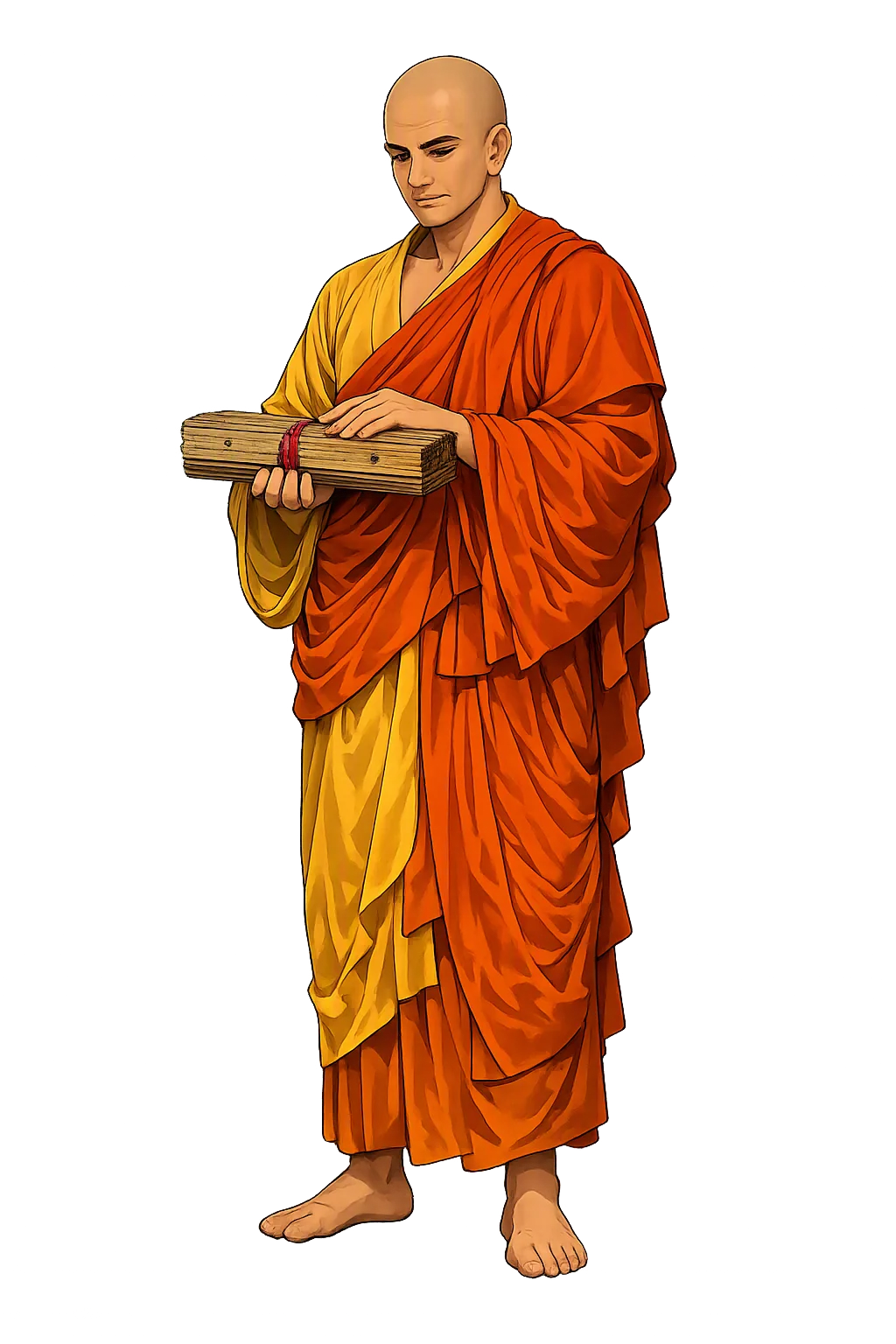
Asanga is imaged as what he was — a monk with a book. No early Indian portrait survives; the iconography is almost entirely Tibetan and East Asian lineage art, where he appears in thangka refuge trees and monastery murals as a serene scholar in monastic robes, holding a text or making the teaching gesture, often paired with his half-brother Vasubandhu as 'the two brothers.' Modern statues at Nālandā show him in bronze, eyes lowered over an open book. His attributes belong to story more than to image: Maitreya's tower in Tuṣita, the wounded dog, the wiped-clean mirror. Yogācāra's founder is remembered in libraries, not icons — fittingly for a man whose doctrine made the whole visible world a construction of mind.

06

Reception & Transformation

The name after its own age — transmission, translation, survival

Afterlives

Asanga's fate was to travel almost entirely in translation — literally. The Sanskrit originals of much of his corpus vanished from India; the works survive whole in Chinese, chiefly through Xuanzang's seventh-century study at Nālandā and his enormous translation project with his disciple Kuiji, which founded the Faxiang school, whose line reached Japan as Hossō in the eighth century through the monk Dōshō. In Tibet, the eleventh-century translator Ngog Lotsāwa rendered the Maitreya-Asanga treatises anew, and they became the philosophical spine of every Tibetan curriculum. Modern scholarship reassembled the man: Erich Frauwallner's 1951 study fixed his chronology against Vasubandhu's, Lambert Schmithausen traced the ālaya-vijñāna's textual growth across the early Yogācāra sūtras, and critical editions of the Mahāyāna-saṃgraha restored him as the systematic founder Indian Buddhism almost forgot it had.

Identifications Across Traditions

Yogācāra's fate was absorption: too useful to defeat, it was eaten by its rivals. In India, the great synthesis of the 8th century married Asanga's psychology to Nāgārjuna's emptiness — Śāntarakṣita's Madhyāmakālaṃkāra declared the two schools two doors into one house, a verdict all later Indian Buddhism accepted. In East Asia, Yogācāra merged with Huayan's cosmos and Tiantai's Lotus hermeneutics, surviving explicitly only in Japan's Hossō school while secretly structuring everything else. In Tibet, Asanga is 'the two brothers' half of every curriculum — the Abhisamayālaṃkāra is the master commentary on the Prajñāpāramitā that Nāgārjuna supposedly rescued from the sea. The modern meeting is stranger: William James and the Yogācārins now read each other — 'pure experience' and 'mind-only' are neighbors across a century, and the ālayavijñāna reappears in cognitive science as 'predictive processing.' The school named 'practice' became, in the end, the theory everyone practices against.

Modern Legacy

Asanga's legacy is institutional and conceptual at once. Nālandā, where his lineage taught for seven centuries, is a UNESCO World Heritage site and the name of India's modern flagship university; the Tibetan monastic curriculum still opens philosophy with his Abhisamayālaṃkāra, memorized line by line across every shedra from Lhasa to Mundgod. In East Asia the Faxiang/Hossō line, though small, preserved his texts when India lost them — Xuanzang's rescue of the manuscripts is itself one of the great stories of civilization's luggage. And the concepts migrated far beyond Buddhism: the store-consciousness anticipates the unconscious, the three natures prefigure constructivist accounts of perception, and 'mind-only' is quoted in contemporary philosophy of mind and machine-learning debates alike. A man whose name means 'without attachment' ended up attached to everything.

07

The Meditation

What Asanga means — beyond the dictionary

Asanga's school asks the question most traditions bury: not 'what is the world?' but 'who is building it right now?' His answer — the mind, constructing its world and mistaking the construction for the thing — was psychology three centuries before Augustine and fifteen before the laboratory. But his founding parable keeps the science honest: the vision came not from analysis but from a dying dog, and the first act of the school's founder was to bleed for a stranger's wounds.

There is a lesson in the pairing. Yogācāra's map of mind — seeds, stores, three natures — is as intricate as any in antiquity, yet the tradition insists it was dictated by compassion itself, in the form of Maitreya. Analysis without tenderness, Asanga's life says, is just another attachment — to being right. The name is the teaching: without attachment, even to the map. A psychologist who knew that the last obstacle is the theory of the obstacle.

08

Frequently Asked Questions

Common questions about Asanga, Yogacara, Mind-Only, and Unicode restoration

01How do you pronounce Asanga?

In reconstructed pronunciation, Asanga is /ˈɐ.sɐŋ.ɡɐ/ — approximately 'UH-sung-guh' — short vowels, even stress; the ṅg is the nasal 'ng' of 'singer,' not 'finger.'.

02What does Asanga mean?

Asanga means Without attachment in the buddhist tradition.

03What are the symbols of Asanga?

Asanga is associated with The wounded dog (The dying dog whose maggots he moved with his tongue — the act of compassion that revealed Maitreya, and the founding parable of Yogācāra: insight comes through the heart, not the head), Maitreya's tower (Tuṣita heaven, where the five treatises were received — Yogācāra's scriptural charter is literally from the future), The mirror (The school's favorite image in later East Asian art — perception like a mirror: images arise, none stick; Asanga's name, 'without attachment,' is the mirror wiped clean), The storehouse (ālaya) (The ālayavijñāna, the warehouse consciousness where seeds of karma sleep and sprout — his school's most influential and most argued concept), The three natures (Imagined, dependent, perfected — Asanga's map of how the mind builds its world and how it sees through the building).

04Why restore Asanga in Unicode?

Asanga is written entirely in ASCII letters, so its restoration is about canonical fidelity rather than recovered diacritics: the temple fixes the name in its scholarly standard spelling, attested in the source tradition, instead of leaving it to drift.

05What is the most important myth about Asanga?

“Two Brothers, One Teaching” — the The Brothers story that anchors the mythology of Asanga, told in full on the lore page.

09

Scholarly Sources

The philological foundations of this restoration

Every claim on this page is grounded in established scholarship. The orthographic restorations follow disciplinary convention. The etymological chain follows the best available reference works. This is not invention — it is resurrection through scholarship.

◈

Lexicography & Philology

  • Yogacara texts
  • Buddhist texts
◎

Primary Texts

  • The Larger Sukhāvatī-vyūha Sūtra; the Smaller Sukhāvatī-vyūha Sūtra; the Amitāyurdhyāna Sūtra; the Lotus Sūtra.
◉

Archaeology & Art History

  • Material evidence — iconography, inscriptions, and temple archaeology — for Asanga and related cults.
✦

Religious Studies

  • Mahāyāna-saṃgraha
  • Abhidharmasamuccaya
  • Xuanzang, Great Tang Records of the Western Regions (conversion narrative)
  • Saṃdhinirmocana Sūtra (the school's charter)
  • Frauwallner, On the Date of the Buddhist Master of the Law Vasubandhu (1951)
  • Buswell & Lopez, The Princeton Dictionary of Buddhism (2014)
Return

The Surface Awaits

You have traced the name from its earliest attestation to its Unicode restoration. Now return to the myth. The story is where the name lives.

Back to Lore
Asanga mascot