The Living Myth
Worthy One, Saint · an Arhat or superior divinity with the Jainas
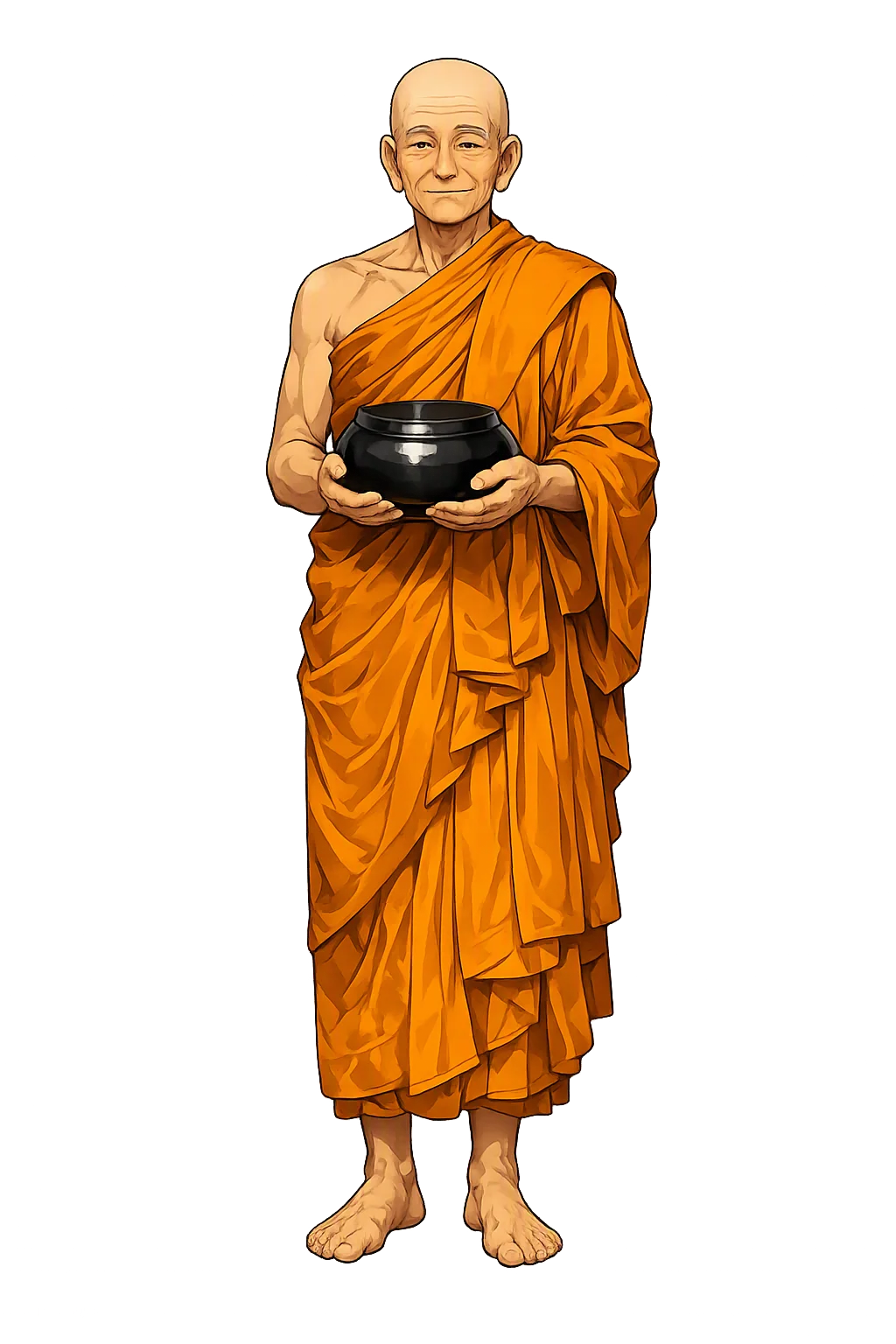
Stories of Arhat
The arhat has no biography because the arhat is a hundred biographies — the finished saints of the Theragāthā and Therīgāthā, the chief disciples of the canon, and in China a band of sixteen immortals commanded to wait out the ages for the next Buddha.
Arhat comes from √arh, "to deserve, to be worthy," with the participle -at — "the worthy one," one deserving of the alms of gods and men. The Buddha claimed it as his own foremost title: in the canonical litany he is arahaṃ sammāsambuddho, "arahant, fully self-awakened" — a claim whose audacity the Udāna records being tested in his lifetime, when rivals demanded he prove it. The commentarial definition sharpens the word into a checklist: one who has destroyed the taints (āsava), lived the holy life, done what had to be done, laid down the burden, and knows "there is no more of this." The Jaina tradition uses the same word in parallel: its twenty-four tīrthaṅkaras are arhats, worthy ones who ford the flood of rebirth. The mythic weight of a title: Buddhism made holiness a completed task, not a birth — and gave it a word anyone could check.
The Buddha named his two greatest arahants in the Etadagga verses (AN 1): Sāriputta, foremost in great wisdom — the Dhamma's marshal, who could unfold a single line into a hundred meanings and who, questioned on his deathbed in the Sāriputta Sutta (SN 47.19), replied only that there was nowhere he had ever clung; and Moggallāna, foremost in psychic powers, who humbled Brahmā's pride by shaking the Vejayanta palace with a toe (DN 11, Kevaṭṭa Sutta). Both were murdered — Moggallāna beaten to death by brigands — the Buddha predicting that the pair would die as the twin sāla trees fall. The Theragāthā lets the arahants speak in their own voices: "Cut down the whole forest of craving, not just one tree; from the jungle of craving, fear is born." The ideal is given a human face twice — the thinker and the wonder-worker — and both faces end in the one death arahants cannot refuse.
Arahantship is the fourth and last gate. The canon maps the road precisely: the stream-enterer (sotāpanna), certain of awakening, never again reborn lower than human; the once-returner (sakadāgāmin), who comes back once to this world; the non-returner (anāgāmin), who awakens in a higher heaven and does not return at all; and the arahant, freed here and now. The decisive faculty is stated everywhere and nowhere better than the Satipaṭṭhāna Sutta (MN 10): mindfulness of body, feelings, mind, and dhammas — "the direct path for the purification of beings, for the overcoming of sorrow." Fifteen centuries later Buddhaghosa's Visuddhimagga (5th c. CE) welded the whole road into one manual, still the map of Theravāda practice. The interpretive core: holiness is gradual, inspectable, and irreversible — a ladder whose rungs can be named, and whose top rung is the end of needing anything, forever.
Chinese Buddhism gave the arahants a second life as luohan — sixteen great disciples the Buddha, before his parinirvāṇa, commanded to remain in the world without entering final nirvāṇa until Maitreya comes. Their charter text, Xuanzang's 654 translation of Nandimitra's Record of the Duration of the Dharma, names them — Mahākāśyapa, Ājñāta-Kauṇḍinya, Kanakavatsa, Subhūti, Nandimitra himself and the rest — each assigned a mountain, a retinue, and a district of the earth to protect. The painter Guanxiu (10th c.) gave them their immortal faces, gaunt and strange, and his line was copied for a thousand years; Ming temples house ranks of gilded lohans, five hundred strong, each with his own demon, dragon, or tiger. The myth is a quiet reversal: the extinct ideal of early Buddhism — the saint who is done — is drafted as a permanent garrison, waiting out the ages at their posts for the next Buddha, deathless on duty.
The Worthy One — Perfection as a Finished Task
The arhat is the ideal of early Buddhism made flesh: one who has destroyed the taints, done what had to be done, and laid down the burden — freedom achieved in this life, by this person, without a god's intervention. The Theragāthā lets the finished saints speak for themselves.
The literal sense — āhūneyyo, 'worthy of offerings,' the field of merit for gods and men alike.
The canonical formula: 'done is what had to be done, laid down the burden, reached the goal' — the end of need itself.
Stream-enterer, once-returner, non-returner, arhat — the graduated ladder to the deathless, rung by rung.
In China the arhat ideal became an immortal garrison — sixteen great disciples commanded to guard the Dharma until Maitreya comes.
From the original script to the living URL
अर्हत्
The name in its original Buddhist form. Arhat (अर्हत्) is attested in the source tradition — “an Arhat or superior divinity with the Jainas”. Its original diacritics and script distinctions carry the full phonetic and orthographic weight of the source tradition.
arhat
The plain arhat form is identical to the Unicode restoration. Because this name is already written in Latin letters, no diacritics, stress, or script information were lost — only capitalization differs.
Arhat
The Unicode restoration does not need to recover lost marks for Arhat. Its value is canonical spelling and consistent cataloguing, not the reconstruction of erased orthography. The domain is readable as-is to both DNS and humanity.
Arhat.com
This restoration is written entirely in ASCII letters — no Punycode encoding stands between Arhat and the DNS. The domain reads identically to machines and to human eyes.
Owned, ideal, and ASCII forms of Arhat
Arhat
Restores अर्हत्. The full Unicode restoration. arhat.com is not in the PuniCodex collection — it is watched for release; if it drops, this temple upgrades to an owned flagship.
How Arhat was spoken
How Arhat travels from ancient script to the modern URL
The lore you have read is the living myth. Extended Lore opens the scholarly vault beneath it: the cult and its material remains, a history of the image, the name after antiquity, a meditation on what the name still means, and the full scholarly apparatus — etymology, orthography, sources.
Enter Extended Lore