
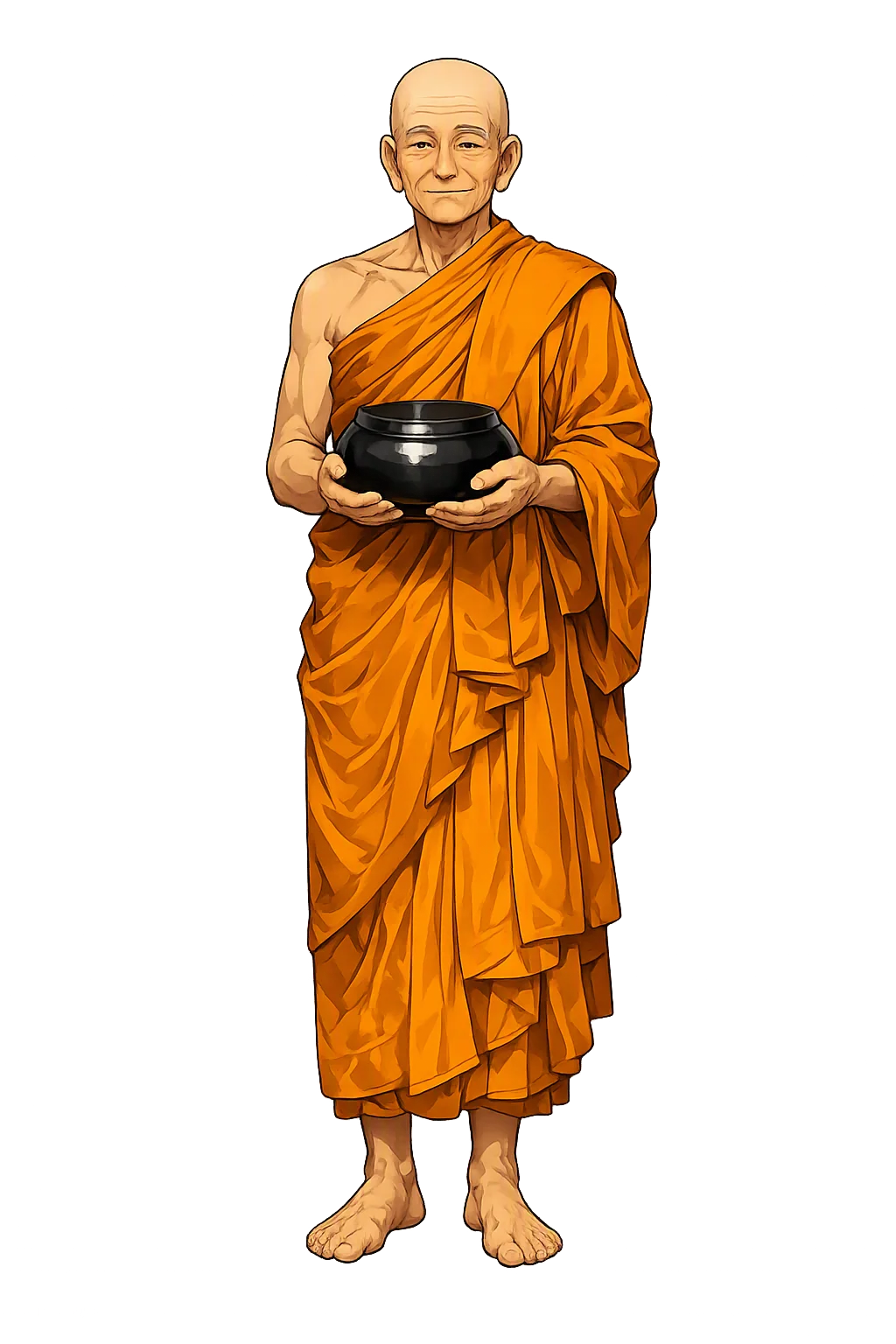
The provenance file on Arhat
Catalogue entry — Arhat. Every claim below carries its chain of custody.
Provenance
1. The attestation. अर्हत्, from the tradition's own record. On record: Satipaṭṭhāna Sutta (MN 10), Sāriputta Sutta (SN 47.19), Kevaṭṭa Sutta (DN 11), Etadagga Vagga (AN 1).
2. The narrative record. Worthy of Gifts — Arhat comes from √arh, "to deserve, to be worthy," with the participle -at — "the worthy one," one deserving of the alms of gods and men. The Buddha claimed it as his own foremost title: in the canonical litany he is arahaṃ sammāsambuddho, "arahant, fully self-awakened" — a claim whose audacity the Udāna records being tested in his lifetime, when rivals demanded he prove it. Sāriputta and Moggallāna — The Buddha named his two greatest arahants in the Etadagga verses (AN 1): Sāriputta, foremost in great wisdom — the Dhamma's marshal, who could unfold a single line into a hundred meanings and who, questioned on his deathbed in the Sāriputta Sutta (SN 47. 19), replied only that there was nowhere he had ever clung; and Moggallāna, foremost in psychic powers, who humbled Brahmā's pride by shaking the Vejayanta palace with a toe (DN 11, Kevaṭṭa Sutta).
3. The physical record. The arhat's archaeology is the archaeology of the aniconic saṅgha. The Bharhut and Sanchi reliefs (2nd–1st c. BCE) show the great disciples flanking the empty throne — identifiable by label in Brahmi inscriptions: Sāriputa, Mogalāna, Maha Kāsava. The earliest anthropomorphic saṅgha images come from Gandhāra and Mathurā (1st–3rd c. CE): monks in patched robes, each with his attribute. The lohans' gallery in Chinese art is documented from the Tang — Guanxiu's sixteen (c. 891–901) survive in the Tokyo Seikado and Imperial Household collections — and the Five Hundred Lohans halls of the Song and Ming (Jingshan, Biyun, Baoguang monasteries) preserve the type at monumental scale. In Pāli lands, the arhat leaves no relic-cults of his own by design: the finished one, the tradition says, leaves nothing to enshrine but the teaching.
4. The current holding. The temple at /arhat/, classified Tier 2. Tier-2 here means one preserved truth — not less important, just singular. The temple shows it and names it.
5. The documented resonances. Education, Research & Knowledge, Mythic Name Restoration, Writing, Publishing & Media — seats argued and weighted in the pattern atlas, read through the myths in this temple's Resonance File.
6. The primary sources. Lotus Sutra, Sukhāvatīvyūha Sūtras — the library this file answers to, open at the Sacred Texts collection.
7. The continuing record. The arhat's afterlife is the afterlife of the Theragāthā — a book of verses by the first saints, still chanted in Pāli lands, among the oldest autobiographies in the world. Chinese temples fill halls with lohan: the Five Hundred Arhats of Beijing's Biyun Si and the sixteen of Hangzhou's Jingshan Si are national treasures; Guanxiu's originals survive in Japan, designated national treasures there too.
At a Glance
- Restored name: Arhat
- ASCII form: arhat
- Meaning: "an Arhat or superior divinity with the Jainas"
- Domain of influence: Worthy One, Saint
- Pantheon: Buddhist
- Classification: Tier 2
- Original script: अर्हत्
- Series: The Restoration Files, No. 51 of 548
The File Continues
Read the founding dispatch for the name's full story, the Resonance File for the archetype at work — or the whole archive in one sitting.
Continue the series — previous file: Árgos (read it here) · next file: Arinna (read it here).
The Restoration Files are written from the same canonical record as the temples themselves: the lexicon, the lore catalog, the pattern atlas, and the cited scholarly sources. If a file ever disagrees with its temple, the temple is right — tell us, and the file will be corrected.