
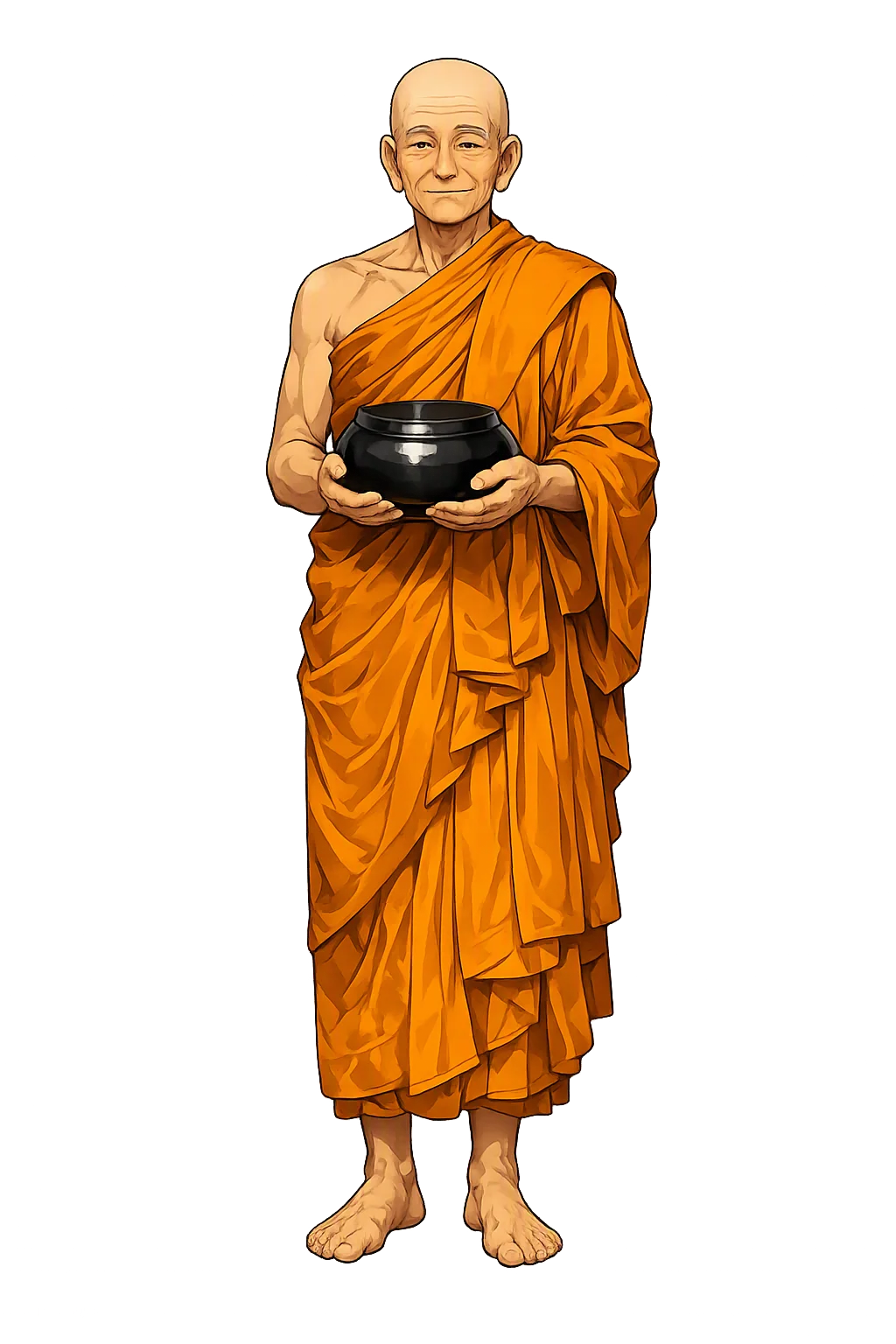
Arhat in 2026: why scholars still care
In 2026, a name is rarely treated as a historical object. It is typed, parsed, indexed, and flattened until only the ASCII skeleton remains. Arhat is one of the names that resist that flattening. Behind the five letters lies one of the most consequential religious ideals of the Indian subcontinent: a human being who has finished the work of liberation. The word traveled from Sanskrit into Pali, from Pali into the living liturgies of Theravada temples, and from there into the dictionaries of every Buddhist tradition on earth. It also traveled, more quietly, into the registry of internet domains, where the unmarked form arhat became the only spelling the infrastructure could accept. PuniCodex restores the capitalized, scholarly form Arhat as a working domain not because the spelling is exotic, but because the name deserves the dignity of a proper noun. This post is a full account of that restoration: the sound, the script, the theology, the cultural afterlife, and the engineering decision that lets the original form live in an address bar.
At a Glance
- Restored name: Arhat
- ASCII form: arhat
- Meaning: "Worthy One, venerable"
- Domain of influence: Worthy One, Saint
- Pantheon: Buddhist
- Classification: Tier 2
- Original script: अर्हत् (Devanagari)
- Pronunciation: /arhat/ — "ar-hat," with the stress implied by the scholarly restoration
Overview
Arhat (arhat) is a title, an attainment, and a category of sacred person. In the Buddhist tradition it denotes one who has eradicated the mental defilements, cut the chain of rebirth, and realized the cessation of suffering. The term is cognate with the Sanskrit root arh-, meaning to be worthy, to deserve, or to be able. In Pali the figure is the arahant, in Jain texts the arihant, and in scholarly English the capitalized Arhat. Across all of these forms the core meaning remains the same: a being who is worthy of veneration because the work of awakening has been completed.
The name sits in Tier 2 of the PuniCodex tier system. That classification is mechanical, not evaluative: the restored form Arhat carries no diacritic or distinctive letter that ASCII would erase, so the plain ASCII form arhat is technically lossless. But technical losslessness is not scholarly equivalence. A lowercase arhat reads like a common noun; Arhat reads like a name. The restoration therefore restores something the old domain-name system could not encode: capitalization itself as a mark of proper-noun status. PuniCodex serves the restored temple at its temple, and the rest of this post explains why that small change in spelling carries a large change in meaning.
Etymology and Meaning
The Sanskrit word arhat (अर्हत्) is the present participle of the root arh-. That root covers a cluster of related senses: to be worthy, to be entitled, to be capable, to deserve. An arhat is literally "the worthy one," the one who has become deserving of offerings, praise, and refuge. The term is not a personal name but a title of achievement, comparable in some ways to "saint" or "elder" in other religious lexicons. Yet because the title is conferred on specific historical individuals — on the Buddha's immediate disciples, on forest ascetics, on the perfected saints of the Jain lineage — it functions in practice as a proper name for a recognized class of being.
In Pali the same figure is called arahant. The form has been explained in Buddhist dictionaries through several folk etymologies: one who is worthy (arahati) of gifts, one who has destroyed (araha) the enemy of defilement, one who is free from secret evil. These explanations are devotional rather than historical, but they show how tightly the community tied the sound of the word to the moral perfection it named. In Jainism, the term becomes arihant or arhat, a title for the twenty-four Tirthankaras who have conquered all passions and attained omniscience. The Jain usage preserves the same root sense while shifting the theological context from Buddhist liberation to Jina victory.
The bilingual life of the word — Sanskrit arhat, Pali arahant, Jain arihant — is a reminder that religious vocabulary does not respect modern disciplinary boundaries. The same phonetic core served Buddhist monks in Sri Lanka, Jain merchants in Gujarat, and Sanskrit grammarians in Kashmir. When PuniCodex restores Arhat, it is not choosing one tradition over another. It is choosing the scholarly convention that best preserves the word's dignity as a proper noun across all of those inheritances.
The Figure in Buddhist Doctrine
In early Buddhist soteriology, the arhat is the endpoint of the path. The four stages of awakening — stream-enterer (sotāpanna), once-returner (sakadāgāmī), non-returner (anāgāmī), and arhat — describe a progressive weakening of the fetters that bind consciousness to rebirth. The arhat has destroyed all ten fetters, including the subtle conceit "I am," and will not be reborn. This makes the arhat the immediate practical ideal of the Theravada tradition, the living proof that the Buddha's teaching produces results within a single human life.
The Pali Canon is full of named arhats. Sāriputta, the chief in wisdom, and Moggallāna, the chief in psychic powers, are the two foremost disciples of the Buddha. Mahākassapa preserved the discipline and convened the First Buddhist Council. Ānanda, the Buddha's personal attendant, attained arhatship on the eve of the council, becoming the figure through whom the remembered teachings were committed to collective memory. These are not abstract types; they are persons with temperaments, debates, and burial stupas. The title arhat therefore carries a biographical density that the English word "saint" only approximates.
Mahayana literature sometimes contrasts the arhat with the bodhisattva, presenting the arhat as concerned with personal liberation while the bodhisattva postpones final nirvana to save all beings. This contrast can be overstated. Many Mahayana texts still honor the arhats, and the sixteen or eighteen arhats became a major theme in East Asian Buddhist art. The doctrinal tension should not obscure the practical fact: in nearly every Buddhist culture, the arhat remains a figure of reverence, a model of what a human being can become through discipline, insight, and ethical refinement.
The Path to Arhatship: Fetters and Fruits
The Buddhist path to arhatship is often described as the progressive destruction of ten fetters (saṃyojana) that bind the mind to the cycle of rebirth. The first three — belief in a permanent self, doubt about the teaching, and attachment to rites and rituals — are destroyed at the stage of stream-entry. The next two — sensual desire and ill will — are weakened by the once-returner and eliminated by the non-returner. The final five — desire for fine-material existence, desire for immaterial existence, conceit, restlessness, and ignorance — are destroyed only by the arhat. This sequence gives the title its psychological precision: an arhat is not someone who has performed a single dramatic act but someone who has systematically uprooted every form of clinging.
Each stage brings a "fruit" (phala) corresponding to the depth of liberation already achieved. The stream-enterer is assured of eventual awakening within seven lives at most; the once-returner will return to the human world only once more; the non-returner will be reborn in a subtle realm and attain final release there. The arhat, however, has no more seeds of rebirth. At death the aggregates dissolve without generating a new existence. The Pali term for this state is parinibbāna, the complete extinguishing of the fires of greed, hatred, and delusion. The figure of the arhat thus represents the full maturation of the path, the living proof that the Buddha's diagnosis of suffering and its cessation was correct.
The Cult and Cultural Legacy
The cult of the arhats left material traces across Asia. In China, the luóhàn became one of the most popular subjects of temple painting and sculpture. Sets of sixteen, eighteen, or five hundred arhats line the walls of monasteries, each with a distinctive face, posture, and attribute. The Eighteen Arhats of Chinese Buddhism — Pindola, Kanaka, Kanakavatsa, and their companions — are protectors of the Dharma and intercessors for the community. Their iconography mixes the Indian ideal of the forest sage with Chinese tastes for personality and humor. An arhat might ride a tiger, hold a begging bowl, or sit in profound abstraction; the variety testifies to the title's adaptability.
In Theravada Southeast Asia, the term retains its classical sense. Monks and nuns are formally addressed in ways that acknowledge their renunciation, and the highest praise a deceased teacher can receive is the recognition that he or she had reached one of the stages of awakening, including arhatship. The living ideal is visible in the strict observance of the Vinaya, in the practice of meditation, and in the devotional relationship between lay communities and ordained teachers. The word arhat is not a museum piece in these contexts; it is a working category of spiritual attainment.
The visual vocabulary of the arhat is equally durable. In Indian art the perfected disciple is usually shown as an ascetic: simple robe, shaved head, elongated earlobes, meditative posture. The ushnisha, the cranial bump that marks advanced wisdom, and the urna, the spot between the brows, sometimes distinguish the Buddha from his disciples, but the arhat shares the same restrained majesty. Over centuries the image migrated along trade routes, absorbing regional dress and facial types while keeping the core message: this is a person who has finished the work of suffering.
Arhats in Living Buddhist Cultures
The arhat is not only a canonical category; it is a living presence in Buddhist cultures around the world. In Thailand, the figure of the arahant is invoked in funeral sermons as the model of a life well spent. Monks who are widely respected may be praised after death with the cautious hope that they had reached one of the noble stages, and the highest such hope is that they had become arhats. In Burma, accomplished meditation masters are sometimes discussed in terms that echo the classical descriptions of arhatship, though tradition discourages public claims to attainment. In Sri Lanka, the ideal of the arhat has shaped monastic education, meditation practice, and the relationship between the ordained community and the state.
The arhat also persists in Buddhist art and popular imagination. The Chinese luóhàn appear not only in temple murals but in prints, porcelain, and even contemporary cartoons. They are sometimes portrayed as eccentric, almost comical figures, but the humor is devotional: it reminds the viewer that enlightenment can appear in unexpected forms. In Japan, the rakan are guardians of Zen temples, their weathered faces suggesting the long discipline of the path. Whether in the austere images of Theravada Southeast Asia or the expressive statues of East Asia, the arhat remains a figure of aspiration.
The Jaina Connection
It would be incomplete to discuss Arhat without acknowledging the Jain tradition, where the word has an equally central role. In Jainism, an arihant or arhat is a soul that has destroyed the four destructive passions — anger, pride, deceit, and greed — and has attained kevala jñāna, omniscience. The twenty-four Tirthankaras of the present age are all arhats. Their teaching, preserved in the Agamas, is the foundation of Jain ethics, cosmology, and monastic discipline. The first Tirthankara, Rishabhanatha, and the last, Mahavira, are the best known, but each of the twenty-four is an arhat in the full technical sense.
This shared terminology points to a deeper history. Buddhism and Jainism emerged in the same North Indian religious environment, used related Prakrits, and debated many of the same questions about karma, rebirth, and liberation. Their vocabularies overlap because their worlds overlapped. The restoration Arhat therefore belongs to more than one canonical lineage. It is a point of contact between two major Indian religions, each of which has made the "worthy one" a central pillar of its soteriology.
The Original Script and Sound
The Devanagari form given in the PuniCodex record is अर्हत्. The characters spell a-r-ha-t: अ (a), र् (r with halant), ह (ha), त् (t with halant). In Sanskrit the final consonant is voiceless and unaspirated, closing the word with a crisp t. The Pali arahant adds syllables and a nasal, producing the longer form familiar in Theravada chanting. Both forms derive from the same root and carry the same meaning; they are regional and linguistic variants of a single title.
The restored scholarly pronunciation is given as /arhat/. The first syllable receives the weight implied by the Sanskrit root, and the final t is articulated clearly, not softened into a th sound as English speakers sometimes do. Chanting traditions in Sri Lanka, Thailand, and Burma preserve their own melodic and rhythmic shapes, but the phonemic core — ar-hat — remains recognizable across borders. The restoration does not impose one accent; it preserves the word well enough that each tradition can hear its own inflection inside the spelling.
The Name in Translation
Translating arhat into English is surprisingly difficult. "Saint" captures the note of veneration but carries Christian associations of canonization and miracle-working that do not map neatly onto Buddhist categories. "Worthy one" is etymologically precise but sounds archaic. "Accomplished one" or "perfected being" get closer to the soteriological sense but can sound grandiose. Many scholars therefore prefer to leave the term untranslated, using arhat or arahant and allowing the context to supply the meaning.
This translational dilemma is one reason the PuniCodex restoration matters. By preserving Arhat as a proper noun, the restoration avoids the flattening effect of translation. It keeps the title in its own linguistic and conceptual world, where it can continue to mean precisely what Buddhist traditions have meant by it. The capital letter is a small protest against the tendency to turn every sacred title into a generic English word.
Why the Unicode Restoration Matters
The original domain-name system was designed for English typewriters. It had no room for Devanagari, no room for diacritics, and, in a subtle but important sense, no room for the distinction between a common noun and a proper noun. The lowercase form arhat is what survived. For decades that limitation was accepted as a fact of infrastructure, but IDN — Internationalized Domain Names — and Unicode have made it possible to serve a more careful spelling at a real web address.
PuniCodex restores Arhat as the canonical form. The change looks small: one capital letter. Yet that capital letter restores the name's status as a proper noun, the title of a completed being, the endpoint of a path. It also creates a place on the web where the full record — meaning, script, pronunciation, mythology, and cultural legacy — can be gathered and kept current. The temple at its temple is not a vanity domain. It is a claim that the original spelling is still the best address for the idea.
Conclusion
Arhat is not an obscure term. It is one of the foundational categories of Buddhist and Jain religious life, a title for the perfected disciple, a model for monks and laypeople, and a subject of art across Asia. The plain ASCII form arhat will continue to work in search boxes and legacy systems, just as Romanization has always worked for scholars who need a quick transcription. But the restored form Arhat does something more: it gives the title the capital it has earned. In 2026, when names are data points, that capital letter is a reminder that some names are also accomplishments. The PuniCodex temple keeps the restored spelling alive, not as decoration, but as the right address for one of humanity's oldest ideals of human perfection. The next time the lowercase form arhat appears in a search result or a database entry, treat it as a transcription made necessary by older technology, not as the name itself. The restored form Arhat is the spelling that carries the title's history, and the temple that bears it is the address where that history remains open for anyone who cares to look.
Related Names
- Akṣobhya — Immovable, East
- Amitābha — Infinite Light, Pure Land
- Avalokiteśvara — Compassion, Mercy, Bodhisattva
- Bhaiṣajyaguru — Healing, Medicine, Lapis-Lazuli Light
- Kṣitigarbha — Earth Womb, Savior of Hell Beings
Sources
- Étienne Lamotte, History of Indian Buddhism (1958; trans. 1988).
- Walpola Rahula, What the Buddha Taught (1959).
- Edward Conze (trans.), Buddhist Scriptures (1959).