The Living Myth
Vigilance, Hera's Watcher · The All-Seeing · Hera's Hundred-Eyed Watcher
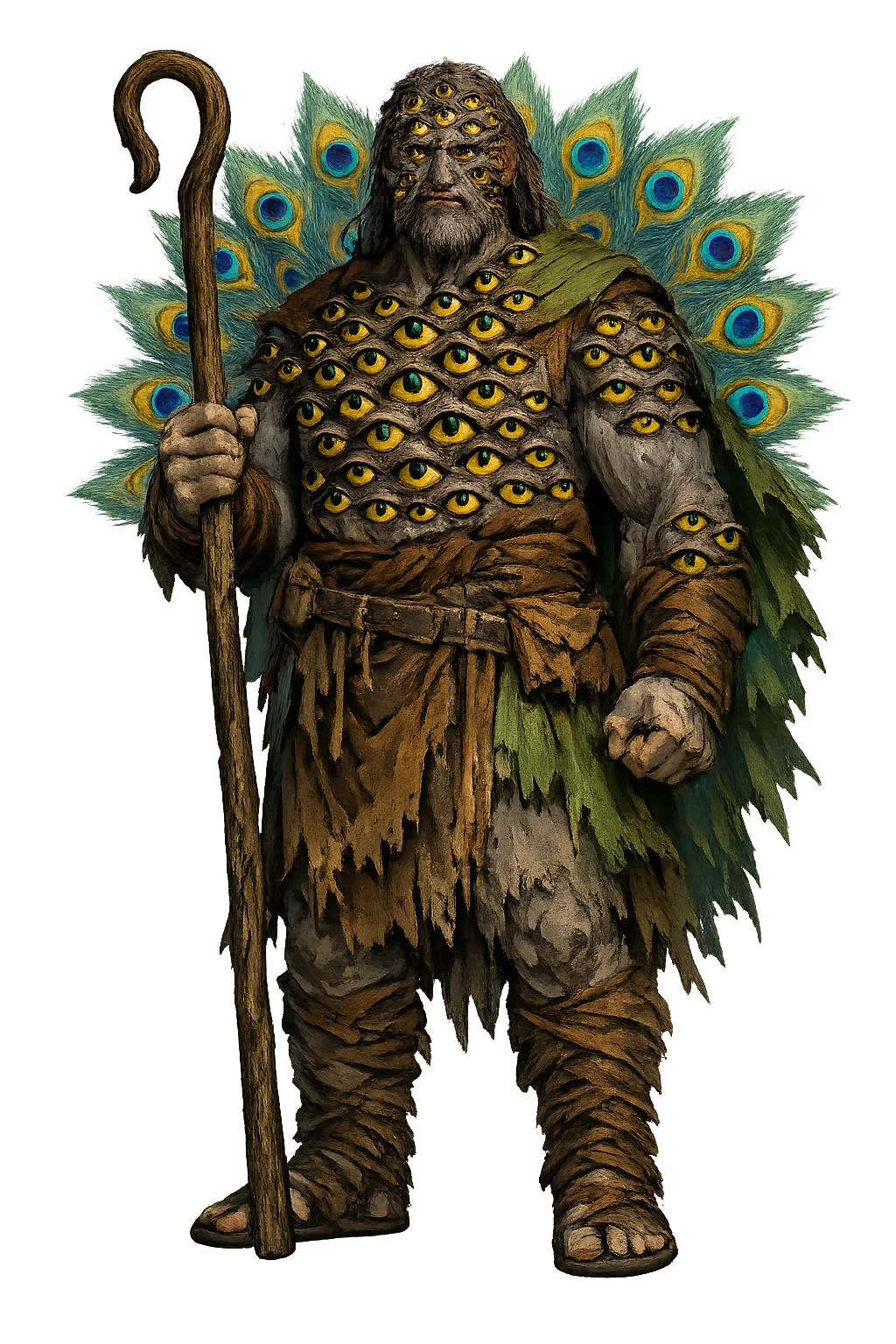
Stories of Árgos
Árgos exists within a single great story — the wanderings of Io — but it is one of the oldest stories the Greeks told, already old when Homer gave Hermês the epithet Argeiphontēs, 'Slayer of Árgos' (Iliad 24.24). His myths are few because his function is single: he is watchfulness, given a hundred eyes and a herd.
Zeús pursued Io, daughter of the river-god Inachos, and — in the common telling — Hera's jealousy had the girl changed into a white cow, either by the goddess herself or by Zeús trying to hide the affair (Aeschylus, Suppliants 291–324; Ovid, Metamorphoses 1.588–600). Hera was not deceived. She took the cow as a gift and set over it the giant Árgos Panoptes, the All-Seeing, whose body — Ovid gives him a hundred eyes — slept in relays so that some were always open (Met. 1.625–630). He tethered his charge to an olive tree in the grove of Mycenae and watched her day and night: a princess grazing as a beast, guarded by a creature made of vigilance (Apollodorus 2.1.3). The myth sets its terms without mercy: Io's misery is total, Árgos's attention is total, and between the two there is no gap anywhere for pity to enter. The story begins by defining a perfect system — and spends the rest of its time finding the one flaw a system cannot see.
Árgos kept Io as a cowherd keeps a beast: by day she grazed under his eyes, by night she was bound to her tree (Apollodorus 2.1.3). The poets dwell on the horror of the arrangement — Aeschylus stages the tormented cow as a speaking suppliant in the Suppliants, while Ovid lingers over the hundred eyes that closed only two at a time, like lamps going out in sequence across a darkened house (Metamorphoses 1.625–630). Notably, the myth does not make Árgos cruel. He is simply, absolutely, employed: duty incarnate, a mind with no interior, no sleep, no dream, whose only relation to the world is the unbroken line of his gaze. That purity of function is what makes him mythic rather than monstrous — and what makes his eventual death feel less like the slaying of a villain than the unplugging of an instrument. Watchfulness itself, the myth observes, is neither good nor evil; it is only total — and totality is what finally draws the god's sword.
Zeús could not free Io by force without open war upon Hera, so he sent Hermês to end the watch by craft (Homeric Hymn to Hermes knows the god as thief and trickster from birth). Disguised as a shepherd, the god played his pipes to the giant — and Ovid makes his true soporific instrument the story itself: he tells the tale of Syrinx, the nymph who fled Pan's pursuit and became the singing reeds, and one by one the hundred eyes grow heavy and close (Metamorphoses 1.668–721). Then Hermês draws the curved sword and strikes off the watcher's head. The epithet that clings to the god forever after — Argeiphontēs, Slayer of Árgos — is already alive in Homer, which proves the story's antiquity: the Iliad can use the title without explanation, as a name the audience would recognize at once (Iliad 24.24). It is the most civilized killing in Greek myth, and the most ominous. The watcher who saw everything was not overpowered; he was sung to sleep — the oldest recorded defeat of total vigilance by art.
Hera took the eyes of her dead servant and set them in the tail of her peacock, where they gleam like jewels to this day (Ovid, Metamorphoses 1.722–723). But she did not forgive the prisoner: she sent a gadfly to sting Io into madness and drive her over the world — past the Bosporos, the cow-ford that still bears her name, down to Egypt, where Zeús restored her with a touch and she bore Epaphos (Aeschylus, Suppliants; Apollodorus 2.1.3–4). The memorial is the myth's most beautiful and most ambivalent image. The goddess honors her servant's vigilance by preserving his eyes — yet the eyes now watch nothing at all: gorgeous, useless, fixed on no one, a constellation of attention without an object. Árgos's whole life is compressed into ornament. Total attention is honored by its owner, rewarded with beauty, and ended by a story — and the peacock's tail remains the most gorgeous surveillance apparatus in the world, watching nothing whatsoever.
Vigilance, Service, and the Hundred Eyes
Árgos Panoptes is the perfect sentinel of Greek myth: a giant whose body was set with eyes that slept only in relays, so that some were always open. Hera chose him to guard the cow that had been Io. He is the myth's meditation on watchfulness — its power, its cost, and its strange afterlife in feathers.
Ovid gives him a hundred eyes ringed about his head; the tragedians make him many-eyed, and later art covers his whole body with them. Two slept while the others watched.
Chosen by the queen of heaven herself to watch Io — the one servant whose vigilance could be trusted absolutely.
His eyes took turns at rest; there was no hour, no dusk, no dawn in which the prisoner was unseen.
Slain by Hermês, he was memorialized by his mistress: Hera set his eyes on the tail of her bird, where they watch still.
From the original script to the living URL
Ἄργος
The name in its original Greek form. Árgos (Ἄργος) is attested in the source tradition — “Shining, swift”. Its acute accents carry the full phonetic and orthographic weight of the source tradition.
argos
Reduced to plain argos, the name loses everything that made it specific: acute accents. What remains is an ASCII string that machines can parse but that no longer speaks with its original voice.
Árgos
The Unicode restoration recovers what ASCII flattened. Árgos restores acute accents, returning the name to its original written dignity. The domain encodes to Punycode, but the browser displays the truth.
Árgos.com → xn--rgos-4na.com
The non-ASCII characters in Árgos are encoded while the ASCII remains visible. To the DNS, it is Punycode. To humanity, it is Árgos.
Owned, ideal, and ASCII forms of Árgos
Árgos
Restores Ἄργος. The live temple domain — árgos.com.
argos
Flattens Ἄργος. The plain ASCII fallback — what DNS and legacy systems see.
How Árgos was spoken
How Árgos is preserved in writing
A bespoke provenance study for Árgos is being prepared by the PUNICODEX scholarly team.
Contribute scholarly provenance →The lore you have read is the living myth. Extended Lore opens the scholarly vault beneath it: the cult and its material remains, a history of the image, the name after antiquity, a meditation on what the name still means, and the full scholarly apparatus — etymology, orthography, sources.
Enter Extended Lore