
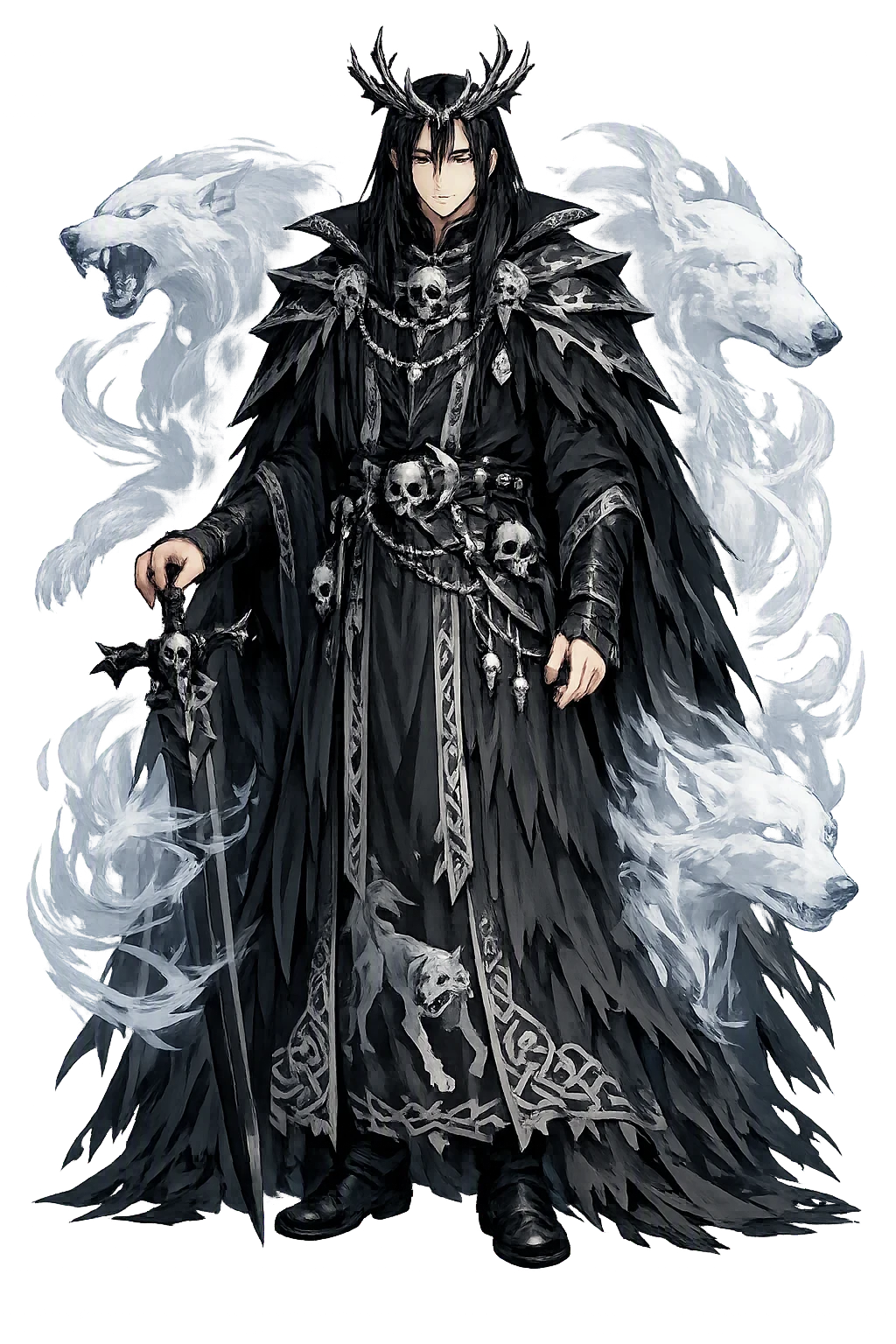
Why Arawn is spelled that way — and what it costs to get it right
There is no broken version of this name to repair. There is a record to preserve: Arawn, exactly as the scholarly convention supports it.
Arawn's whole dossier is one story, and it is the opening movement of the Mabinogi: the hunting-debt at Glyn Cuch and the year-long exchange that turns an insult into the strongest friendship in Welsh prose. Every word of it is preserved in the First Branch, Pwyll Pendefig Dyfed.
At a Glance
- Canonical name: Arawn
- ASCII form: arawn
- Meaning: "Silver-tongued"
- Domain of influence: Otherworld, Annwn
- Pantheon: Celtic
- Restoration: ASCII-equivalent form
- Scholarly Transliteration: no original script securely attested — the romanized form is the primary record
- Series: The Restoration Files, No. 48 of 597
The Name, Plain and Exact
Spoken, the name runs `/aˈraʊn/` — 'a-ROWN' — the aw sounds like the 'ow' of 'town', and the stress falls on the second syllable, the Welsh penult.
The Temple That Stands Now
The canonical name is not a plaque; it is an address. The temple of Arawn lives at /arawn/, with its mythology in the lore halls, its peer-reviewed record in the Scholarly Edition, and its place in the pattern atlas on the patterns floor.
The displayed form is ASCII-equivalent.
Where the Name Stood First
Arawn is a textual figure: no inscription, votive deposit, or cult site names him, and the epigraphic record of pre-Christian Wales — Latin and ogham memorial stones of roughly the fifth to seventh centuries — records personal names, not theonyms. His evidence is manuscript evidence. The Four Branches survive complete in the White Book of Rhydderch (Aberystwyth, NLW Peniarth MSS 4–5, c. 1350) and the Red Book of Hergest (Oxford, Jesus College MS 111, c. 1382–1410), with earlier fragments in Peniarth 6; the tales' date of composition is argued rather than documented — Ifor Williams placed them in the later eleventh century, and current scholarship generally holds a range around 1060–1120. The geography of the tale is real: Glyn Cuch, where the insult happens, is identified with the valley of the River Cych on the Pembrokeshire–Carmarthenshire border, inside the Dyfed the story governs. The nearest material echo of the Otherworld hunt is literary: the Book of Taliesin, the manuscript that preserves Preiddeu Annwfn, is a fourteenth-century Welsh codex (NLW Peniarth MS 2). The temple on the web is the newest of these addresses — the first one that fits in a pocket.
The Archetype at Work
The pattern atlas seats this temple in 3 industries, each match argued and weighted: Leadership, Governance & Public Administration (the king whose honor holds when no one is watching — a year on another man's throne without a single trespass.); Legal, Justice & Compliance (the hunting-debt at Glyn Cuch and the single permitted blow at the ford — the Mabinogion's case study in honorable settlement.); Pet Care & Animal Industries (his white hounds with their red ears — the Otherworld pack.). The Resonance File reads those seats through the myths themselves.
The File Continues
The temple's founding dispatch tells the name's story; its Resonance File reads the myths into the industries; the blog index holds the whole archive.
Continue the series — previous file: Arachnē (read it here) · next file: Archḗ (read it here).
The Restoration Files are written from the same canonical record as the temples themselves: the lexicon, the lore catalog, the pattern atlas, and the cited scholarly sources. If a file ever disagrees with its temple, the temple is right — tell us, and the file will be corrected.