
How Arawn got its accent back
The ASCII form arawn is missing something. Arawn restores the marks the source language used to distinguish this name from a thousand others — and those marks change how the name is read, pronounced, and understood. This post explains, with the full scholarly record behind it, what each restored mark preserves: the Celtic transcription evidence, the reconstructed sound, the myths the name carries, and the classification logic that separates Tier 1 restorations from Tier 2. By the end, the marks in Arawn will look less like ornaments and more like what they are — recovered evidence, pinned back in its proper place.
At a Glance
- Restored name: Arawn
- ASCII form: arawn
- Meaning: "Silver-tongued"
- Domain of influence: Otherworld, Annwn
- Pantheon: Celtic
- Classification: Tier 2
Overview
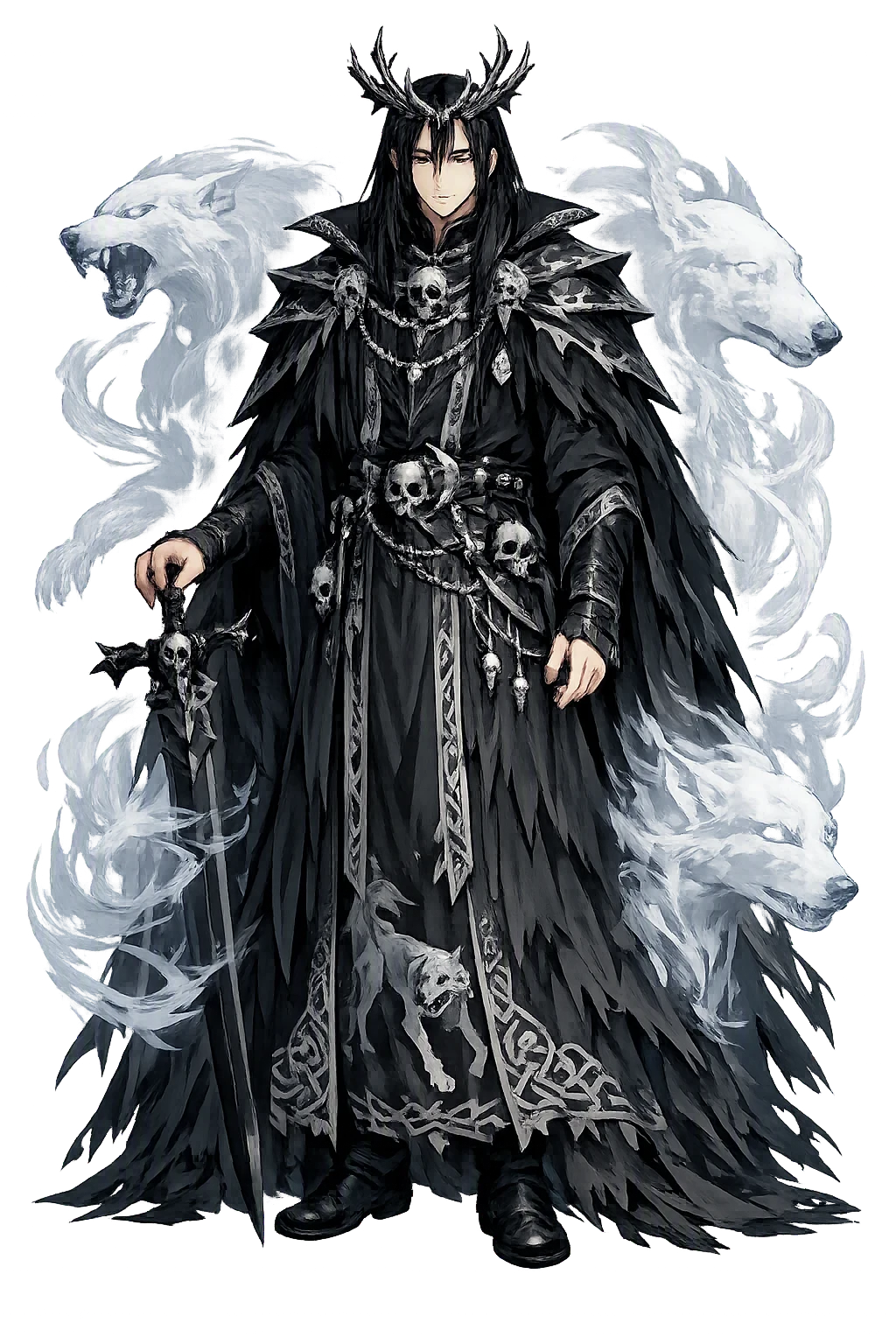
Arawn (arawn) — Otherworld, Annwn · Silver-tongued — is the king of Annwn, the Welsh Otherworld, in Pwyll Pendefig Dyfed, the First Branch of the Mabinogi: the lord whose white, red-eared hounds Pwyll drives from their kill at Glyn Cuch, and whose price for friendship is the strangest exchange in Welsh prose — a year and a day in which each king takes the other's shape, throne, and bed, so that Pwyll may fight Arawn's enemy Hafgan at the ford and prove his honor where no one can see it.
The name's etymology is genuinely unsettled. The lexicon's traditional gloss is 'silver-tongued'; the handbooks record that the derivation is unknown — Ifor Williams proposed a learned borrowing of the biblical Aaron, carried into Welsh by Latin learning, and native Celtic derivations have also been attempted, none commanding consensus.
PuniCodex restores the name as Arawn — identical to the ASCII input, because Middle Welsh writes the name in plain Latin letters with no diacritic for the restoration to recover; the name is Tier 2 by the mechanical rule. No domain is claimed: the plain-ASCII arawn.com is registered to a third party outside the collection and is watched for release.
The Name
The theonym is attested in Middle Welsh as Arawn, king of Annwn, in the First Branch of the Mabinogi — a king with a kingdom and no genealogy: the tale gives him no epithet, no patronymic, and no ancestry, as if the Otherworld's lord needed no introduction beyond his crown. The lexicon's traditional gloss is 'silver-tongued', but the philology behind the name is honestly unsettled. Ifor Williams proposed that Arawn is a learned borrowing of the biblical Aaron, carried into Welsh through Latin learning; native Celtic derivations have also been attempted, and the modern reference works — Koch's Celtic Culture and the Geiriadur Prifysgol Cymru — record the etymology as uncertain rather than resolved.
The ASCII form is not a compromise here: Middle Welsh writes the name in plain Latin letters, and the normalized spelling is already Arawn. There is no diacritic and no distinctive letter for the restoration to recover; only the capital distinguishes the restored form from the input, which places the name in Tier 2 by the mechanical rule.
The letter-by-letter transformation runs:
- a → A — Same, capitalized
- r → r — Same
- a → a — Same
- w → w — Same
- n → n — Same
The project holds no domain for this name: arawn.com is registered to a third party outside the PuniCodex collection and is watched for release. The temple is served at /arawn/ and claims no domain it does not hold.
The Original Script
The name is preserved in Middle Welsh manuscripts in the Latin alphabet as Arawn — Middle Welsh (Brythonic Celtic), attested in the White Book of Rhydderch (c. 1350) and the Red Book of Hergest (c. 1382–1410), recording material composed centuries earlier. The script is written left-to-right in the medieval Welsh bookhand.
The scholarly rendering proceeds step by step:
- Middle Welsh writes the name in plain Latin letters; the digraph aw represents the diphthong [aʊ] that Modern Welsh still keeps.
- No diacritic attaches to the name in any witness: normalized Middle Welsh orthography and the ASCII spelling are identical.
- The etymology is unsettled — the biblical Aaron (Ifor Williams's proposal) and native Celtic derivations are both on record — but no variant spelling of the theonym is attested in the manuscripts.
- The Unicode restoration Arawn therefore changes nothing but the capital; the name stands in Tier 2 by the mechanical rule, and the plain-ASCII domain arawn.com — held by a third party outside the PuniCodex collection and watched for release — is the philologically complete form.
One caution attaches to the record: the gloss 'silver-tongued' is the lexicon's traditional rendering, not a settled philological result, and this edition presents it as such.
Pronunciation
The pronunciation of the name is /aˈraʊn/ — Modern Welsh.
Phoneme by phoneme:
- A- — Unstressed short open [a], the light first syllable; Welsh stress has not yet fallen
- -raw- — Trilled or tapped [r] followed by the Welsh diphthong aw [aʊ], the stressed penult that carries the whole weight of the name
- -n — Final alveolar nasal [n], closing the stressed syllable cleanly
For the modern speaker, the closest approximation is: 'a-ROWN' — the aw sounds like the 'ow' of 'town', and the stress falls on the second syllable, the Welsh penult.
Kindred and historical forms of the name:
- Middle Welsh — Arawn, king of Annwn in Pwyll Pendefig Dyfed, the First Branch of the Mabinogi
- Possible biblical loan — Aaron, the derivation proposed by Ifor Williams and registered as a possibility by the modern handbooks
- Modern Welsh — Arawn, a rare but living given name
- Welsh folklore — master of the Cŵn Annwn, the white red-eared hounds of the Otherworld, a folk elaboration of his Mabinogi pack
Arawn is Tier 2 because the restoration preserves nothing ASCII loses: the letters of the manuscript form are the letters of the keyboard. The capital alone marks the temple form.
Mythology
Arawn's whole dossier is one story — the opening movement of the Mabinogi — told with the economy and exactness that mark the Four Branches at their best.
The Wrong at Glyn Cuch (Pwyll Pendefig Dyfed)
Pwyll, lord of Dyfed, goes hunting at Glyn Cuch, and there he sees a sight he has never seen: a pack of hounds shining white with red ears bringing down a stag. He drives them off and sets his own hounds on the kill — and the stranger who rides up is Arawn, king of Annwn, and it was his hunt. Arawn names the discourtesy plainly and refuses revenge; what he asks instead is amends. He has a rival, Hafgan, king of the other realm of Annwn, who wars on him without end: let Pwyll take Arawn's shape and his place for a year and a day, and meet Hafgan at the ford at the year's turning.
The Exchange of Shapes (Pwyll Pendefig Dyfed)
Each king takes the other's form and goes to the other's court, and neither realm suspects. Arawn rules Dyfed so well that there had never been so good a year in it. Pwyll enters Annwn in Arawn's likeness, and that first night he is led to the bed of Arawn's wife — the fairest and most comely woman he had ever seen. He turns his back to her, and he does so every night of the year: courteous by day, and in the bed he never once turns his face toward her. The queen never knows. The whole test of the tale is here, in the dark, where no one could have seen the difference.
The Single Blow at the Ford (Pwyll Pendefig Dyfed)
Arawn's instructions were exact: Hafgan — the name suggests 'Summer-White' — can be slain by one blow and only one; strike him a second time and he will rise as strong as before and fight again the next day. At the appointed time the two kings meet at the ford, and at the first clash Pwyll strikes Hafgan one blow that shears through shield and armour. Hafgan begs for the finishing stroke, and Pwyll refuses: the blow he gave is all Hafgan will have from him. Hafgan's nobles declare their king lost, and Pwyll takes the submission and hostages of Hafgan's realm, so that the two kingdoms of Annwn are made one under Arawn's crown.
The Restoration and the Title (Pwyll Pendefig Dyfed)
The two kings meet again at the ford, each in his own shape, and embrace and go home. Arawn's queen, rejoicing at his return, remarks that he has not spoken to her as he does tonight for a whole year — and Arawn praises God for a friend so true. In Dyfed, Pwyll's court hears the story and tells him he did well to make such a friend. From that time the two realms send each other gifts every year: horses and greyhounds and hawks, and every kind of treasure. And because Pwyll had ruled Annwn and joined its two kingdoms in one, he was called from then on Pwyll Pen Annwn — Pwyll Head of Annwn — in place of Pwyll lord of Dyfed. The friendship he bought back is the foundation on which the whole of the First Branch, and the coming of Rhiannon, is built.
The Spoils of Annwn (Book of Taliesin)
The Mabinogi never brings Arawn back on stage, but his world keeps growing. The poem Preiddeu Annwfn, 'The Spoils of Annwn', preserved in the Book of Taliesin, sends Arthur's men to raid the Otherworld for the cauldron of the Head of Annwfn — Pen Annwfn, the very title the First Branch gives Pwyll's honour — and only seven come home. The poem never names Annwn's king, and honest scholarship leaves it unnamed; the echo of the title is the only thread between the two texts. Later Welsh folklore knows the Cŵn Annwn, the Hounds of Annwn — white with red ears, exactly Arawn's pack — whose baying across the night sky was heard as a death-omen; folk tradition gave their mastery to Gwyn ap Nudd rather than to Arawn.
Symbols & Iconography
Arawn's regalia are not weapons but conditions — the working parts of the one great test:
- The white hounds with red ears — The colour of the Otherworld: a hunt that arrives from the far side of the boundary
- The exchanged shape — Kingship as a trust held for another: the year Arawn's face ruled two realms
- The single blow — Restraint as the condition of victory: strike once, or not at all
- The untouched bed — Honor kept in the dark, where no one would ever have known
- The ford — The meeting-place between realms, where debts are paid and blows are counted
- The yearly gifts — Friendship renewed in kind: horses and greyhounds and hawks, and every kind of treasure
Archaeology & Evidence
Arawn is a textual figure: no inscription, votive deposit, or cult site names him, and the epigraphic record of early Wales — the Latin and ogham memorial stones of roughly the fifth to seventh centuries — records personal names in funerary formulae, not theonyms. His evidence is manuscript evidence. The Four Branches survive complete in the White Book of Rhydderch (Aberystwyth, NLW Peniarth MSS 4–5, c. 1350) and the Red Book of Hergest (Oxford, Jesus College MS 111, c. 1382–1410), with earlier fragments in Peniarth 6; the tales' date of composition is argued rather than documented — Ifor Williams placed them in the later eleventh century, and current scholarship generally holds a range around 1060–1120.
The geography of the tale is real: Glyn Cuch, where the insult happens, is identified with the valley of the River Cych on the Pembrokeshire–Carmarthenshire border, inside the Dyfed the story governs. The nearest material echo of the Otherworld hunt is literary: the Book of Taliesin, the codex that preserves Preiddeu Annwfn, is a fourteenth-century Welsh manuscript (NLW Peniarth MS 2).
Realm & Domain
Arawn is catalogued under the domain 'Otherworld, Annwn' — one domain in two words, the place and what it is.
Annwn
Annwn (later Annwfn) is the Welsh Otherworld: not a land of the dead in the classical sense but a world beside this one — richer, stranger, and reachable at its borders, with its own kings, its own hunts, and its own war. The First Branch knows it divided into two kingdoms, Arawn's and Hafgan's, until Pwyll makes them one. The lexicon keeps its own temple for the realm itself at Annwn.
The Otherworld Hunt
Arawn enters the tale hunting: his pack of hounds shining white with red ears — the colour the Welsh tradition fixed on Otherworld creatures — brings down a stag in Pwyll's own hunting-ground at Glyn Cuch. The hounds are Annwn made visible; the insult Pwyll offers them is what sets the whole exchange in motion.
Kingship Held in Trust
Arawn's answer to the insult is to lend a stranger his entire identity: face, throne, court, and bed for a year and a day. Kingship, in his hands, is a trust that can be handed over and returned — and the tale measures both kings by how they carry what is not theirs.
Honor
The exchange is a test with no witness: what Pwyll does in Arawn's bed, in Arawn's shape, no one in either world can see. The First Branch builds its definition of honor on exactly that darkness — and Arawn, who devised the test, is the god of the standard it sets.
Across Cultures
Arawn's comparisons are almost all inward, and the Welsh corpus itself supplies them. His clearest rival for the kingship of the Otherworld is Gwyn ap Nudd, whom Culhwch ac Olwen says God set over the demons of Annwn — a second king of Annwn in a second text, and the folklore gave Gwyn the hounds the Mabinogi gave Arawn. The structural reading runs deeper: commentators since Mac Cana have read the Annwn adventure as the proving of Pwyll's character before the coming of Rhiannon — the hero tested in honor and restraint in the Otherworld before the Otherworld's queen chooses him in this one.
The name itself may be the tale's one foreign guest: Ifor Williams proposed that Arawn is a learned borrowing of the biblical Aaron, carried into Welsh by Latin learning, and the handbooks register the possibility without deciding it. No Gaulish or Irish counterpart of Arawn has ever been convincingly proposed; the exchange-of-kings motif, with its unseen test and its kept bed, is the Mabinogi's own.
Cultural Legacy
Lady Charlotte Guest's translation of the Mabinogion (1838–49) carried Arawn out of the White and Red Books and into English, and the white red-eared hounds entered the stock of Celtic imagery from that day. In the twentieth century the figure found his widest audience inverted: Lloyd Alexander's Chronicles of Prydain (1964–68) made 'Arawn Death-Lord of Annuvin' the arch-villain of five children's novels, and Disney's The Black Cauldron (1985) kept the dark-lord version on screen — a long way from the most honorable king in Welsh prose, but the reason the name is known worldwide.
The Cŵn Annwn meanwhile never left Welsh folklore, still baying as a death-omen in folk memory into the modern period. Modern Druid and pagan practice honours Arawn as lord of the Otherworld and patron of kept faith, and the name survives in Wales as a rare living given name.
The Scholarly Record
The account of Arawn given in this edition rests on the witnesses and reference works listed below. The First Branch of the Mabinogi supplies the whole narrative spine; the Book of Taliesin and Culhwch ac Olwen frame the wider Annwn tradition; the handbooks and the Geiriadur Prifysgol Cymru arbitrate the name's unsettled etymology.
- Davies, Sioned, trans., The Mabinogion (Oxford: Oxford University Press, 2007), 'Pwyll Prince of Dyfed'.
- Williams, Ifor, ed., Pedeir Keinc y Mabinogi (Cardiff: University of Wales Press, 1930).
- Guest, Lady Charlotte, trans., The Mabinogion, 3 vols. (London, 1838–49).
- Haycock, Marged, ed. and trans., Legendary Poems from the Book of Taliesin (Aberystwyth: CMCS, 2007), 'Preideu Annwfyn'.
- Bromwich, Rachel, and D. Simon Evans, eds., Culhwch and Olwen: An Edition and Study of the Oldest Arthurian Tale (Cardiff: University of Wales Press, 1992).
- Mac Cana, Proinsias, The Mabinogi, 2nd ed. (Cardiff: University of Wales Press, 1992).
- Koch, John T., ed., Celtic Culture: A Historical Encyclopedia, 5 vols. (Santa Barbara: ABC-CLIO, 2006), s.vv. Arawn, Annwn, Pwyll Pendefig Dyfed.
- MacKillop, James, Dictionary of Celtic Mythology (Oxford: Oxford University Press, 1998), s.vv. Arawn, Annwn, Cŵn Annwn, Gwyn ap Nudd.
- Geiriadur Prifysgol Cymru / A Dictionary of the Welsh Language (Cardiff: University of Wales Press, 1950–2002), s.v. Arawn.
- Alexander, Lloyd, The Chronicles of Prydain, 5 vols. (New York: Holt, Rinehart and Winston, 1964–68).
- Nash-Williams, V. E., The Early Christian Monuments of Wales (Cardiff: University of Wales Press, 1950).
A Meditation
Arawn sets the one test that cannot be cheated: he gives a stranger his face, his throne, and his bed, and waits a year to learn what the stranger is. Everything Pwyll does in Annwn is invisible — no one in either kingdom can tell the kings apart, and no one will ever know what passed in the bed unless the doer confesses it. That is exactly the point. Honor, the First Branch argues, is what a man does when the only witness is himself.
The tale rewards it without sentimentality: the kept faith becomes an unbroken friendship, an alliance across the boundary of the worlds, the title Pen Annwfn, and a court that tells its lord he chose his friend well. Arawn's kingdom is the far side of reality, but his question is asked everywhere — who are you when no one is watching?
The Unicode Restoration
Arawn is classified as Tier 2: the restoration needs no distinctive letters or diacritics its ASCII form would lose. The ASCII fallback arawn still resolves everywhere, but it is the restored form that carries the name's full information. That is the whole thesis of this temple: the marks are the message.
Why This Restoration Matters
The marks in Arawn were never lost; they were only waiting for a carrier that could hold them. Now that the carrier exists, the burden flips: every use of arawn is a choice to leave evidence on the table. The PuniCodex temple keeps the restored form in circulation — as a domain, a dataset entry, and a scholarly argument — so that the choice to use it stays easy. Accent by accent, macron by macron, that is how the original names come back: not with a single grand gesture, but with a spelling that finally works everywhere.
Explore Further
This post is one doorway into the temple. The home page carries the full character breakdown and the ambient canvas; the lore page tells the myths in long form; the Scholarly Edition preserves the sources, pronunciation data, and revision history; and the patron wall supports the restoration directly. For the wider map, browse the Lexicon, explore the Pantheon, or return to the PuniCodex blog.
Related Names
Sources
The full scholarly apparatus — every citation, revision, and review — lives in the Scholarly Edition. Key references for this post:
- Davies, Sioned, trans., The Mabinogion (Oxford: Oxford University Press, 2007), 'Pwyll Prince of Dyfed'; Welsh text ed. Ifor Williams, Pedeir Keinc y Mabinogi (Cardiff: University of Wales Press, 1930).
- Williams, Ifor, ed., Pedeir Keinc y Mabinogi (1930), notes; Koch, John T., ed., Celtic Culture: A Historical Encyclopedia (Santa Barbara: ABC-CLIO, 2006), s.v. Arawn.
- MacKillop, James, Dictionary of Celtic Mythology (Oxford: Oxford University Press, 1998), s.vv. Arawn, Annwn.
- Davies, Sioned, trans., The Mabinogion (Oxford, 2007), 'Pwyll Prince of Dyfed'.
- Lexicon authorities for this entry: Mabinogion, MacKillop.