
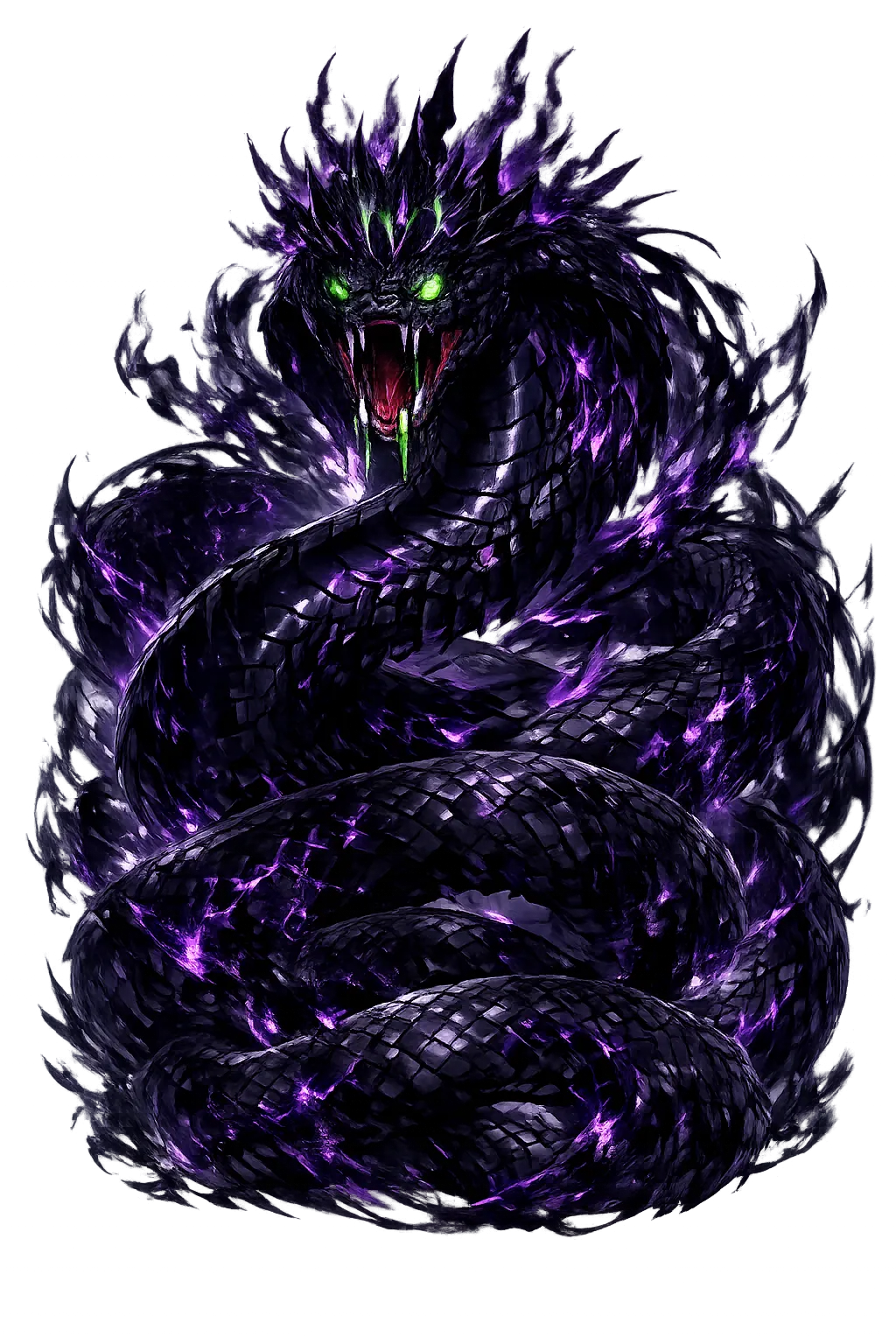
ꜥꜣpp: the stories first, then the spelling
Before the spelling, the story. ꜥꜣpp earns its restoration the old way — through what was actually told.
The Stories That Carry the Name
The Nocturnal Battle in the Duat. In the New Kingdom underworld books — the Amduat, the Book of Gates, and their relatives, painted on the walls of royal tombs in the Valley of the Kings — Ra's barque sails through the twelve hours of night. In the middle hours Apophis waits, a vast serpent coiled in the river of the Duat, sometimes in his menacing form called Rerek. The crew of gods and blessed dead must fight him with spear, rope, and fire: the serpent Mehen encircles the boat as living armor, goddesses of the hours bind the monster, and Seth stands at the prow to spear him as the barque passes.
The Book of Overthrowing Apophis. Preserved most fully in the Bremner-Rhind papyrus (British Museum EA 10188) and on temple walls, this liturgical composition instructs the lector priest to fashion a wax figure of Apophis, pierce it with knives, burn it in a fire of bryony, trample the ashes, spit upon them, and recite spells that sever his vertebrae and scatter his body, his name, and his soul. The ritual was performed daily in the great temples of Amun-Ra at Thebes, so that the sun would rise. It is the most elaborate surviving example of Egyptian execration magic, and Robert Ritner's The Mechanics of Ancient Egyptian Magical Practice remains its definitive study.
The Eye of Ra and the Returning Fire. In the cycle of the 'Distant Goddess', the Eye of Ra — Tefnut in some tellings, the lioness Mehit in others — flees south in anger, and the sun god's light dims until Thoth retrieves her. Her joyful return transforms her into the uraeus, the fire-spitting cobra rearing from Ra's brow, whose flame is precisely the weapon turned against Apophis when he attacks. Late underworld compositions weave this fire into the nightly voyage: the solar barque does not merely survive the serpent's coils but burns them.
And Here Is What the Spelling Preserves
At a Glance
- Restored name: ꜥꜣpp
- ASCII form: apep
- Meaning: "He who was spat out"
- Domain of influence: Chaos, Darkness, Serpent
- Pantheon: Egyptian
- Classification: Tier 1
- Original script: 𓂝𓊪𓊪𓆓
- Series: The Restoration Files, No. 41 of 546
The Name Travels
Apophis has no positive syncretisms; he is the anti-god against whom all order defines itself. The biblical Leviathan and the Gnostic chaos-dragon have often been compared to him, and Coptic tradition transmitted his name (as Apōph) alongside Christian demonology — though the Egyptian figure is cosmic and impersonal, more entropy than devil.
The Address It Earned
The temple of ꜥꜣpp stands at /apep/ — lore, scholars, patterns — because a name carrying this much story deserves more than a parking page. Tier-1 is not a compliment; it is a measurement. This restoration keeps something the ASCII form provably loses, and the measurement is repeatable.
The Sources Are Open
The myths above are retold from the temple's record; the primary voices are in the Sacred Texts: The Book of the Dead. Nothing in this file outranks them.
The File Continues
Read the founding dispatch for the name's full story, the Resonance File for the archetype at work — or the whole archive in one sitting.
Continue the series — previous file: ꜣnpw (read it here) · next file: Aphrodítē (read it here).
The Restoration Files are written from the same canonical record as the temples themselves: the lexicon, the lore catalog, the pattern atlas, and the cited scholarly sources. If a file ever disagrees with its temple, the temple is right — tell us, and the file will be corrected.