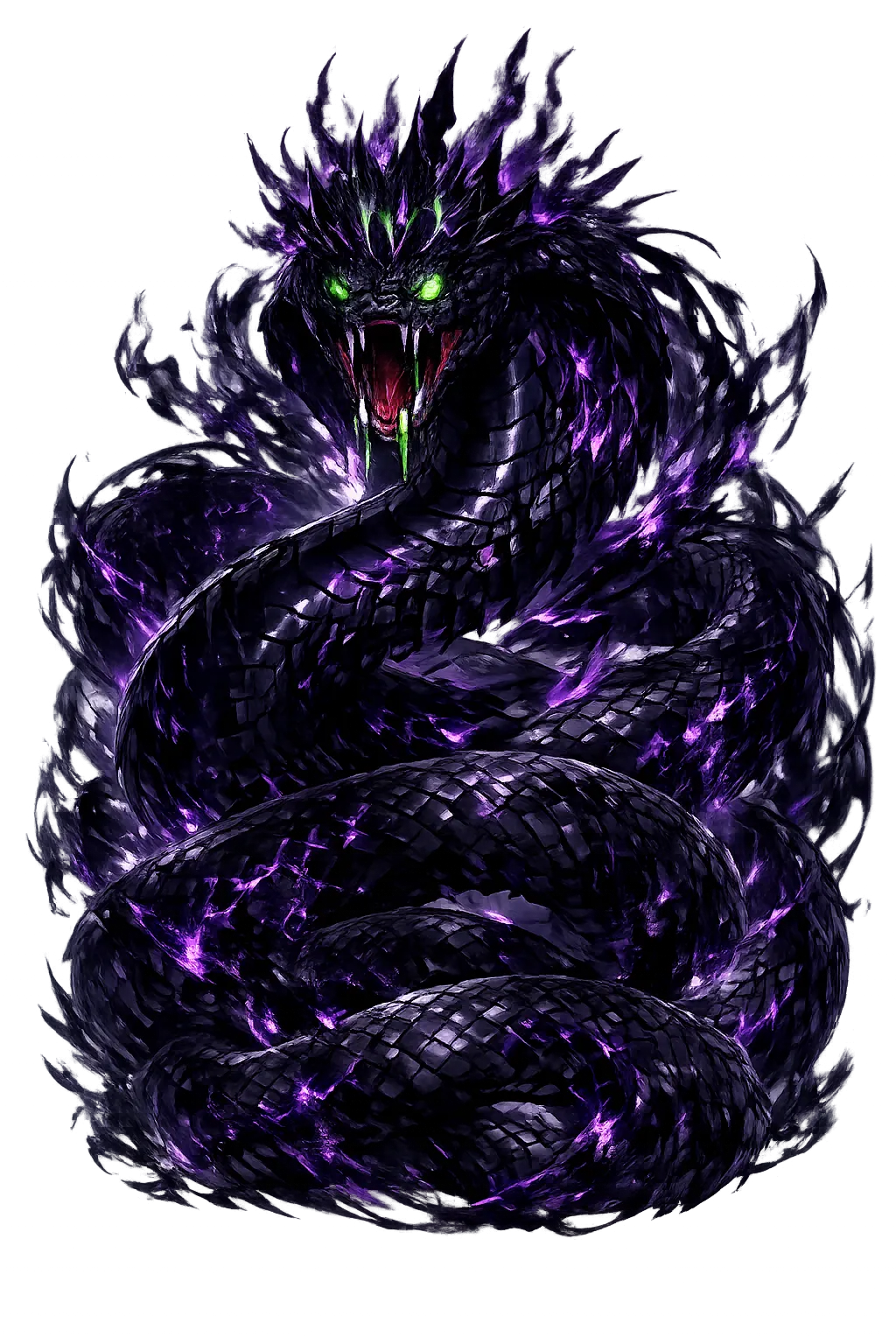
Stories of ꜥꜣpp
Apophis has no temple, no cult, no hymns of praise — he exists to be defeated. Yet his role is essential: he is the adversary against whom the gods and the justified dead fight each night. His mythology is a mythology of cosmic maintenance, in which order is not given but won again and again.
In the New Kingdom underworld books — the Amduat, the Book of Gates, and their relatives, painted on the walls of royal tombs in the Valley of the Kings — Ra's barque sails through the twelve hours of night. In the middle hours Apophis waits, a vast serpent coiled in the river of the Duat, sometimes in his menacing form called Rerek. The crew of gods and blessed dead must fight him with spear, rope, and fire: the serpent Mehen encircles the boat as living armor, goddesses of the hours bind the monster, and Seth stands at the prow to spear him as the barque passes. In the Book of Gates the punishment of the damned is staged as their enforced participation in this warfare — the enemies of order are made to row Apophis's own boat. The scene encodes the whole Egyptian theology of night: the sun's journey is not a cruise but a combat patrol, and dawn is the report of a battle won.
Preserved most fully in the Bremner-Rhind papyrus (British Museum EA 10188) and on temple walls, this liturgical composition instructs the lector priest to fashion a wax figure of Apophis, pierce it with knives, burn it in a fire of bryony, trample the ashes, spit upon them, and recite spells that sever his vertebrae and scatter his body, his name, and his soul. The ritual was performed daily in the great temples of Amun-Ra at Thebes, so that the sun would rise. It is the most elaborate surviving example of Egyptian execration magic, and Robert Ritner's The Mechanics of Ancient Egyptian Magical Practice remains its definitive study. The text is not symbolic theater to its performers: the wax image is the god of chaos, and its destruction in the temple courtyard is one front of the same war fought each night on the barque. The morning exists because someone, every day, did the paperwork of the cosmos.
In the cycle of the 'Distant Goddess', the Eye of Ra — Tefnut in some tellings, the lioness Mehit in others — flees south in anger, and the sun god's light dims until Thoth retrieves her. Her joyful return transforms her into the uraeus, the fire-spitting cobra rearing from Ra's brow, whose flame is precisely the weapon turned against Apophis when he attacks. Late underworld compositions weave this fire into the nightly voyage: the solar barque does not merely survive the serpent's coils but burns them. The myth explains why the sun's fiercest weapon grows out of his own head: order defends itself with power that was once disorder's hostage. Chaos, in the Egyptian analysis, is never destroyed — it is recruited. The returning Eye, once a runaway, becomes the serpent-fire that guards the solar boat; and Apophis, the anti-god, is the fixed point against which every such conversion is measured.
Spell 17 of the Book of the Dead — the great theological commentary on the creation — preserves the strangest victory over Apophis. The deceased declares: 'I am that great cat beside which the ished tree was split in Heliopolis on that night of battle, when what was to be punished was punished among the blessed.' The accompanying vignettes show a cat decapitating a serpent beneath a sacred tree; tradition identifies the cat with Ra (and in later readings with the lion god Maahes) and the serpent with Apophis. The image is deliberately homely: the universe's decisive battle is fought not by a cosmic dragon but by the household cat, the small guardian of the granary, cutting off the head of chaos at its root. If even the cat keeps watch, no creature is excused from the defense of order — the spell's point for the deceased, who must now join the same vigil from the other side of death.
Darkness, Eclipse, and the Enemy of Ra
Ꜥpp is the giant serpent of primordial chaos, enemy of the sun and of ma'at, who lies in the depths of the Duat and each night attacks the solar barque. His defeat is renewed daily in temple liturgy and underworld books: without Apophis there is no drama of order, and without his defeat there is no dawn.
Each night Apophis coils around the solar barque; eclipses are moments when he nearly succeeds.
He personifies isfet, the chaos that opposes mꜣꜥt; his defeat is the daily re-creation of the cosmos.
Priests performed 'The Book of Overthrowing Apophis' to magically knife, burn, and bind him each day.
He haunts the waters of the Duat, the dark mirror of the Nile through which Ra must pass.
From the original script to the living URL
𓂝𓊪𓊪𓆓
The name in its original Egyptian form. ꜥꜣpp (𓂝𓊪𓊪𓆓) is attested in the source tradition — “He who was spat out”. Its Egyptological ain and alef letters carry the full phonetic and orthographic weight of the source tradition.
apep
Reduced to plain apep, the name loses everything that made it specific: Egyptological ain and alef letters. What remains is an ASCII string that machines can parse but that no longer speaks with its original voice.
ꜥꜣpp
The Unicode restoration recovers what ASCII flattened. ꜥꜣpp restores Egyptological ain and alef letters, returning the name to its original written dignity. The domain encodes to Punycode, but the browser displays the truth.
ꜥꜣpp.com → xn--pp-rq8hha.com
The non-ASCII characters in ꜥꜣpp are encoded while the ASCII remains visible. To the DNS, it is Punycode. To humanity, it is ꜥꜣpp.
Owned, ideal, and ASCII forms of ꜥꜣpp
ꜥꜣpp
Restores 𓂝𓊪𓊪𓆓. The live temple domain — ꜥꜣpp.com.
ꜥpp
Restores 𓂝𓊪𓊪𓆓. A second live spelling — ꜥpp.com.
apep
Flattens 𓂝𓊪𓊪𓆓. The plain ASCII fallback — what DNS and legacy systems see.
How ꜥꜣpp was spoken
How ꜥꜣpp travels from ancient script to the modern URL
Egyptian Ꜥpp; the original vocalisation is unknown. The name is connected with the verb “to slither" or “to be spat out".
The lore you have read is the living myth. Extended Lore opens the scholarly vault beneath it: the cult and its material remains, a history of the image, the name after antiquity, a meditation on what the name still means, and the full scholarly apparatus — etymology, orthography, sources.
Enter Extended Lore