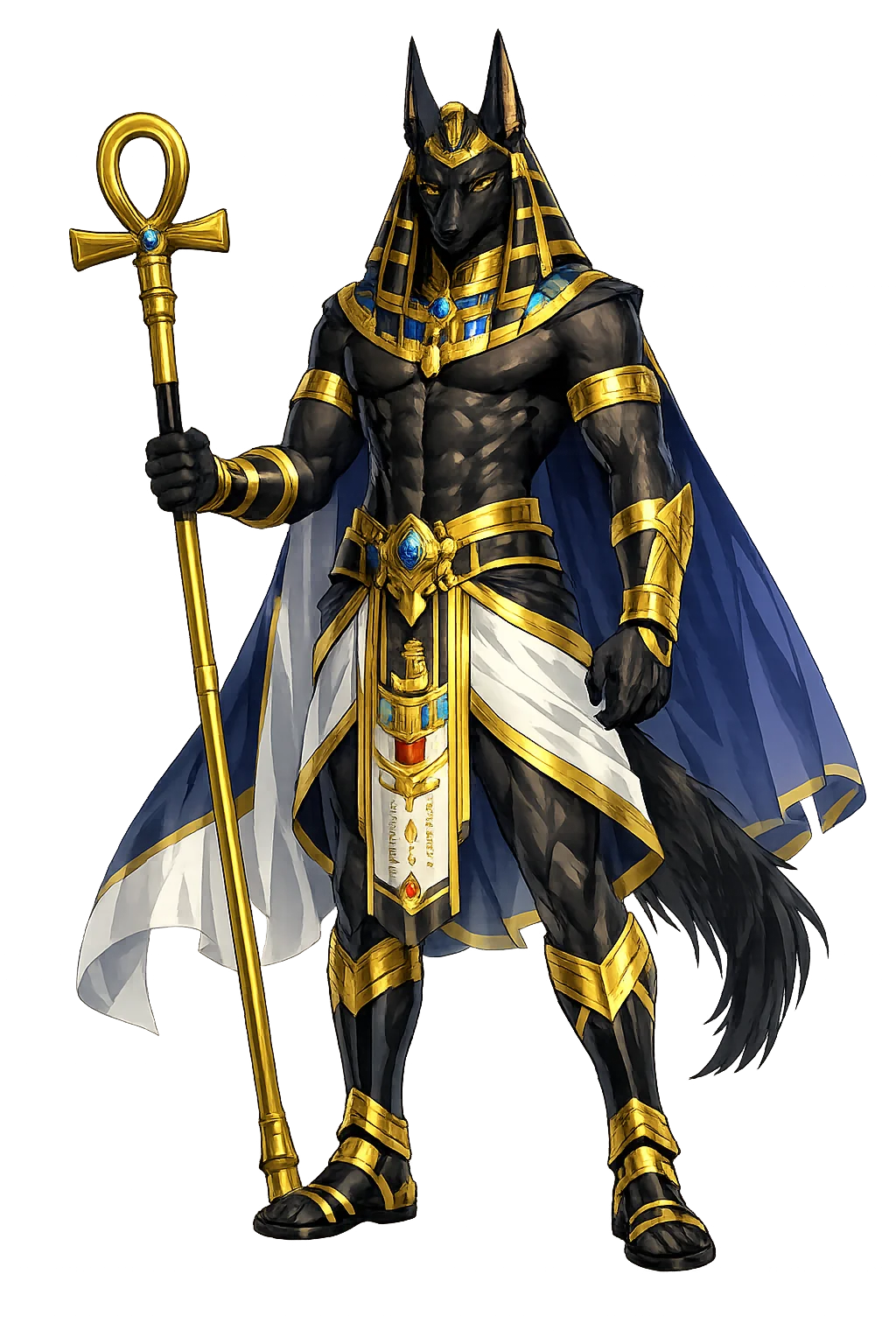
Stories of ꜣnpw
In the earliest religion ꜣnpw simply is the god of the dead; when the Osiris cycle rose, he was written into it — as embalmer, son, and guide — without ever losing his seniority at the grave.
Isis had gathered all the pieces of Osiris' body that Set had scattered — save one, swallowed by a fish of the Nile — when ꜣnpw came to perform the rite no god had yet done. He washed the god's flesh, anointed it with oils, wrapped it in fine linen and breathed the first funerary formula over it: the first mummy, and the template of every burial Egypt would ever perform (Plutarch, De Iside et Osiride 13–14; the older Pyramid Texts already call ꜣnpw 'he who is upon his mountain', watcher of the god's booth). In temple ritual the connection stayed literal for three thousand years: the chief embalmer, the 'overseer of the mysteries', wore the jackal mask, so that the hands wrapping the dead were visibly Anubis' own. The myth makes the funerary craft a divine inheritance: mummification is not technique applied to religion but religion continued by technique.
Spell 125 of the Book of the Dead — whose vignettes multiply from the Eighteenth Dynasty onward — fixes his most famous office. In the Hall of the Two Truths the deceased recites the Negative Confession, forty-two denials of sin before forty-two judges; then ꜣnpw, he who counts the hearts, leads the dead to the scales and steadies the beam while the heart is weighed against the single feather of Maat. Thoth records the verdict; a heart heavy with lies tips the pan, and Ammit the Devourer — crocodile's head, lion's foreparts, hippopotamus' hindquarters — waits beside the scales to eat it, annihilating the sinner's afterlife. A true-of-voice heart passes on to Horus and Osiris. That the terrible reading of the scales belongs to the jackal-god is the theology in one image: the watcher at the desert's edge, feared in life as a digger among bodies, is in death the incorruptible accountant of souls.
The genealogy is late and layered. In the Old Kingdom texts ꜣnpw simply is — lord of the necropolis before any family attached. Later traditions tried to attach him: one strand makes him son of the cow-goddess Hesat, and the story preserved by Plutarch (De Iside et Osiride 12, 14) makes him the secret child of Osiris and Nephthys — conceived while Set was away, hidden in the marshes for shame, found and raised by Isis. Plutarch's is the version that stuck, and its pathos is real: the god of the embalming-table as the concealed child of the very body he would wrap. But scholars note the direction of the theology: it was written backwards, from his office to his family. The hidden child of a murder is set, for eternity, to repairing that murder — lineage as job description.
His Old Kingdom titles read like a map of the necropolis: jmy-wt, 'he who is in the place of embalming'; ḫnty-sḥ-nṯr, 'foremost of the divine booth'; ḫnty-jmntjw, 'foremost of the Westerners' — the dead, who live where the sun goes down; and tpy-ḏw=f, 'he who is upon his mountain', the watcher on the ridge above the graves. On Middle Kingdom coffins and later tomb walls he leans over the bier, one black paw resting gently on the mummy — not a threat but an escort. No soul reaches the Field of Reeds unaccompanied: spells of the Book of the Dead equip the dead to travel in his retinue, and he leads the justified through the night roads of the Duat. The theology is consistent across three millennia: death is a border crossing, and the border is his.
Embalming, the Scales, and the Guiding of Souls
ꜣnpw is the oldest funeral god of Egypt: lord of the necropolis before Osiris ever ruled it, master of embalming, and the steady hand at the scales where every human heart is weighed against a feather. His black jackal watches from the edge of the desert where the dead were always buried.
The desert canid seen at the graves' edge — feared for what it digs, honoured as the grave's defender.
He steadies the scales in the Hall of Two Truths: heart against Maat's feather, exact to the grain.
He wrapped Osiris himself — the first mummy — and every priestly embalmer wore his mask.
"Foremost of the Westerners" — guide of souls through the night roads of the dead.
From the original script to the living URL
𓃢
The name in its original Egyptian form. ꜣnpw (𓃢) is attested in the source tradition — “Egyptian god of embalming and the necropolis; the name's etymology is uncertain (his epithet tpy-ḏw=f means He who is upon his mountain)”. Its Egyptological ain and alef letters carry the full phonetic and orthographic weight of the source tradition.
anubis
Reduced to plain anubis, the name loses everything that made it specific: Egyptological ain and alef letters. What remains is an ASCII string that machines can parse but that no longer speaks with its original voice.
ꜣnpw
The Unicode restoration recovers what ASCII flattened. ꜣnpw restores Egyptological ain and alef letters, returning the name to its original written dignity. The domain encodes to Punycode, but the browser displays the truth.
ꜣnpw.com → xn--npw-lk3l.com
The non-ASCII characters in ꜣnpw are encoded while the ASCII remains visible. To the DNS, it is Punycode. To humanity, it is ꜣnpw.
Owned, ideal, and ASCII forms of ꜣnpw
ꜣnpw
Restores 𓃢. The live temple domain — ꜣnpw.com.
anubis
Flattens 𓃢. The plain ASCII fallback — what DNS and legacy systems see.
How ꜣnpw was spoken
How ꜣnpw travels from ancient script to the modern URL
Egyptian jnpw; the original vocalisation is unknown. The name is traditionally connected with “he who is upon his sacred mountain" or with a word for “royal child".
The lore you have read is the living myth. Extended Lore opens the scholarly vault beneath it: the cult and its material remains, a history of the image, the name after antiquity, a meditation on what the name still means, and the full scholarly apparatus — etymology, orthography, sources.
Enter Extended Lore