
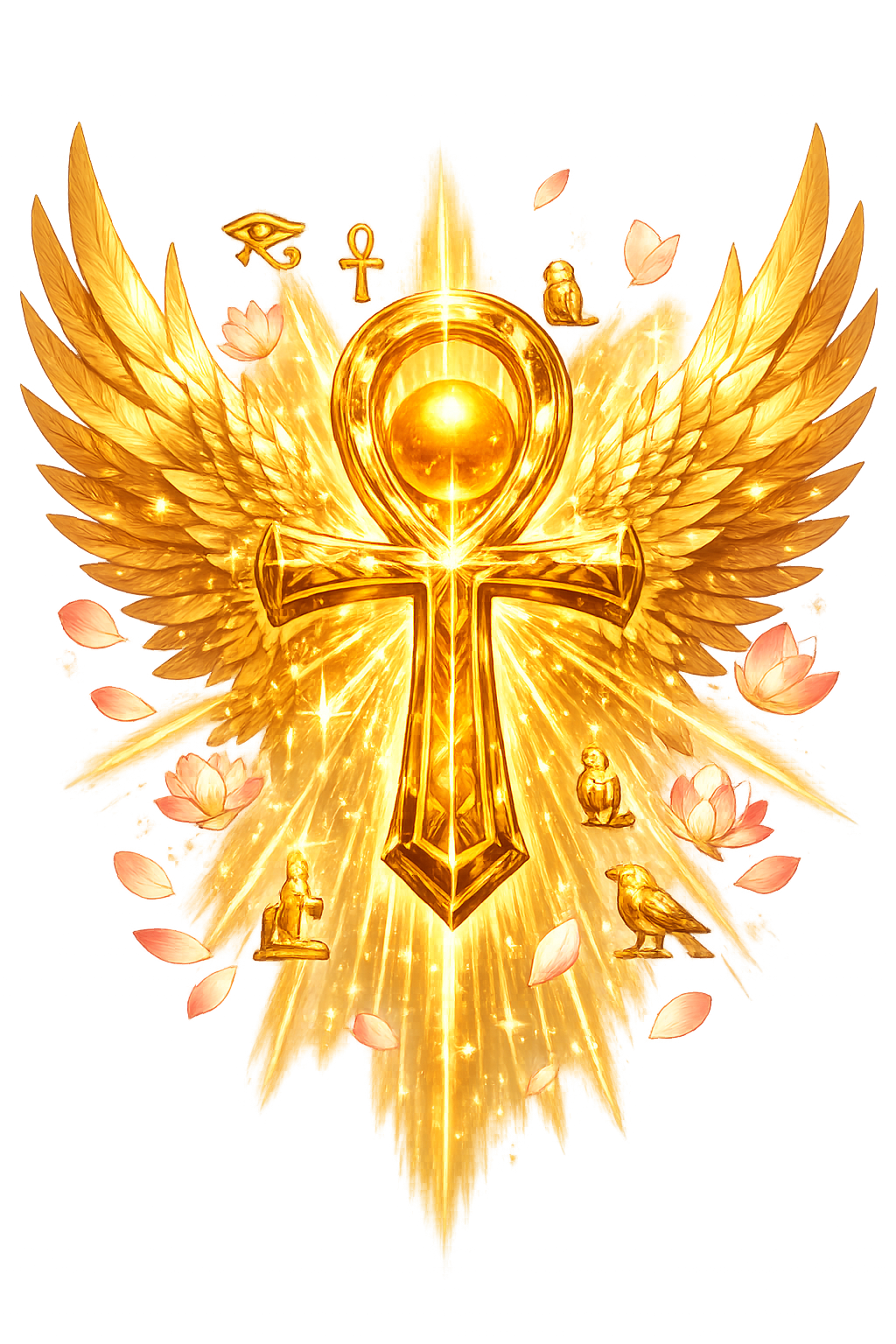
ꜥnḫ: the stories first, then the spelling
The marks in ꜥnḫ make the most sense standing next to the myths they have to carry. So the myths come first.
The Stories That Carry the Name
The First Giving of Life. In the Heliopolitan cosmogony attested from the Pyramid Texts of Unas (c. 2350 BCE) onward, the creator Atum comes forth on the primeval mound and begins to differentiate the one into the many — sneezing out Shu and Tefnut, speaking the first pairs into being. The instrument of that animation is the ankh: in temple creation reliefs from Edfu and elsewhere the sun-god extends the sign toward the nostrils of the newly made gods and kings, and 'life' passes as a current, not a metaphor.
The Daily Renewal of Life. The Egyptian temple was not a church but a power station, and its daily office was the recharging of life. Each morning the cult statue was washed, anointed, clothed, and offered the ankh-sign of life by the officiating king or priest; reliefs from Karnak, Luxor, and Edfu show the transaction endlessly repeated — Amun, Mut, or Khonsu extending the looped cross toward the royal nose. The rite renewed not only the god's vitality but the king's, and through him the country's: a chain of life flowing from the divine to the human to the land.
The Ankh in the Duat. The afterlife literature turns the ankh from a divine courtesy into the dead person's survival kit. The Book of the Dead equips the deceased with spells 'for causing a man to live again', and the Late-Period Book of Breathings promises that its recitation will supply the ba with air — the title of the composition is the promise. Ankh amulets of faience, carnelian, or gold were hung at the throat or laid over the chest as the pledge of that breath.
And Here Is What the Spelling Preserves
At a Glance
- Restored name: ꜥnḫ
- ASCII form: ankh
- Meaning: "Life; Egyptian ankh sign"
- Domain of influence: Symbol of Life
- Pantheon: Egyptian
- Classification: Tier 1
- Original script: 𓋹
- Series: The Restoration Files, No. 37 of 546
The Name Travels
The ankh outlived pharaonic religion. Coptic Christians adopted it as the crux ansata, the 'handled cross,' seeing in its loop the triumph of eternal life over death.
The Address It Earned
The temple of ꜥnḫ stands at /ankh/ — lore, scholars, patterns — because a name carrying this much story deserves more than a parking page. The restoration preserves more than the ASCII form can express — stress, length, or a letter the Latin keyboard lost — which places it, mechanically, in Tier-1.
The Sources Are Open
The myths above are retold from the temple's record; the primary voices are in the Sacred Texts: The Book of the Dead. Nothing in this file outranks them.
The File Continues
Read the founding dispatch for the name's full story, the Resonance File for the archetype at work — or the whole archive in one sitting.
Continue the series — previous file: Animus (read it here) · next file: Annwn (read it here).
The Restoration Files are written from the same canonical record as the temples themselves: the lexicon, the lore catalog, the pattern atlas, and the cited scholarly sources. If a file ever disagrees with its temple, the temple is right — tell us, and the file will be corrected.