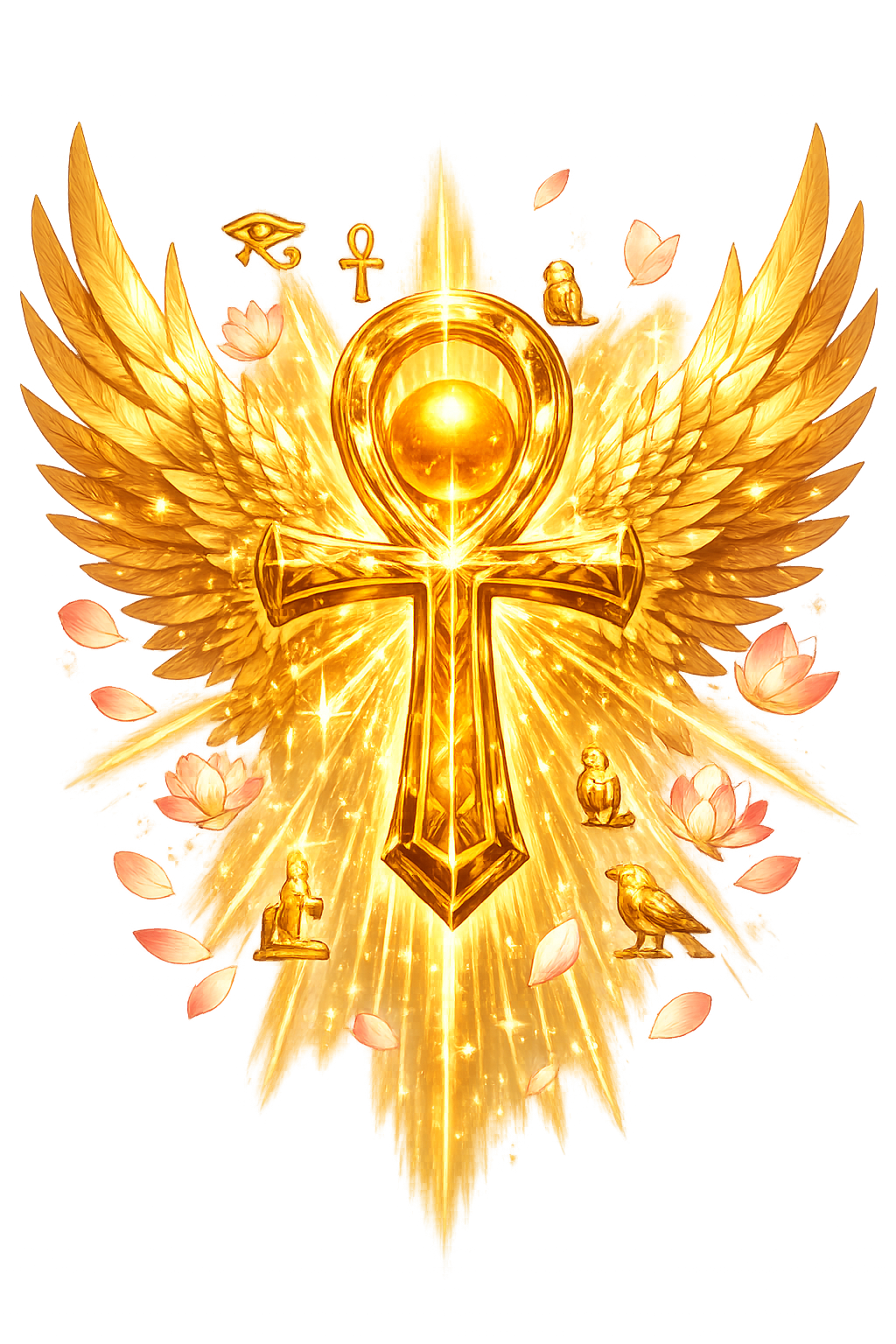
Stories of ꜥnḫ
The ankh has no single mythic biography because it is older than biography: it enters the record at the moment the gods begin to give life, and it never leaves their hands. Every chapter of Egyptian religion — creation, kingship, temple ritual, burial — is also a chapter of the sign. What follows are four such chapters.
In the Heliopolitan cosmogony attested from the Pyramid Texts of Unas (c. 2350 BCE) onward, the creator Atum comes forth on the primeval mound and begins to differentiate the one into the many — sneezing out Shu and Tefnut, speaking the first pairs into being. The instrument of that animation is the ankh: in temple creation reliefs from Edfu and elsewhere the sun-god extends the sign toward the nostrils of the newly made gods and kings, and 'life' passes as a current, not a metaphor. The sign is not given from one person to another; it is the medium of divine animation itself — breath, circulation, and legitimacy in a single loop. When Egyptian artists wanted to show the moment the cosmos became inhabited, they reached for the ankh the way a modern draftsman reaches for a power symbol: it is the oldest image in the world for 'turned on.'
The Egyptian temple was not a church but a power station, and its daily office was the recharging of life. Each morning the cult statue was washed, anointed, clothed, and offered the ankh-sign of life by the officiating king or priest; reliefs from Karnak, Luxor, and Edfu show the transaction endlessly repeated — Amun, Mut, or Khonsu extending the looped cross toward the royal nose. The rite renewed not only the god's vitality but the king's, and through him the country's: a chain of life flowing from the divine to the human to the land. The theology was maintenance, and the Egyptians were literalists about it. To omit the morning ankh was to let the world's charge drain — which is why, on temple walls for three thousand years, someone is always, unfailingly, handing life to someone else.
The afterlife literature turns the ankh from a divine courtesy into the dead person's survival kit. The Book of the Dead equips the deceased with spells 'for causing a man to live again', and the Late-Period Book of Breathings promises that its recitation will supply the ba with air — the title of the composition is the promise. Ankh amulets of faience, carnelian, or gold were hung at the throat or laid over the chest as the pledge of that breath. New Kingdom tombs in the Valley of the Kings place the sign at the nostrils of mummies and on coffin lids: the last thing the corpse is given, at the threshold, is the first thing the gods ever gave. The dead did not ask for death reversed but for life continued — beating heart, open nostrils, free passage along the roads of the Duat.
No pose is more common in Egyptian art: a deity — Isis, Amun, Horus — leans forward and presses the ankh to the king's nose. It is the visual signature of pharaonic theology, repeated tens of thousands of times from the Old Kingdom to the Roman period. The sphinx-stela of Thutmose IV gives the scene a voice: the god Harmachis promises the young prince the throne, and with it life — ankh — in abundance. The gesture encodes the whole theory of kingship: life is not earned but bestowed, flowing from the gods through the anointed body of the pharaoh into the Two Lands. Kingship is a current, and the ankh is its visible spark. The modern eye reads the scene as a blessing; the Egyptian read it as circuitry — the god completing the circuit, the king conducting it, the nation lighting up.
Life, Vitality, and the Living
The ꜥnḫ is the shape of life itself in Egyptian thought: a looped cross that gods press to the nostrils of kings and of the dead. Its three consonants — ꜥ-n-ḫ — mean 'life', 'to live', and, by extension, 'salvation'. To be given the ankh is to be given breath, heartbeat, and the right to exist, in this world and in the Field of Reeds.
The looped cross (Gardiner S34) represents the breath and circulation that distinguish the living from the dead; it is offered in countless tomb and temple reliefs.
Deities extend the ankh toward the king's nose, giving him the breath of life; the sign is both noun and verb, object and action.
Carved in faience, wood, or precious stone, ankh amulets protected the body and served as talismans for rebirth in the Duat.
The ankh transforms mortal life into an eternal recurrence: to die is to live again in the Field of Reeds.
From the original script to the living URL
𓋹
The name in its original Egyptian form. ꜥnḫ (𓋹) is attested in the source tradition — “Life; Egyptian ankh sign”. Its Egyptological ain and alef letters carry the full phonetic and orthographic weight of the source tradition.
ankh
Reduced to plain ankh, the name loses everything that made it specific: Egyptological ain and alef letters. What remains is an ASCII string that machines can parse but that no longer speaks with its original voice.
ꜥnḫ
The Unicode restoration recovers what ASCII flattened. ꜥnḫ restores Egyptological ain and alef letters, returning the name to its original written dignity. The domain encodes to Punycode, but the browser displays the truth.
ꜥnḫ.com → xn--n-bom2786d.com
The non-ASCII characters in ꜥnḫ are encoded while the ASCII remains visible. To the DNS, it is Punycode. To humanity, it is ꜥnḫ.
Owned, ideal, and ASCII forms of ꜥnḫ
ꜥnḫ
Restores 𓋹. The live temple domain — ꜥnḫ.com.
ankh
Flattens 𓋹. The plain ASCII fallback — what DNS and legacy systems see.
How ꜥnḫ was spoken
How ꜥnḫ travels from ancient script to the modern URL
Egyptian ꜥnḫ “life"; the hieroglyphic sign and word for life, breath, and prosperity.
Symbol of Life
The Unicode restoration ꜥnḫ uses Egyptological characters registrable in .com; hieroglyphs are outside the .com IDN table.
The lore you have read is the living myth. Extended Lore opens the scholarly vault beneath it: the cult and its material remains, a history of the image, the name after antiquity, a meditation on what the name still means, and the full scholarly apparatus — etymology, orthography, sources.
Enter Extended Lore