
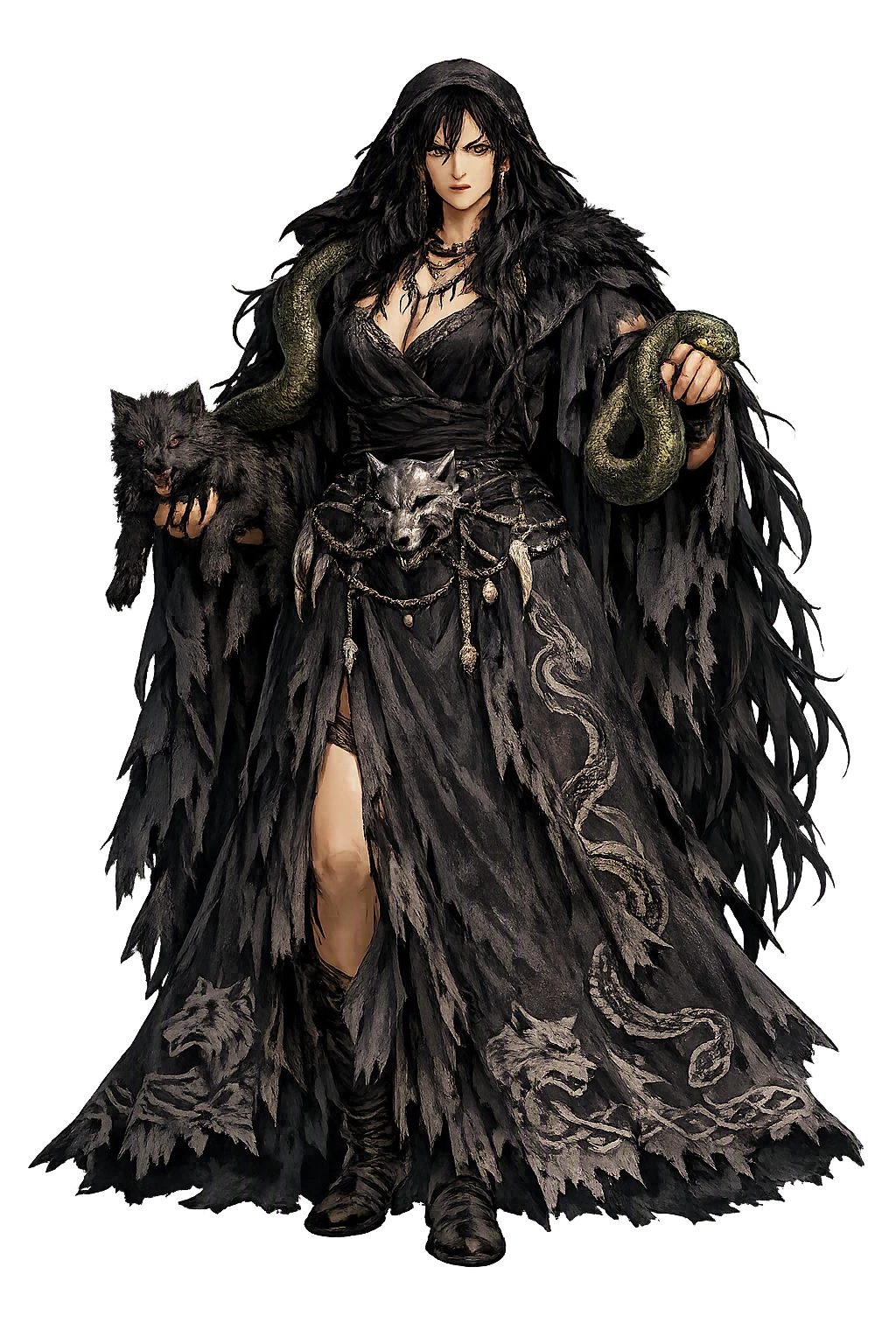
The provenance file on Angrboða
The provenance file for Angrboða. Nothing here is unsourced; that is what the file is for.
Provenance
1. The attestation. ᛅᚾᚴᚱᛒᚢᚦᛅ, from the tradition's own record. On record: Poetic Edda, Völuspá st. 40–41 (ed. Neckel–Kuhn; trans. Larrington, 2014), Prose Edda, Gylfaginning (ed. Faulkes, 1982), Grimm, Jakob, Deutsche Mythologie (1835), Simek, Rudolf, Dictionary of Northern Mythology (1993), s.v. Angrboða.
2. The narrative record. Three Children by Loki — Snorri Sturluson, in Gylfaginning, gives the whole genealogy in a sentence: Loki lay with a giantess named Angrboða in Jötunheimr, and she bore him three children — the wolf Fenrir, the Midgard-serpent Jörmungandr, and Hel. The gods took the children and did what gods do with prophecy made flesh: they flung the serpent into the encircling sea, cast Hel down into Niflheim to rule those who die of sickness and age, and kept the wolf in Asgard to be reared — until the day they bound him with the dwarves' fetter Gleipnir and paid for it with Týr's right hand in the wolf's mouth. The Old Woman of Járnviðr — Völuspá (st. 40) looks east and sees her — or sees someone scholars have long identified with her: an aged one sat in the ironwood and nourished Fenrir's offspring; from that brood comes one, in troll's shape, who steals the moon.
3. The physical record. Angrboða has left no cult site, no amulet, and no image that can be securely tied to her — the record is entirely textual. The witnesses are the vellum books: Völuspá survives whole in the Codex Regius (GKS 2365 4°, c. 1270) and fragmentarily in AM 748 I 4°; Snorri's sentence naming her rides in the Prose Edda manuscripts, above all Codex Upsaliensis (DG 11, early 14th century) and the Codex Regius of the Prose Edda (GKS 2367 4°). Indirect iconography exists for her brood: the eighth-century Gotland picture stone Ardre VIII shows the bound wolf, and the Gosforth Cross in Cumbria carves scenes from the end-time she mothers. But of the giantess herself the Middle Ages drew nothing — an absence that suits her.
4. The current holding. The temple at /angrboda/, classified Tier 1. Tier-1 is not a compliment; it is a measurement. This restoration keeps something the ASCII form provably loses, and the measurement is repeatable.
5. The documented resonances. Mythic Name Restoration, Astrology, Tarot & Esoteric Services, Diacritic-First Domains — seats argued and weighted in the pattern atlas, read through the myths in this temple's Resonance File.
6. The primary sources. Poetic Edda, Prose Edda — the library this file answers to, open at the Sacred Texts collection.
7. The continuing record. Angrboða's legacy runs through two channels: language and archetype. The Old Norse angr, 'grief, affliction,' crossed into Middle English and survives whenever anyone feels anger — her name's root is spoken daily by millions who have never heard of her.
At a Glance
- Restored name: Angrboða
- ASCII form: angrboda
- Meaning: "She who offers sorrow"
- Domain of influence: Monster Mother, Sorcery
- Pantheon: Norse
- Classification: Tier 1
- Original script: ᛅᚾᚴᚱᛒᚢᚦᛅ
- Series: The Restoration Files, No. 34 of 548
The File Continues
Read the founding dispatch for the name's full story, the Resonance File for the archetype at work — or the whole archive in one sitting.
Continue the series — previous file: Andvari (read it here) · next file: Anima (read it here).
The Restoration Files are written from the same canonical record as the temples themselves: the lexicon, the lore catalog, the pattern atlas, and the cited scholarly sources. If a file ever disagrees with its temple, the temple is right — tell us, and the file will be corrected.