The Living Myth
Princess, Chained, Rescued by Perseus · The Princess of the Rock
Stories of Andromedē
Andromédē's story is a chain of consequences: a queen's boast, a god's wrath, a daughter's punishment, and a hero's arrival at the decisive moment. It is also a founding myth of genealogy, linking Greek and Persian royal lines.
The chain begins with a boast. Kassiepeia, queen of Aithiopia, declared that she — or, in some tellings, her daughter — was more beautiful than the Nereids, the sea-nymphs in Poseidôn's train (Apollodorus, Bibliotheca 2.4.3; the fullest telling is Ovid, Metamorphoses 4.663–764). The insulted sea answered with a flood and a ketos, a ravening sea-beast against the Ethiopian coast, and the oracle of Zeus-Ammōn delivered the verdict: only the exposure of Andromédē, the king's daughter, would end the devastation. Kepheus, pressed by his starving people, had the princess stripped and chained to a sea-cliff as the monster's due. Sophocles wrote an Andromeda, now lost but for fragments, and painted vases carried the scene to every Greek city. The myth's logic is pitiless: the daughter pays for the mother's tongue, and the sea, which the Greeks both crossed and feared, collects its tribute in royal flesh.
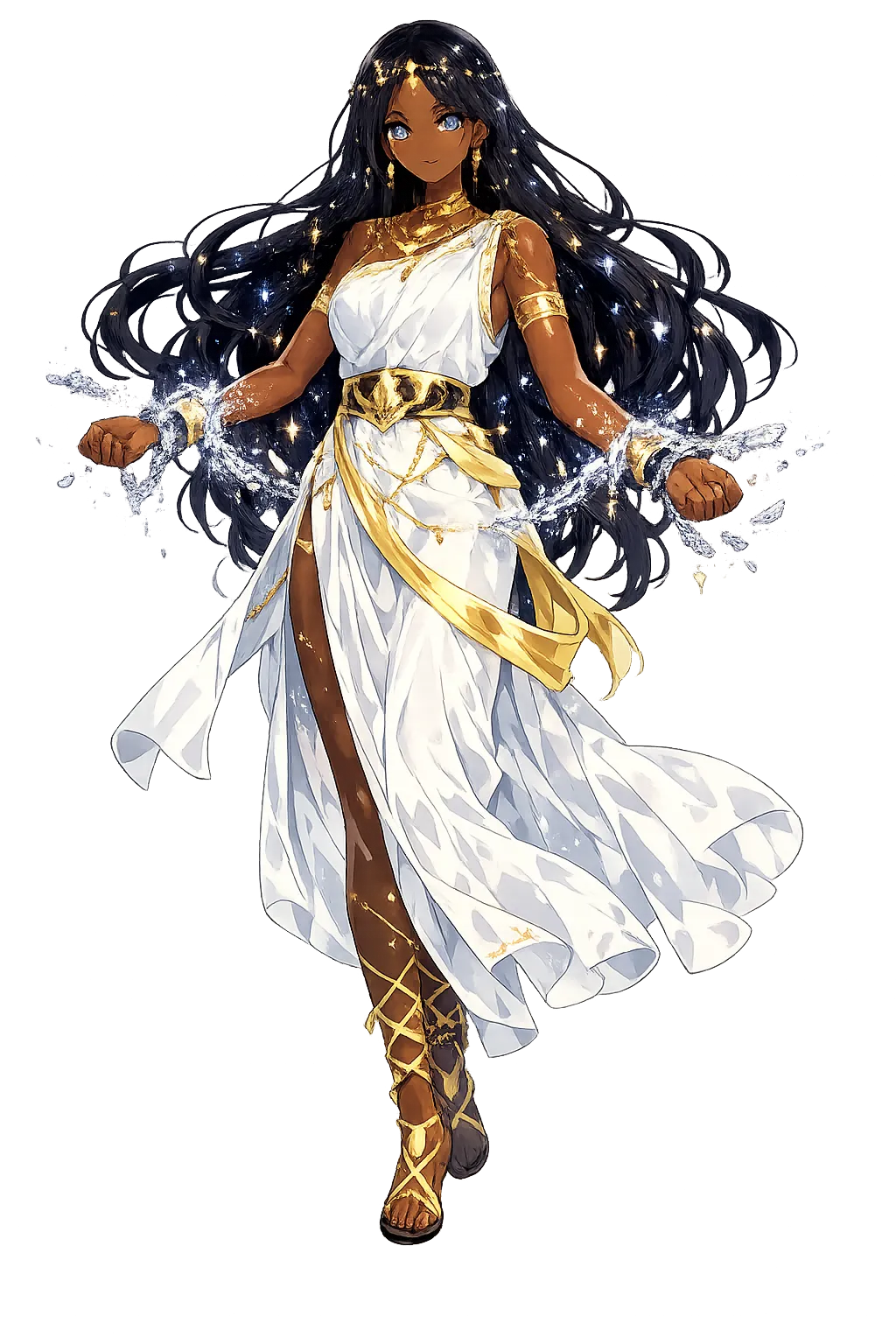
Andromédē was fastened to the rock by bonds Ovid calls indissoluble — the Nereids' own handiwork, in his exquisite cruelty — and left to the rising beast. At that moment Perseus came flying home from the Gorgons' shore, with Hermes' harpe, Athena's mirrored shield, and the kibisis on his shoulders. Struck by the chained figure — a statue, 'but for the wind in her hair and the tears on her cheeks' (Ovid, Met. 4.672–679) — he struck a bargain with Kepheus: the girl's life for her hand. The scene proved irresistible to Greek painters: from early Corinthian and Attic vases to the frescoes of Pompeii, the pale maiden against dark rock, the descending hero, and the monster breasting the foam became antiquity's canonical rescue image. Innocence displayed and violence arriving in the same instant — the myth compresses the whole psychology of the heroic moment into one shoreline.
The rescue did not end the story. Andromédē had been promised to her uncle Phineus, and while the wedding feast of Perseus and Andromédē was still singing, Phineus burst in with an armed mob to claim her. Outnumbered, Perseus unslung the kibisis and turned the Gorgoneion on the attackers, transforming Phineus and his men into a stone tableau mid-swing — Ovid lingers over the frozen weapons and marble mouths (Metamorphoses 5.1–249; Apollodorus 2.4.3 gives the sober prose version). The slaughter shadowed the marriage it defended: Andromédē's deliverance was purchased in her kinsmen's blood, a price the myth does not hide. She bore Perseus many sons, among them Persēs, whom Herodotus (7.61) makes the eponymous ancestor of the Persian kings — folding a Greek princess into the genealogy of an empire. The rescued become the founders; the monster's intended bride mothers a royal line.
At death, Athena set Andromédē among the stars — the 'chained lady' of the northern sky, as Eratosthenes' Catasterismi and Hyginus' De Astronomica (2.11) preserve the tale. The constellation keeps the whole family on stage: Perseus above her with the Gorgon's head, Kepheus and Kassiepeia on either hand, and the ketos — our Cetus — still rising from the sea below, the pursuit made permanent. The Great Andromeda Galaxy, M31, the nearest spiral galaxy to our own, bears her name, so that the princess exposed to a sea-monster now names an island universe two and a half million light-years away. Catasterism is the Greeks' quiet answer to mortality: what could not be saved on earth is preserved in the pattern of the sky, where the chains are drawn as stars and no god's wrath can reach her again.
Rescue, Constellation, Royal Sacrifice
Andromédē is the princess chained to a sea-rock, offered to a monster and saved by a hero. Her myth is one of the most widely reproduced rescue narratives in Western art, and her catasterism placed her among the stars forever.
Daughter of Kepheus and Kassiepeia, rulers of Aithiopia; her lineage is royal and unfortunate.
Chained to a coastal rock as appeasement to the ketos sent by Poseidôn.
Saved by the gorgon-slayer, she becomes his wife and, through their son Persēs, ancestor of the Persian line (Herodotus 7.61).
Placed in the northern sky after death, she keeps the whole family group as stars; the Andromeda galaxy is her stellar home.
From the original script to the living URL
Ἀνδρομέδη
The name in its original Greek form. Andromedē (Ἀνδρομέδη) is attested in the source tradition — “Ruler of men”. Its long vowels and acute accents carry the full phonetic and orthographic weight of the source tradition.
andromeda
Reduced to plain andromeda, the name loses everything that made it specific: long vowels and acute accents. What remains is an ASCII string that machines can parse but that no longer speaks with its original voice.
Andromedē
The Unicode restoration recovers what ASCII flattened. Andromedē restores long vowels and acute accents, returning the name to its original written dignity. The domain encodes to Punycode, but the browser displays the truth.
Andromedē.com → xn--andromed-bdb.com
The non-ASCII characters in Andromedē are encoded while the ASCII remains visible. To the DNS, it is Punycode. To humanity, it is Andromedē.
Owned, ideal, and ASCII forms of Andromedē
Andromedē
Restores Ἀνδρομέδη. The live temple domain — andromedē.com.
Andromédē
Restores Ἀνδρομέδη. Acute on the stressed short vowel, matching Greek Ἀνδρομέδη; preserves stress where the canonical macron-only form records length only.. Not in the PuniCodex collection.
andromeda
Flattens Ἀνδρομέδη. The plain ASCII fallback — what DNS and legacy systems see.
How Andromedē was spoken
How Andromedē is preserved in writing
A bespoke provenance study for Andromedē is being prepared by the PUNICODEX scholarly team.
Contribute scholarly provenance →The lore you have read is the living myth. Extended Lore opens the scholarly vault beneath it: the cult and its material remains, a history of the image, the name after antiquity, a meditation on what the name still means, and the full scholarly apparatus — etymology, orthography, sources.
Enter Extended Lore