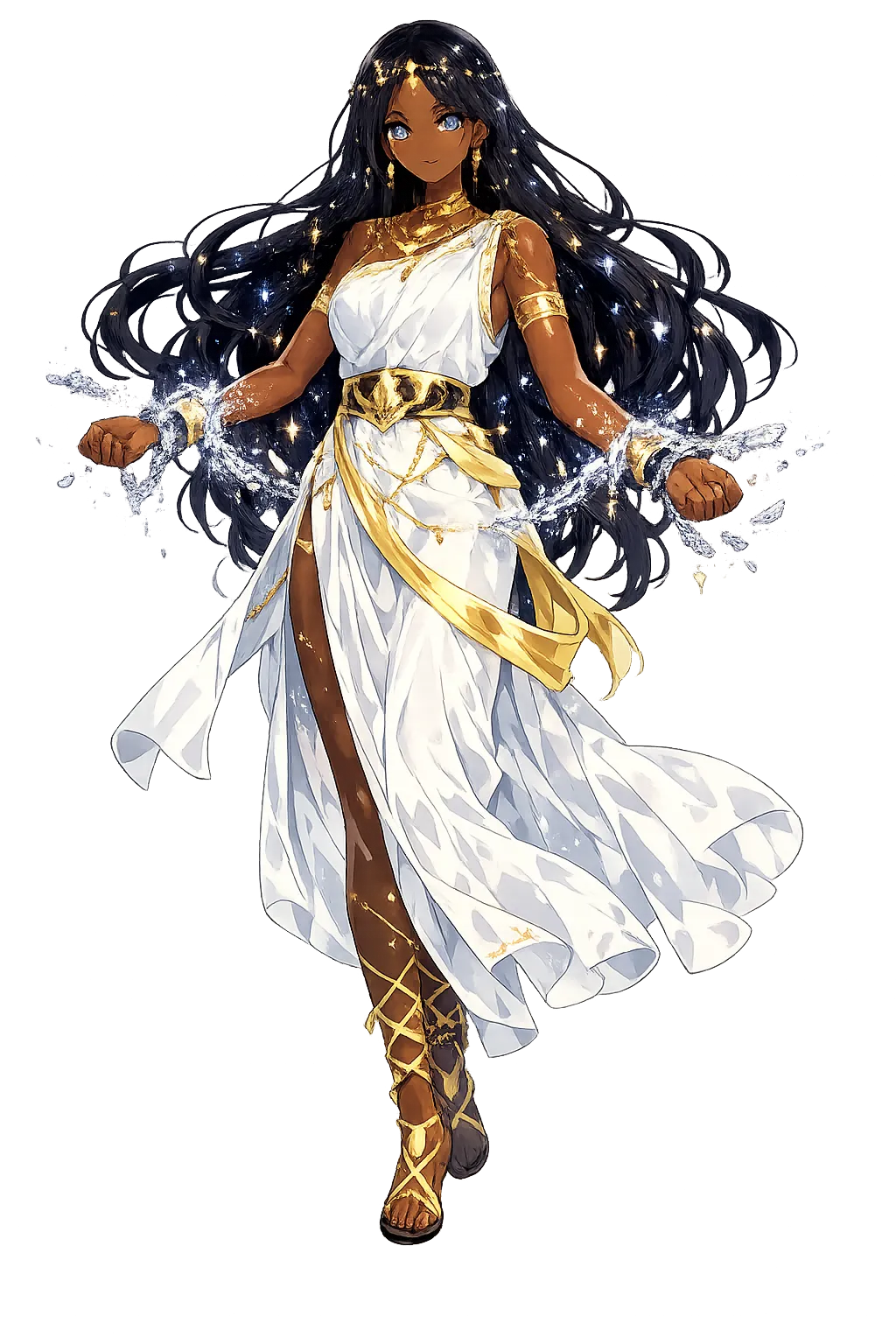
PuniCodex

Extended Lore

Ἀνδρομέδη Andromedē

Etymology · Orthography · Cult · Iconography · Reception · Sources

Tier 1 Andromedē.com
Andromedē — Princess, Chained, Rescued by Perseus
01

Quick Facts

Essential information about Andromedē, Princess, Chained, Rescued by Perseus

Original ScriptἈνδρομέδη
Unicode RestorationAndromedē
Reconstructed Pronunciation/an.dro.mé.dɛː/
PantheonGreek
DomainPrincess, Chained, Rescued by Perseus
MeaningRuler of men
ClassificationTier 1
Primary DomainAndromedē.com
Sacred SymbolsSea-rock and chains, Mirror of Kassiepeia, Head of Medousa, Wedding crown
02

Etymology & Word Family

From original script to Unicode restoration

Original Script Ἀνδρομέδη Andromedē — "Ruler of men"
Unicode Restoration Andromedē Restored stress, length, and script
Modern ASCII andromeda Plain-ASCII fallback

The name Andromedē carries the orthographic signature of the greek tradition: Ἀνδρομέδη. Unicode restoration recovers what ASCII flattens.

03

Unicode Character Breakdown

Character-by-character philological analysis

CharacterUnicodeNameBlockPhonetic Role
AU+0041Latin Capital Letter ABasic LatinSame
nU+006ELatin Small Letter NBasic LatinSame
dU+0064Latin Small Letter DBasic LatinSame
rU+0072Latin Small Letter RBasic LatinSame
oU+006FLatin Small Letter OBasic LatinSame
mU+006DLatin Small Letter MBasic LatinSame
eU+0065Latin Small Letter EBasic LatinSame
dU+0064Latin Small Letter DBasic LatinSame
ēU+0113Latin Small Letter E with MacronLatin Extended-AMacron: long eta

The Tier 1 classification reflects how much of the original phonology this restoration preserves — stress and vowel length for Greek names, distinctive letters and diacritics for every other tradition.

04

Cult & Worship

How the sacred was kept — rites, sanctuaries, remains

The Cult

No sanctuary, festival or priesthood for Andromédē is attested anywhere in Greek religion; she is a heroine of story, not a power of cult. What the evidence gives instead is geography and stars. The city of Joppa — modern Jaffa — claimed her rock in antiquity, and travelers were shown a sea-cliff bearing the marks of chains well into the Roman and medieval periods; ancient writers already treat the identification as local promotion rather than fact. Herodotus, with a historian's interest, folds her into genealogy: through her son Persēs she becomes the ancestress of the Persian kings, a claim the Persians themselves reportedly repeated (7.61, 7.150). And the catasterism served as her immortal rite: Eratosthenes and Hyginus record the constellation as the memorial that replaced worship. Her cult, in short, is written in star-catalogues and itinerary notes — the honors of a story that never needed an altar.

In the Earth

The myth of Andromeda was popular in Greek and Roman visual culture. Painted vases show Perseus approaching the chained maiden; Roman wall paintings and sarcophagi reproduce the rescue scene. The constellation was mapped by Ptolemy and transmitted through Arabic and Renaissance star catalogs. No single archaeological site claims to be her rock, though Joppa (modern Jaffa) was identified with the location in antiquity.

05

Iconography

How Andromedē was imaged across the ages

The Image

The chained princess is among antiquity's most loved images, and the scheme was fixed early: a pale maiden against dark rock, arms raised or bound, Perseus descending with harpe and kibisis, the ketos breasting the foam. Corinthian and Attic painters of the sixth century BCE carried the scene across the Greek world, and on fifth-century Attic vases her rigid, frontal pose — a kōrē transplanted to a cliff — is exactly what Ovid later verbalizes: a statue but for the wind in her hair and the tears on her cheeks. Etruscan urns, Pompeian frescoes and Roman sarcophagi repeated the trio for six centuries; the painted version from the House of the Dioscuri at Pompeii, now in Naples, preserves the full cast. Only the monster changes much, growing from a seal-bodied beast into a crocodilian dragon. The maiden barely changes at all: from first appearance to last, Andromédē is the still point of the image — exposed, unrescued, waiting.

06

Reception & Transformation

The name after its own age — transmission, translation, survival

Afterlives

Andromédē entered literature through lost masterworks. Sophocles wrote an Andromeda, and Euripides' tragedy of 412 BCE survives in the famous fragment where the bound princess apostrophizes the night — a lament coeval with the universe — one of antiquity's most quoted monologues. Ovid's retelling in Metamorphoses 4–5 became the medieval and Renaissance pipeline: the Ovide Moralisé folded her into Christian allegory, and illustrated Ovid manuscripts kept the rock, the chains and the monster circulating in every literate court. In the visual arts the rescue became a princely set-piece — Piero di Cosimo, Titian (c. 1554–56, London), Veronese and Rubens all painted her, drawn by the same trio of maiden, hero and monster that had sold vases in the sixth century BCE. In the sky her journey was steadier: Ptolemy catalogued the constellation, Arabic astronomers named her al-mar'ah al-musalsalah, 'the chained woman', and Renaissance star atlases from Bayer onward engraved her with her chains — where, untouched by any rescuer, she still waits.

Identifications Across Traditions

The Romans adopted Andromeda without renaming her; she is one of the few Greek mythic figures to enter Latin poetry under her original form. In the Middle Ages and Renaissance she became an emblem of rescue, feminine beauty in distress, and the redemptive hero. Modern astronomy keeps her constellation and galaxy names intact. Some scholars compare her Near Eastern analogues — the exposed princess, the sea-monster combat — but the Greek narrative is distinctively tied to Perseus and the Argolid-Persian genealogy.

Modern Legacy

Andromeda is the archetype of the damsel in distress and the catasterized heroine. From Titian and Rubens to Victorian painting and modern fantasy, her image persists: the chained woman, the arriving savior, the monster from the deep. The Andromeda Galaxy, 2.5 million light-years away, carries her name into astrophysics, making her one of the few Greek figures whose cultural reach extends beyond the solar system.

07

The Meditation

What Andromedē means — beyond the dictionary

Andromeda is not a willing victim; she is the price of someone else's pride. Her passivity on the rock is not weakness but the consequence of a cosmic transaction in which she had no voice. The myth therefore asks us to look at the people sacrificed to appease forces they did not create.

Yet her rescue is also the myth's redemption. Perseus does not merely slay the monster; he sees her, chooses her, and makes her his equal in marriage. In that moment, the object of sacrifice becomes a queen and a star. Andromeda reminds us that dignity can survive exposure, and that the gaze that recognizes suffering can also transform it.

08

Screen & Culture

Where Andromedē echoes through film, television, and games — and how

09

Frequently Asked Questions

Common questions about Andromedē, Princess, Chained, Rescued by Perseus, and Unicode restoration

01How do you pronounce Andromedē?

In reconstructed pronunciation, Andromedē is /an.dro.mé.dɛː/ — approximately 'ahn-dro-MAY-day' — the third syllable is pitched and drawn out; the final -ē is long.

02What does Andromedē mean?

Andromedē means Ruler of men in the greek tradition.

03What are the symbols of Andromedē?

Andromedē is associated with Sea-rock and chains (Her exposure to the ketos and the vulnerability of innocence before power), Mirror of Kassiepeia (The boast that set the myth in motion: her mother's claim to surpass the Nereids), Head of Medousa (The weapon Perseus carries when he rescues her — and turns back her own kinsmen), Wedding crown (Her marriage to Perseus and catasterism into the northern sky).

04Why are there different spellings of Andromedē?

Each form is a historically attested restoration rather than a mistake: Andromédē is the ideal form (Acute on the stressed short vowel, matching Greek Ἀνδρομέδη; preserves stress where the canonical macron-only form records length only.). PUNICODEX registers the full set so the tradition is preserved under every defensible spelling.

05Why restore Andromedē in Unicode?

Plain ASCII andromeda strips the stress, length, and script that make the name specific. Unicode restoration returns the name to its original written dignity.

06What is the most important myth about Andromedē?

“The Queen Who Rivaled the Nereids” — the The Boast story that anchors the mythology of Andromedē, told in full on the lore page.

10

Scholarly Sources

The philological foundations of this restoration

Every claim on this page is grounded in established scholarship. The orthographic restorations follow disciplinary convention. The etymological chain follows the best available reference works. This is not invention — it is resurrection through scholarship.

◈

Lexicography & Philology

  • Liddell, H. G., Scott, R., & Jones, H. S. A Greek-English Lexicon. Oxford: Clarendon Press, 9th ed. 1996.
  • Pape, W., & Benseler, G. E. Wörterbuch der griechischen Eigennamen. Braunschweig: Vieweg, 1884.
  • Beekes, R. S. P. Etymological Dictionary of Greek. Leiden: Brill, 2010.
◎

Primary Texts

  • Apollodorus, Bibliotheca 2.4.3–5
  • Ovid, Metamorphoses 4.663–5.249
◉

Archaeology & Art History

  • Material evidence — iconography, inscriptions, and temple archaeology — for Andromedē and related cults.
✦

Religious Studies

  • Hyginus, De Astronomica 2.11
  • Eratosthenes, Catasterismi
  • Herodotus 7.61, 7.150
Return

The Surface Awaits

You have traced the name from its earliest attestation to its Unicode restoration. Now return to the myth. The story is where the name lives.

Back to Lore
Andromedē mascot