
Amoghasiddhi: the stories first, then the spelling
You cannot weigh an accent without knowing what it carries. Here is what Amoghasiddhi has been carrying.
The Stories That Carry the Name
The Fifth from the One. The Sarva-tathāgata-tattva-saṅgraha — 'The Compendium of the Reality of All the Thus-Gones' — is the great tantra of the late eighth century from which the five-Buddha system descends. It organizes the Buddhas as a mandala: Vairocana at the center, and four Jinas in the quarters — Akṣobhya east, Ratnasambhava south, Amitābha west, Amoghasiddhi north. Each rules a family (kula) and transmutes a poison into its mirror-virtue: anger becomes mirror-like wisdom, pride becomes equality, desire becomes discernment, and, for Amoghasiddhi, envy becomes all-accomplishing wisdom (kṛtyānuṣṭhāna-jñāna).
The Subduing of Maheśvara. The tantra stages its founding drama in the karma family's own theater. The worldly gods, led by Maheśvara — Śiva enthroned on Mount Meru with his consort and his host — defy the Buddha's law and oppress the beings under their rule. Vajrapāṇi, first among the karma-family beings, descends to the summit, binds Maheśvara with his noose, and tramples him underfoot; and where a lesser story would end in destruction, this one ends in conscription — the conquered god accepts initiation and becomes a guardian of the very mandala that broke him (STTS; Snellgrove, Indo-Tibetan Buddhism, reads the episode as the tantric appropriation of Śiva).
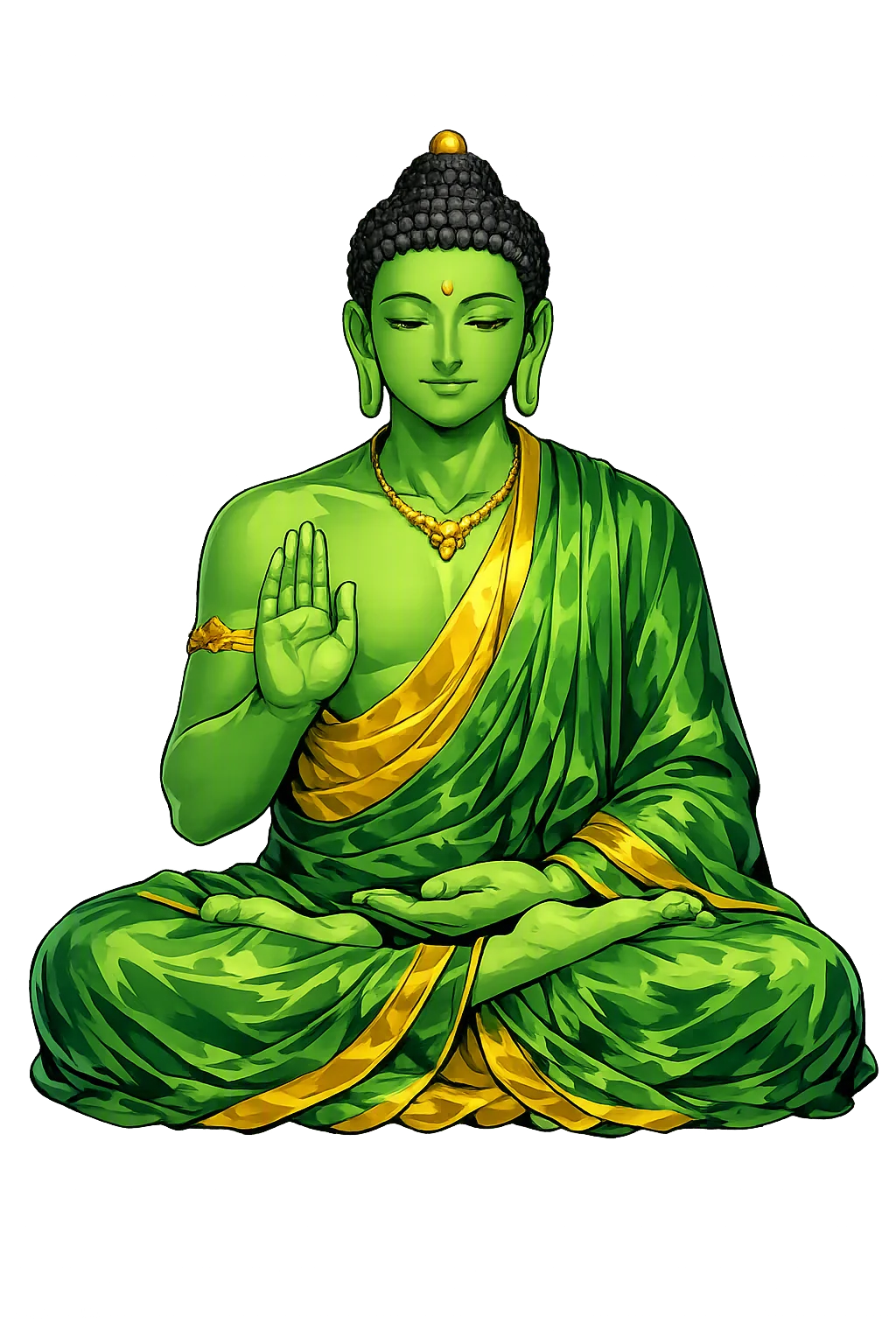
The Hand That Answers Fear. Amoghasiddhi's right hand is raised, palm outward — the abhaya mudrā, the gesture of fearlessness. The iconographic manuals of Nepal and Tibet prescribe it for him alone of the five, with the left hand resting in the lap, and the Vinaya tradition supplied the gesture's biography: when Devadatta loosed the maddened elephant Nālāgiri against the Buddha, the beast came trumpeting down the road of Rājagṛha and knelt before the raised hand, tamed by an empty palm (Cullavagga 7. 4; the Dhammapada commentary tells it fully).
And Here Is What the Spelling Preserves
At a Glance
- Restored name: Amoghasiddhi
- ASCII form: amoghasiddhi
- Meaning: "'Unfailing Accomplishment' — the fifth Dhyānibuddha, lord of the karma family"
- Domain of influence: Infallible Success, North
- Pantheon: Buddhist
- Classification: Tier 2
- Original script: अमोघसिद्धि
- Series: The Restoration Files, No. 26 of 548
The Name Travels
Amoghasiddhi's closest relative is Śiva, in a relationship of deliberate supersession: the root tantra has Vajrapāṇi of the karma family subdue Maheśvara on Mount Meru and trample him into the mandala as its guardian — conquest written as conversion. In East Asia the five-Buddha mandala traveled with esoteric Buddhism: in the Shingon school of Japan, Amoghasiddhi appears as Fukūjōju Nyorai, the 'Tathāgata of Infallible Success', enthroned in the north of the Diamond-Realm mandala preserved in the ninth-century scrolls of Tō-ji.
The Address It Earned
The temple of Amoghasiddhi stands at /amoghasiddhi/ — lore, scholars, patterns — because a name carrying this much story deserves more than a parking page. Tier-2 here means one preserved truth — not less important, just singular. The temple shows it and names it.
The Sources Are Open
The myths above are retold from the temple's record; the primary voices are in the Sacred Texts: Lotus Sutra and Sukhāvatīvyūha Sūtras. Nothing in this file outranks them.
The File Continues
Read the founding dispatch for the name's full story, the Resonance File for the archetype at work — or the whole archive in one sitting.
Continue the series — previous file: Amitābha (read it here) · next file: Aṃśa (read it here).
The Restoration Files are written from the same canonical record as the temples themselves: the lexicon, the lore catalog, the pattern atlas, and the cited scholarly sources. If a file ever disagrees with its temple, the temple is right — tell us, and the file will be corrected.