The Living Myth
Infallible Success, North · 'Unfailing Accomplishment' — the fifth Dhyānibuddha, lord of the karma family
Stories of Amoghasiddhi
Amoghasiddhi has no biographical myths — he was never born, never walked the earth, never died. He belongs to the tantric synthesis of the early medieval period, when Mahāyāna Buddhism organized its meditation Buddhas into a mandala of five. His stories are the ritual and iconographic programs that grew around his name from the eighth century on, above all in the Sarva-tathāgata-tattva-saṅgraha, the root tantra of the system.
The Sarva-tathāgata-tattva-saṅgraha — 'The Compendium of the Reality of All the Thus-Gones' — is the great tantra of the late eighth century from which the five-Buddha system descends. It organizes the Buddhas as a mandala: Vairocana at the center, and four Jinas in the quarters — Akṣobhya east, Ratnasambhava south, Amitābha west, Amoghasiddhi north. Each rules a family (kula) and transmutes a poison into its mirror-virtue: anger becomes mirror-like wisdom, pride becomes equality, desire becomes discernment, and, for Amoghasiddhi, envy becomes all-accomplishing wisdom (kṛtyānuṣṭhāna-jñāna). Note what his name does that the others' do not: while Akṣobhya, Ratnasambhava, and Amitābha are described by what they are — unshakable, jewel-born, infinite light — Amoghasiddhi is described by what he does. The name is the system's only promise: it does not fail.
The tantra stages its founding drama in the karma family's own theater. The worldly gods, led by Maheśvara — Śiva enthroned on Mount Meru with his consort and his host — defy the Buddha's law and oppress the beings under their rule. Vajrapāṇi, first among the karma-family beings, descends to the summit, binds Maheśvara with his noose, and tramples him underfoot; and where a lesser story would end in destruction, this one ends in conscription — the conquered god accepts initiation and becomes a guardian of the very mandala that broke him (STTS; Snellgrove, Indo-Tibetan Buddhism, reads the episode as the tantric appropriation of Śiva). It is a theological conquest, not a defeat: the powers of the older religion are neither destroyed nor tolerated but converted into doorkeepers. The karma family's first recorded action is the transformation of an enemy into a function.
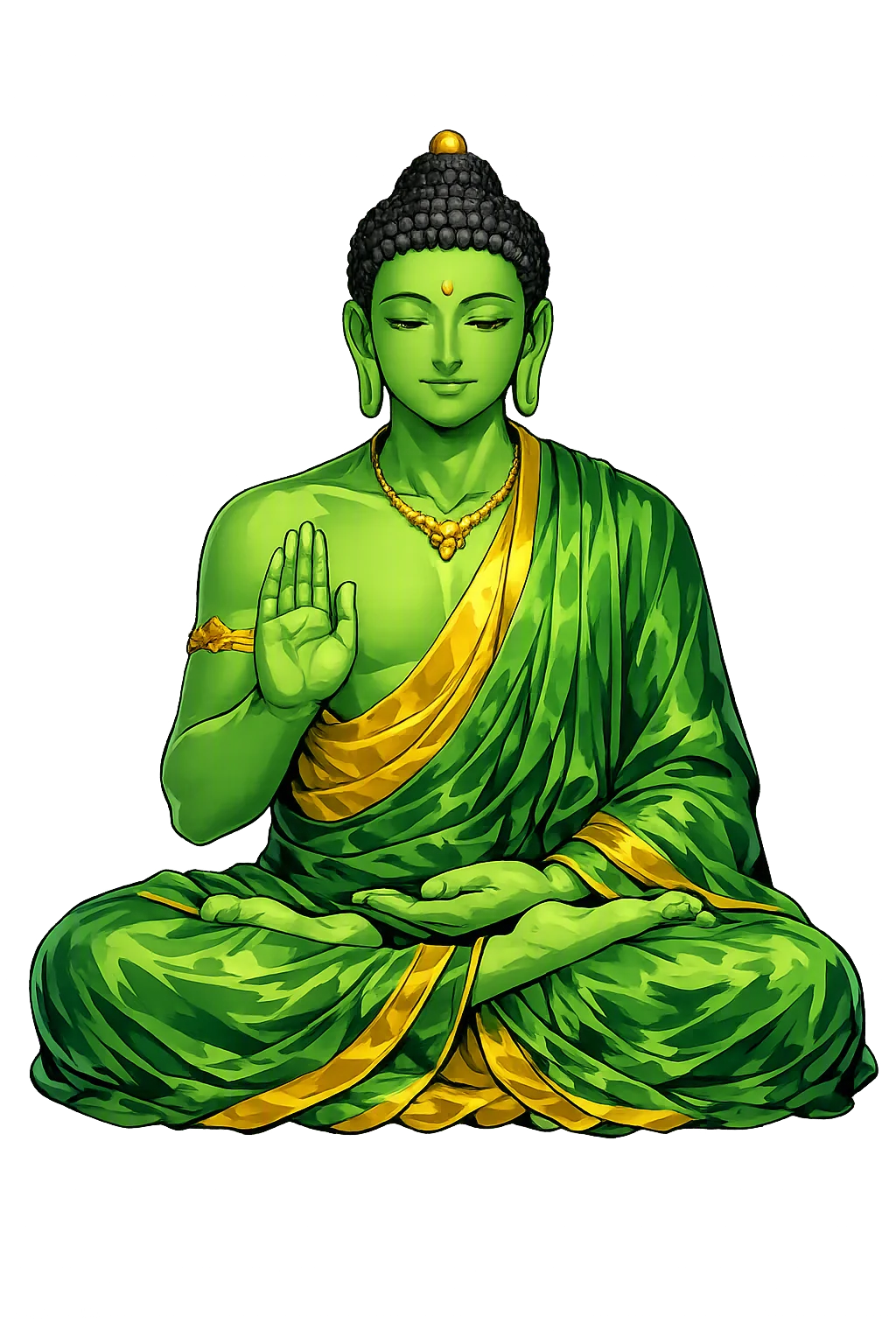
Amoghasiddhi's right hand is raised, palm outward — the abhaya mudrā, the gesture of fearlessness. The iconographic manuals of Nepal and Tibet prescribe it for him alone of the five, with the left hand resting in the lap, and the Vinaya tradition supplied the gesture's biography: when Devadatta loosed the maddened elephant Nālāgiri against the Buddha, the beast came trumpeting down the road of Rājagṛha and knelt before the raised hand, tamed by an empty palm (Cullavagga 7.4; the Dhammapada commentary tells it fully). Later commentators attached the same gesture to Amoghasiddhi's northern quarter, the karma family, whose whole business is action in a frightened world. The meaning is exact and inverse to what we expect of power: a Buddha does not answer threat by closing his fist but by opening his hand — and the threat disarms itself. Fearlessness, in this iconography, is not the absence of danger but the refusal to return it.
The iconographic manuals complete him. Green, the color of ripening action; the wind (vāyu) as his element, the deed carried to its object; autumn as his season, the harvest of effort; a throne borne by garuḍas, the sovereign birds; his consort Samayatārā — the great Green Tārā herself absorbed into the family scheme — and his bodhisattva Viśvapāṇi, 'he whose hand is everywhere'; his northern paradise named, in the ritual texts, Karmaprasiddhi, the fulfillment of action. In the painted mandalas of the Kathmandu Valley and Tibet he sits at the northern gate of the assembly, and it is his family — karma, action — that governs the rites by which the practitioner consecrates the ground, draws the lines, and performs the offerings. Everything about him is oriented toward completion. Where the western Jinas preside over seeing and becoming, the northern one presides over finishing: Amoghasiddhi is the Buddha of the finished work.
Infallible Success
Amoghasiddhi — 'Unfailing Accomplishment' — is the fifth of the Five Meditation Buddhas (Dhyānibuddhas), lord of the karma family and sovereign of the mandala's northern quarter. Where his companions preside over insight, anger, pride, and desire, he presides over action itself: the wisdom that completes what is begun. His raised palm answers fear; his green body, the color of ripening, promises that no honest effort is wasted.
Lord of the karma family and bearer of all-accomplishing wisdom — the knowledge that finishes what is begun.
He occupies the northern quarter of the mandala, body the color of dusk-lit emerald, his element the wind that carries the deed.
His right hand raised in abhaya mudrā — the open palm that answers fear with the promise that no effort is wasted.
The affliction of envy — frozen, comparative, sterile — becomes under his gaze the energy of benevolent action for others.
From the original script to the living URL
अमोघसिद्धि
The name in its original Buddhist form. Amoghasiddhi (अमोघसिद्धि) is attested in the source tradition — “'Unfailing Accomplishment' — the fifth Dhyānibuddha, lord of the karma family”. Its original diacritics and script distinctions carry the full phonetic and orthographic weight of the source tradition.
amoghasiddhi
The plain amoghasiddhi form is identical to the Unicode restoration. Because this name is already written in Latin letters, no diacritics, stress, or script information were lost — only capitalization differs.
Amoghasiddhi
The Unicode restoration does not need to recover lost marks for Amoghasiddhi. Its value is canonical spelling and consistent cataloguing, not the reconstruction of erased orthography. The domain is readable as-is to both DNS and humanity.
Amoghasiddhi.com
This restoration is written entirely in ASCII letters — no Punycode encoding stands between Amoghasiddhi and the DNS. The domain reads identically to machines and to human eyes.
Owned, ideal, and ASCII forms of Amoghasiddhi
Amoghasiddhi
Restores अमोघसिद्धि. The full Unicode restoration. amoghasiddhi.com is not in the PuniCodex collection — it is watched for release; if it drops, this temple upgrades to an owned flagship.
How Amoghasiddhi was spoken
How Amoghasiddhi travels from ancient script to the modern URL
The lore you have read is the living myth. Extended Lore opens the scholarly vault beneath it: the cult and its material remains, a history of the image, the name after antiquity, a meditation on what the name still means, and the full scholarly apparatus — etymology, orthography, sources.
Enter Extended Lore