PuniCodex

Extended Lore

अमोघसिद्धि Amoghasiddhi

Etymology · Orthography · Cult · Iconography · Reception · Sources

Tier 2 Amoghasiddhi
Amoghasiddhi — Infallible Success, North
01

Quick Facts

Essential information about Amoghasiddhi, Infallible Success, North

Original Scriptअमोघसिद्धि
Unicode RestorationAmoghasiddhi
Reconstructed Pronunciation/amoghasiddhi/
PantheonBuddhist
DomainInfallible Success, North
Meaning'Unfailing Accomplishment' — the fifth Dhyānibuddha, lord of the karma family
ClassificationTier 2
Primary DomainAmoghasiddhi
Sacred SymbolsThe double vajra (viśvavajra), The abhaya mudrā, The garuḍa throne-bearers, Green, The wind (vāyu)
02

Etymology & Word Family

From original script to Unicode restoration

Original Script अमोघसिद्धि Amoghasiddhi — "'Unfailing Accomplishment' — the fifth Dhyānibuddha, lord of the karma family"
Unicode Restoration Amoghasiddhi Canonical scholarly spelling — ASCII-identical
Modern ASCII amoghasiddhi Plain-ASCII fallback

The name Amoghasiddhi reaches the modern world through scholarly transliteration of the buddhist tradition. Because the conventional spelling uses only Latin letters, its Unicode and ASCII forms coincide — the tradition it carries is in the name itself, not in diacritics.

03

Unicode Character Breakdown

Character-by-character philological analysis

CharacterUnicodeNameBlockPhonetic Role
AU+0041Latin Capital Letter ABasic LatinSame, capitalized
mU+006DLatin Small Letter MBasic LatinSame
oU+006FLatin Small Letter OBasic LatinSame
gU+0067Latin Small Letter GBasic LatinSame
hU+0068Latin Small Letter HBasic LatinSame
aU+0061Latin Small Letter ABasic LatinSame
sU+0073Latin Small Letter SBasic LatinSame
iU+0069Latin Small Letter IBasic LatinSame
dU+0064Latin Small Letter DBasic LatinSame
hU+0068Latin Small Letter HBasic LatinSame
iU+0069Latin Small Letter IBasic LatinSame

The Tier 2 classification here reflects fidelity to the attested tradition, not recovered diacritics: every character of Amoghasiddhi already survives in ASCII. What the restoration preserves is the canonical spelling itself — the form scholarship standardised.

04

Cult & Worship

How the sacred was kept — rites, sanctuaries, remains

The Cult

There are no temples of Amoghasiddhi and probably never were; his worship is entirely ritual-generic. He is invoked as one of the five, never alone: in the consecrations (abhiṣeka) of Indian tantra, in the Newar Buddhist ritual year of the Kathmandu Valley where painted sets of the five Buddhas are carried around the viharas, in the refuge visualization of Tibetan preliminary practice, and in the mantra-and-mudra cycles of Japan's Shingon school, where as Fukūjōju Nyorai he occupies the northern gate of the Kongōkai mandala at Tō-ji. The fire offerings performed in his family dedicate the merit of action itself. If this seems a thin personal cult, the tradition would answer that it is not thinness but definition: a Buddha whose name means accomplishment that does not fail is honored precisely by finishing rites.

In the Earth

There are no ancient temples of Amoghasiddhi, no inscriptions naming him, no early coins: he appears first in manuscript and image. Palm-leaf copies of the Sarva-tathāgata-tattva-saṅgraha survive among the Newar Buddhist manuscripts of the Kathmandu Valley, and his figure becomes canonical in paubha painting from the twelfth century and in Tibetan thangkas from the thirteenth, where the five Buddhas crown the registers of monastery murals across the Himalaya. In East Asia the ninth-century Tō-ji mandala scrolls preserve him as Fukūjōju in the Kongōkai, among the oldest monumental images of the system. His material record is therefore neither a site nor a relic but a genre — the painted mandala, portable and reproducible, in which the north never lacks its green Buddha.

05

Iconography

How Amoghasiddhi was imaged across the ages

The Image

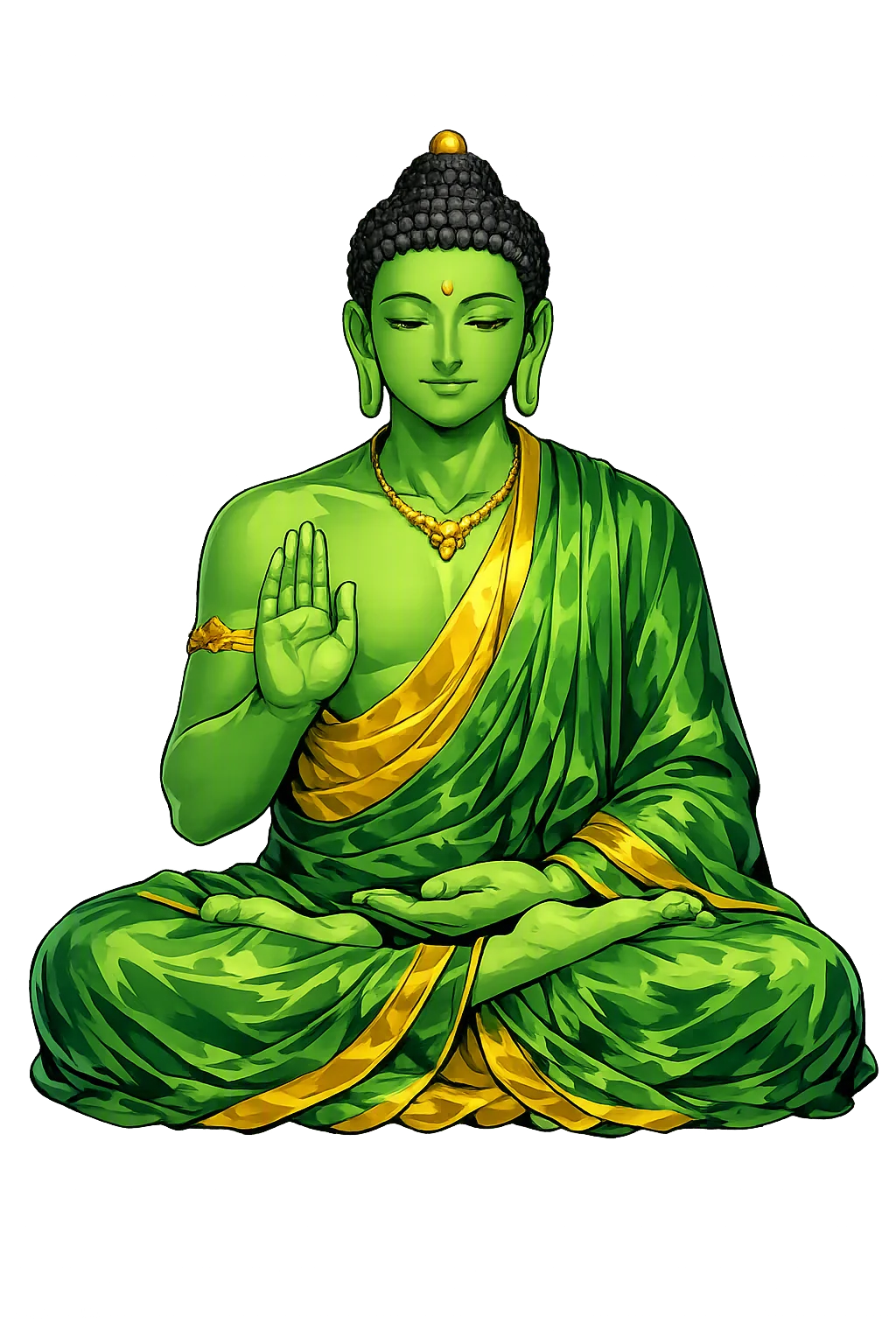
His image is a checklist of one promise: a green body, the right hand raised palm-out in abhaya — fear not — the left resting in meditation, seated on a throne supported by garuḍas, stamped beneath with the crossed double vajra. The Sarva-tathāgata-tattva-saṅgraha cycle of the late eighth century fixes the scheme, and the later iconographic manuals of India transmit it; East Asian esotericism adds the garuḍa-bearing throne-bearers. The oldest monumental set is Chinese-Japanese: Kūkai brought the Kongōkai (Vajradhātu) mandala home from Chang'an in 806, and the ninth-century Tō-ji scrolls in Kyoto preserve him as Fukūjōju. From the thirteenth century, Tibetan thangkas and Newar paubhas repeat him so faithfully that any devotee can read the northern gate at a glance — green, unchanging, hand open. Few icons in world art have varied less across a thousand years; that constancy is his biography.

06

Reception & Transformation

The name after its own age — transmission, translation, survival

Afterlives

Amoghasiddhi entered history with the tantric synthesis: the Guhyasamāja Tantra and above all the Sarva-tathāgata-tattva-saṅgraha (late eighth century) organized the Buddhas into the fivefold mandala, and the Mañjuśrīnāmasaṃgīti versified the pentad for recitation. The system passed into Tibet with the later translation movement, where his northern seat became a fixture of monastery murals and ritual manuals from the eleventh century onward. East Asia received a different branch: the Vajradhātu mandala was carried from Chang'an to Japan by Kūkai in 806, and Shingon practice has kept his name in the Kongōkai rites at Tō-ji and Kōya-san ever since. Europe discovered him late and indirectly, through museum collections and the great iconographic handbooks: Alice Getty's The Gods of Northern Buddhism (1914) described him for English readers, and Bhattacharyya's studies with Snellgrove's Indo-Tibetan Buddhism (1987) gave him scholarship. Twentieth-century psychology added an afterlife he never sought when Jung's studies of mandala symbolism made the five-Buddha diagram famous far beyond Buddhism — the green northern Buddha quietly included in every reproduction.

Identifications Across Traditions

Amoghasiddhi's closest relative is Śiva, in a relationship of deliberate supersession: the root tantra has Vajrapāṇi of the karma family subdue Maheśvara on Mount Meru and trample him into the mandala as its guardian — conquest written as conversion. In East Asia the five-Buddha mandala traveled with esoteric Buddhism: in the Shingon school of Japan, Amoghasiddhi appears as Fukūjōju Nyorai, the 'Tathāgata of Infallible Success', enthroned in the north of the Diamond-Realm mandala preserved in the ninth-century scrolls of Tō-ji. His consort Samayatārā is simply the Green Tārā absorbed into the five-Buddha family scheme, so that the most beloved goddess of Tibetan devotion is also, doctrinally, his wisdom made feminine. Modern Western reception has been quieter than for his companions: he is known chiefly through museum galleries and meditation literature, where his name circulates as a compact promise — that accomplishment pursued without vanity does not fail.

Modern Legacy

Amoghasiddhi's legacy is liturgical rather than narrative, and vast in that register. He presides over the top registers of countless Nepalese paubha paintings and Tibetan thangkas, where his image is among the most standardized in Himalayan art — green, right hand raised, seated on a throne borne by garuḍas. In Japan the esoteric schools chant his mantra within the Kongōkai mandala rites performed at Tō-ji and Kōya-san since the ninth century, and Fukūjōju remains a familiar presence in temple statuary from Nara to Kamakura. His doctrine survives as a compact psychology: envy — the conviction that others accomplish while I do not — is transmuted into all-accomplishing action, because karma performed for others cannot fail. In contemporary dharma centers his name is invoked less often than Tārā's, but it answers a question hers does not: whether the effort itself is worth anything. His name is the vow that it is.

07

The Meditation

What Amoghasiddhi means — beyond the dictionary

Every tradition personifies its favorite anxiety. The Greeks made a goddess of ruin, the Norse of old age; Buddhism personified the fear of wasted effort. Amoghasiddhi is the answer to the question every practitioner asks in the dark middle of the work: is any of this actually working? His name is the vow — not vain, not useless, infallible.

Look at what his assigned affliction is: envy, the poison of comparison, the certainty that accomplishment lives in other people's hands. His teaching does not suppress that energy; it redirects it, because all-accomplishing wisdom acts for others, and action done selflessly for others cannot fail — there is no one left for it to fail in front of. The raised hand is not a trophy. It is a promise made to the frightened, by the one Buddha whose name is not a description but a guarantee.

08

Frequently Asked Questions

Common questions about Amoghasiddhi, Infallible Success, North, and Unicode restoration

01How do you pronounce Amoghasiddhi?

In reconstructed pronunciation, Amoghasiddhi is /amoghasiddhi/ — approximately Say 'amoghasiddhi' with the stress and length implied by the scholarly restoration 'Amoghasiddhi'.

02What does Amoghasiddhi mean?

Amoghasiddhi means 'Unfailing Accomplishment' — the fifth Dhyānibuddha, lord of the karma family in the buddhist tradition.

03What are the symbols of Amoghasiddhi?

Amoghasiddhi is associated with The double vajra (viśvavajra) (The crossed thunderbolt stamped on his throne base — unshakeable means, doubled for the four directions, the karma family's seal.), The abhaya mudrā (The raised right hand, palm outward: fearlessness offered as a teaching, not brandished as a triumph.), The garuḍa throne-bearers (The sovereign birds that carry his seat in the iconographic manuals — emblems of power subdued and enlisted.), Green (His body-color in the five-Buddha system: the hue of ripening action, of autumn and of deeds coming to fruit.), The wind (vāyu) (His element — movement and transmission, the deed carried outward to its object; he is the least static of the five.).

04Why restore Amoghasiddhi in Unicode?

Amoghasiddhi is written entirely in ASCII letters, so its restoration is about canonical fidelity rather than recovered diacritics: the temple fixes the name in its scholarly standard spelling, attested in the source tradition, instead of leaving it to drift.

05What is the most important myth about Amoghasiddhi?

“The Fifth from the One” — the Doctrine story that anchors the mythology of Amoghasiddhi, told in full on the lore page.

09

Scholarly Sources

The philological foundations of this restoration

Every claim on this page is grounded in established scholarship. The orthographic restorations follow disciplinary convention. The etymological chain follows the best available reference works. This is not invention — it is resurrection through scholarship.

◈

Lexicography & Philology

  • Vajrayana texts
  • Buddhist texts
◎

Primary Texts

  • The Larger Sukhāvatī-vyūha Sūtra; the Smaller Sukhāvatī-vyūha Sūtra; the Amitāyurdhyāna Sūtra; the Lotus Sūtra.
◉

Archaeology & Art History

  • Alice Getty, The Gods of Northern Buddhism: Their History, Iconography and Progressive Evolution through the Northern Buddhist Countries (Oxford University Press, 1914) — the classic iconographic reference for Amoghasiddhi's green body, abhaya mudrā, and double-vajra throne.
✦

Religious Studies

  • Guhyasamāja Tantra, ch. III — the earliest systematic tantric mandala of the five Dhyānibuddhas, naming Amoghasiddhi in the northern seat of the karma family.
  • Sarvatathāgatatattvasaṃgraha (Tattvasaṃgraha Tantra) — the paradigmatic narrative of the five tathāgatas' subjugation of the unruly forces, with Amoghasiddhi presiding over the north, the wind element, and all-accomplishing wisdom.
  • Mañjuśrīnāmasaṃgīti, v. 8 — the liturgical verse naming the five tathāgatas (Vairocana, Akṣobhya, Ratnasambhava, Amitābha, Amoghasiddhi) that underlies the whole pentad system.
  • Benoytosh Bhattacharyya, An Introduction to Buddhist Esoterism (Oxford University Press, 1932) — early scholarly exposition of the five Dhyānibuddhas and the karma family.
  • David L. Snellgrove, Indo-Tibetan Buddhism: Indian Buddhists & Their Tibetan Successors (Shambhala, 1987) — standard modern account of the tantric Buddha-family system from which Amoghasiddhi's iconography derives.
  • John C. Huntington & Dina Bangdel, The Circle of Bliss: Buddhist Meditational Art (Columbus Museum of Art / Serindia, 2003) — museum exhibition catalogue documenting Amoghasiddhi and the five Buddha families in Indian and Tibetan art.
Return

The Surface Awaits

You have traced the name from its earliest attestation to its Unicode restoration. Now return to the myth. The story is where the name lives.

Back to Lore
Amoghasiddhi mascot