PuniCodex

Extended Lore

Amaterasu — The Deeper Record

Etymology · Orthography · Cult · Iconography · Reception · Sources

ASCII-equivalent form Amaterasu
Amaterasu — Sun Goddess, Shintō
01

At a Glance

Amaterasu — every fact links to its home

PantheonJapanese
DomainSun Goddess, Shintō
Attested690 CE
Original Script天照 →
Primary Sources4 cited →
02

Etymology & Word Family

From original script to canonical restoration — the full etymology page →

Original Script 天照 Amaterasu — "Sun goddess in Shinto"
Canonical Restoration Amaterasu Canonical scholarly spelling — ASCII-identical
Modern ASCII amaterasu Plain-ASCII fallback

The name Amaterasu reaches the modern world through scholarly transliteration of the japanese tradition. Because the conventional spelling uses only Latin letters, its canonical and ASCII forms coincide — the tradition it carries is in the name itself, not in diacritics.

03

Character breakdown

Character-by-character philological analysis

CharacterUnicodeNameBlockPhonetic Role
AU+0041Latin Capital Letter ABasic LatinSame
mU+006DLatin Small Letter MBasic LatinSame
aU+0061Latin Small Letter ABasic LatinSame
tU+0074Latin Small Letter TBasic LatinSame
eU+0065Latin Small Letter EBasic LatinSame
rU+0072Latin Small Letter RBasic LatinSame
aU+0061Latin Small Letter ABasic LatinSame
sU+0073Latin Small Letter SBasic LatinSame
uU+0075Latin Small Letter UBasic LatinSame

This restoration reflects fidelity to the attested tradition, not recovered diacritics: every character of Amaterasu already survives in ASCII. What the restoration preserves is the canonical spelling itself — the form scholarship standardised.

04

Cult & Worship

How the sacred was kept — rites, sanctuaries, remains

The Cult

Amaterasu is worshipped at Ise not before a statue but within her dwelling: the yata mirror is her shintai, kept in the Inner Shrine and never displayed. Her cult is the most continuous in Japan — the shikinen-zōtai renewal every twenty years rehouses rather than repairs her sanctuary, a rite documented from 690 CE. The court kept her liturgy: the Kannamesai in October presents the first fruits of the new rice, and the Engishiki prescribes the offerings of cloth (heihaku) sent from the palace twice yearly. From the seventh century an unmarried imperial princess, the Saiō, served at Ise on the throne's behalf — a living priesthood that continued into the fourteenth century. Beyond the court, her cult became everyone's: okage mairi mass pilgrimages to Ise swept the country in 1705, 1771, and 1830, and the household kamidana keeps her name daily.

In the Earth

The Ise Grand Shrine (Mie Prefecture) is Amaterasu's principal dwelling: its Inner Shrine (Kōtai Jingū), traditionally founded in the reign of Suinin (1st century BCE), is rebuilt every twenty years (shikinen-zōtai) on alternating adjacent plots, a rite documented from 690 CE and continued without break. Architectural and documentary study of the precincts — the Uji Bridge, the Shōden, the treasure halls — makes Ise the best-documented ritual complex in Japan, though the mirror itself is never displayed. Heian ritual compendia (Engishiki) and shrine records (Shintōshū) list the annual offerings of cloth and first fruits presented by the court.

05

Iconography

How Amaterasu was imaged across the ages

The Image

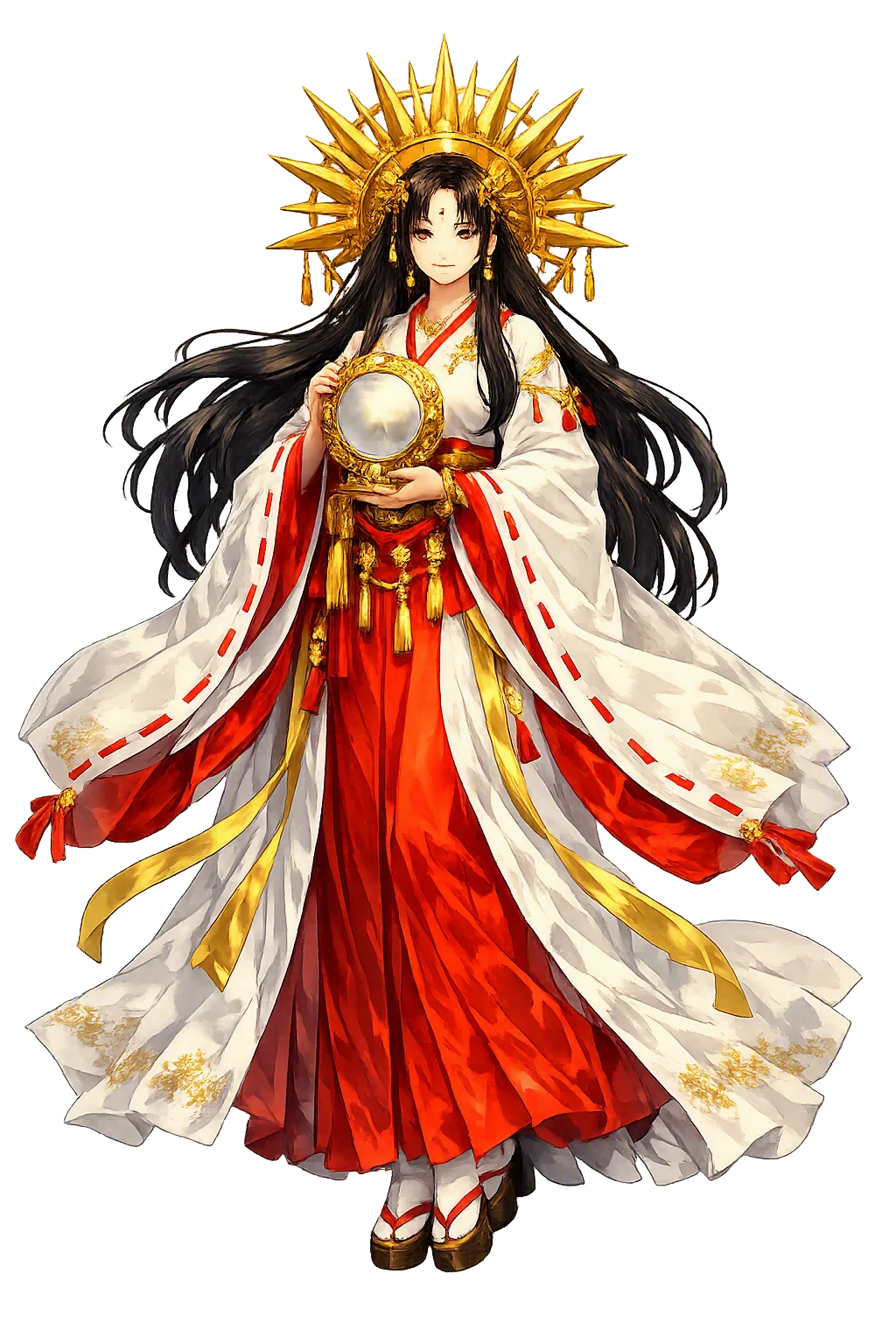
Amaterasu has no cult image — she is the sun, and Ise keeps a mirror. Early imaging is therefore narrative: medieval handscrolls and screens picture the cave episode and Ninigi's descent, and Muromachi-period Ise pilgrimage mandalas (sankei mandala) map her shrine as the sun's earthly residence. The decisive pictures came from Buddhism: under honji-suijaku she was read as the local trace of Dainichi (Vairocana), and medieval Buddhist art gives her the serene seated form of a cosmic Buddha — the closest pre-modern Japan came to her portrait. In everyday symbolism her signs stay abstract: the rising sun disc, the mirror, the three-legged crow (yatagarasu) that guided her grandson's line. Even the red circle of the flag began as her face — a national emblem that is also an icon.

06

Reception & Transformation

The name after its own age — transmission, translation, survival

Afterlives

Her story was written to be passed down: the Kojiki was compiled in 712 by Ō no Yasumaro from the recitations of Hieda no Are, the Nihon Shoki followed in 720, and the oldest substantial Kojiki manuscript, the Shimpuku-ji copy of the fourteenth century, still anchors the text. Transmission then became commentary: medieval Ise Shintō read her cosmology as esoteric Buddhist doctrine, and the early-modern kokugaku scholars reversed the move — Motoori Norinaga's monumental Kojiki-den (composed from 1764, printed complete in 1822) demanded the myths be read without Buddhist or Confucian scaffolding and made the cave episode a parable of restoration. Hirata Atsutane's circle carried her further into nativist devotion. The Meiji state then pressed her descent myth into service as national history — for a time the text's afterlife became ideology, until Tsuda Sōkichi's critical philology, long suppressed, was vindicated after 1945. In the West she arrived through Basil Hall Chamberlain's pioneering Kojiki translation (1882) and Aston's Nihongi (1896); modern ritual studies now treat Ise's twenty-year renewal as the longest-running liturgical program on earth.

Identifications Across Traditions

In the medieval honji-suijaku system Amaterasu was identified with the cosmic Buddha Vairocana (Dainichi Nyorai) — the sun of the Dharma itself — and Buddhist chapels and sutras stood within Ise's precincts until the Meiji separation edicts. State Shinto then stripped away these Buddhist layers, taught the descent of Ninigi as national history, and made her the theological center of imperial ideology; overseas shrines carried her cult into the empire. Her modern reception extends to the video game Ōkami, whose wolf-goddess is drawn from her iconography — evidence that the sun still needs a face.

Modern Legacy

Ise Grand Shrine remains the supreme sanctuary of Shinto, its twenty-year rebuilding unbroken since the seventh century, and the Daijōsai enthronement rite of each new emperor reenacts Ninigi's descent. The red disc of the flag keeps her sign on every public building, and pilgrims stream across the Uji Bridge at New Year. In the countryside, folk religion still addresses her as the guarantor of the harvest sun. Abroad, Ōkami introduced her to millions who will never visit Ise — the newest link in an unbroken chain of sunlight made visible.

09

The Original Script Note

What the written record preserves — and what it does not

Original Script

The name is written 天照 — 天 'heaven' + 照 'to shine' — short for the fuller chronicle form 天照大神 (Amaterasu-ōmikami), 'Heaven-Shining Great August Deity'. The Kojiki (712) and Nihon Shoki (720) set the spelling down; both use the characters semantically, glossing a native Japanese theonym rather than transcribing a Sino-Japanese reading, and no phonetic man'yōgana spelling of the name survives. The characters preserve what the name means; the sound they were read with was that of eighth-century Yamato.

10

The Meditation

What Amaterasu means — beyond the dictionary

Amaterasu teaches that light is not automatic. Her withdrawal shows that even the sun can be wounded into silence, and her return shows what it takes to heal her: not argument, not force, but the laughter of Uzume and the honesty of a mirror. The community of gods succeeds precisely because each plays a part — the dancer, the strong-arm, the ritualist, the mirror-bearer.

To read the myth politically is correct but incomplete: it is also a psychology of withdrawal and return. Everyone who has sealed themselves behind a rock door knows that the way back is not a plea but a celebration worth peeking at. And the mirror matters most of all: she returns not because others praise her, but because she is allowed to see her own radiance reflected.

11

Screen & Culture

Where Amaterasu echoes through film, television, and games — and how

12

Frequently Asked Questions

Deep-dives into the cult, attestation, reception, and sources of Amaterasu

01How do we know how Amaterasu was worshipped?

The Ise Grand Shrine (Mie Prefecture) is Amaterasu's principal dwelling: its Inner Shrine (Kōtai Jingū), traditionally founded in the reign of Suinin (1st century BCE), is rebuilt every twenty years (shikinen-zōtai) on alternating adjacent plots, a rite documented from 690 CE and continued without break. The full cult record →

02Where do the earliest attestations of Amaterasu come from?

The record rests on Kojiki 1 (birth, rampage, cave, Ninigi's descent), Nihon Shoki 1–2 (variant births, Yamato-hime and the founding of Ise), Philippi, Kojiki, among 5 cited works. The full source apparatus →

03How did later traditions reinterpret Amaterasu?

Her story was written to be passed down: the Kojiki was compiled in 712 by Ō no Yasumaro from the recitations of Hieda no Are, the Nihon Shoki followed in 720, and the oldest substantial Kojiki manuscript, the Shimpuku-ji copy of the fourteenth century, still anchors the text. Reception & transformation →

04What do the surviving images of Amaterasu actually show?

Amaterasu has no cult image — she is the sun, and Ise keeps a mirror. The iconography →

05What does the written record of Amaterasu actually preserve?

The name is written 天照 — 天 'heaven' + 照 'to shine' — short for the fuller chronicle form 天照大神 (Amaterasu-ōmikami), 'Heaven-Shining Great August Deity'. The Original Script note →

13

Scholarly Sources

The philological foundations of the record

Every claim on this page is grounded in established scholarship. The orthographic restorations follow disciplinary convention. The etymological chain follows the best available reference works. This is not invention — it is resurrection through scholarship.

◈

Lexicography & Philology

  • Hepburn
◎

Primary Texts

  • Kojiki
  • Kojiki 1 (birth, rampage, cave, Ninigi's descent)
  • Nihon Shoki 1–2 (variant births, Yamato-hime and the founding of Ise)
  • Philippi, Kojiki
◉

Archaeology & Art History

  • Guth, C. Art of Edo Japan; Kidder, J. E. Early Japanese Art.
✦

Religious Studies

  • Aston, Nihongi
  • Bock, Classical Learning and Taoist Practices in Early Japan
Return

The Surface Awaits

You have traced the name from its earliest attestation to its canonical restoration. Now return to the myth. The story is where the name lives.

Back to Lore
Amaterasu mascot