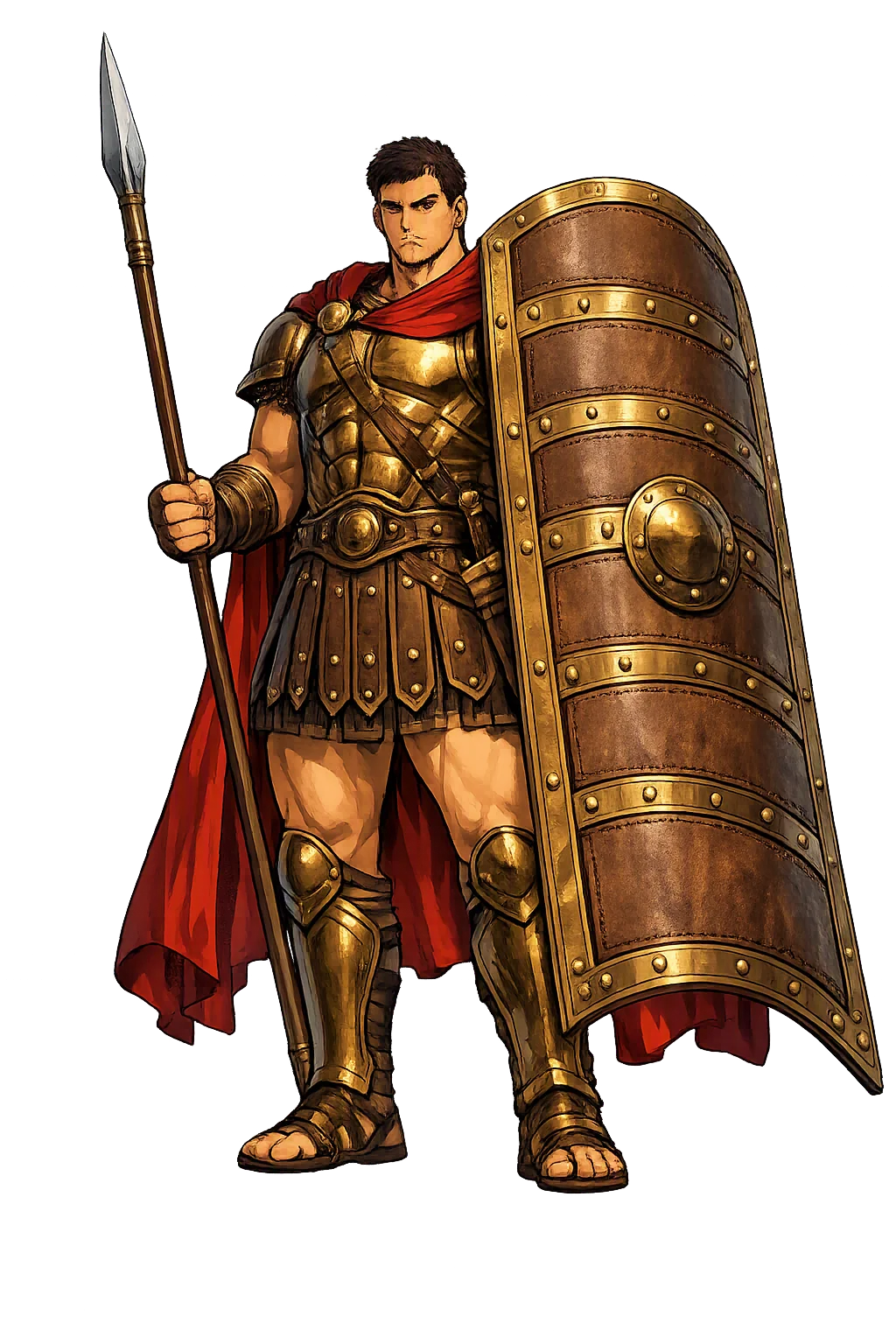
Stories of Aías
The myths of Aias are told in the Iliad, the lost Epic Cycle, and above all in Sophocles' tragedy Aias. They turn on a single quality: the absolute, unbending commitment of the warrior. That quality makes him the Greeks' greatest defender and, when it is slighted, their most terrible casualty.
When the Trojans broke the Greek wall and reached the beached ships, fire was set to Protesilaus' vessel, and the whole Achaean cause hung on a deck. There Homer stations Aias: striding from prow to stern behind his seven-fold oxhide shield, a pike twenty-two cubits long, holding the Trojans off while men rallied behind him (Iliad 15.674–746). Earlier, as Hector cut through the ranks, the poet had compared him to a donkey that boys cannot drive from a cornfield — stubborn, scorned, immovable (Iliad 11.558–562). When even Aias must yield at last, he does so grudgingly, calling the retreat a disaster (Iliad 16.101–111). The Defence of the Ships is the Iliad's hymn to the unglamorous virtue: endurance. Achilles wins the poem's glory; Aias saves its army. Homer seems to know that civilizations stand less on brilliance than on the man who refuses, step by bloody step, to move.
Hector challenges the Greeks to single combat, and the lots fall to Telamonian Aias — the biggest man among them, Homer says, save Achilles (Iliad 7.206–312). The duel fills a book: spear-casts stopped on shield and breastplate, a stone that spins Hector like a top, nightfall parting them at last. Neither yields; each wins honor, and they exchange gifts — Hector's sword and scabbard for Aias's scarlet belt. Homer comments in one terrible line: 'bad gifts' — for Aias will one day fall on Hector's sword, and Hector's corpse will be dragged behind Achilles' chariot by the very belt Aias gave. The duel is the Iliad's picture of war's fairness: two men of equal worth meet, measure each other, and part with respect — while the narrator, who knows how both die, lets us feel the courtesy and the doom in a single gesture. Equality is real; so is what comes after.
Achilles fell at the Scaean gates, struck down by Paris with Apollo's help. The Greeks' greatest corpse became the day's greatest battle. Aias and Odysseus fought through to the body — Odysseus holding the Trojans at bay while Aias heaved the dead hero onto his shoulders and carried him from the field, Achilles' armor in his other arm (Aethiopis, in Proclus' summary; Quintus of Smyrna, Posthomerica 3). It was the last and largest of Aias's labors for the army that would soon betray him: the strong man carrying what the army could not afford to lose, doing the work glory forgot to record. Homer remembers the end — Achilles' ashes mingled with Patroclus' in a golden urn for 'the best of the Achaeans' (Odyssey 24.43–84) — but does not say who bore him there. The silence is the point: Aias's loyalty needed no witness, and asked for none.
The armor of Achilles was the prize of the war, and the Greeks awarded it — by the army's shouting, Sophocles says — to Odysseus. Aias, broken by the judgment, was driven mad by Athena: by night he fell upon the flocks, butchering sheep he took for the sons of Atreus. Sanity returned to the sight of his own disgrace (Ajax 1–133, 284–330). 'A glorious death or a life of shame,' he cried, and chose: planting Hector's gifted sword upright in the sand of the seashore, he fell upon it — the only hero of the Trojan war to die by his own hand, and the first great suicide in Western literature. Sophocles lets the army debate his burial: Menelaus would leave him to the dogs; Odysseus, of all people, argues for honor — 'I hated him while it was honorable to hate' (Ajax 1355–1361). The play that preserves Aias is also the earliest portrait of combat trauma: the wound not in the body but in the code, honor turned inward until it kills. Modern armies still stage it for their soldiers, and it still explains what it was written to explain.
Warrior, Defender, and Unyielding Will
Aias is the great defensive warrior of the Greek army at Troy. In the Iliad he is second only to Achilles in strength and courage, a tower of bronze and stubbornness who saves the Greek ships from fire, duels Hector to a standstill, and carries the dead Achilles from the field. Where Achilles is speed and wrath, Aias is mass, endurance, and absolute loyalty. His name became a byword for the soldier who holds the line when everything else breaks.
Aias fights with a towering seven-fold oxhide shield that protects whole companies, not merely himself.
He meets Hector in single combat and fights him to a draw, proving that defence can match offence.
After Achilles falls, Aias stands over the body and bears Achilles' corpse from the battlefield.
Denied Achilles' armour, he falls into a madness of shame and takes his own life on the seashore.
From the original script to the living URL
Αἴας
The name in its original Greek form. Aías (Αἴας) is attested in the source tradition — “Of the earth”. Its acute accents carry the full phonetic and orthographic weight of the source tradition.
ajax
Reduced to plain ajax, the name loses everything that made it specific: acute accents. What remains is an ASCII string that machines can parse but that no longer speaks with its original voice.
Aías
The Unicode restoration recovers what ASCII flattened. Aías restores acute accents, returning the name to its original written dignity. The domain encodes to Punycode, but the browser displays the truth.
Aías.com → xn--aas-rma.com
The non-ASCII characters in Aías are encoded while the ASCII remains visible. To the DNS, it is Punycode. To humanity, it is Aías.
Owned, ideal, and ASCII forms of Aías
Aías
Restores Αἴας. The full Unicode restoration. aías.com is not in the PuniCodex collection — it is watched for release; if it drops, this temple upgrades to an owned flagship.
ajax
Flattens Αἴας. The plain ASCII fallback — what DNS and legacy systems see.
How Aías was spoken
How Aías is preserved in writing
A bespoke provenance study for Aías is being prepared by the PUNICODEX scholarly team.
Contribute scholarly provenance →The lore you have read is the living myth. Extended Lore opens the scholarly vault beneath it: the cult and its material remains, a history of the image, the name after antiquity, a meditation on what the name still means, and the full scholarly apparatus — etymology, orthography, sources.
Enter Extended Lore