PuniCodex

Extended Lore

Αἴας Aías

Etymology · Orthography · Cult · Iconography · Reception · Sources

Tier 1 Aías
Aías — Warrior, Bulwark of Achaeans
01

Quick Facts

Essential information about Aías, Warrior, Bulwark of Achaeans

Original ScriptΑἴας
Unicode RestorationAías
Reconstructed Pronunciation/aí̯.aːs/
PantheonGreek
DomainWarrior, Bulwark of Achaeans
MeaningOf the earth
ClassificationTier 1
Primary DomainAías
Sacred SymbolsSeven-fold oxhide shield, Sword, The ships, The seashore
02

Etymology & Word Family

From original script to Unicode restoration

Original Script Αἴας Aías — "Of the earth"
Unicode Restoration Aías Restored stress, length, and script
Modern ASCII ajax Plain-ASCII fallback

The name Aías carries the orthographic signature of the greek tradition: Αἴας. Unicode restoration recovers what ASCII flattens.

03

Unicode Character Breakdown

Character-by-character philological analysis

CharacterUnicodeNameBlockPhonetic Role
AU+0041Latin Capital Letter ABasic LatinSame
íU+00EDLatin Small Letter I with AcuteLatin-1 SupplementIota
aU+0061Latin Small Letter ABasic LatinSame
sU+0073Latin Small Letter SBasic LatinSame

The Tier 1 classification reflects how much of the original phonology this restoration preserves — stress and vowel length for Greek names, distinctive letters and diacritics for every other tradition.

04

Cult & Worship

How the sacred was kept — rites, sanctuaries, remains

The Cult

Aias was genuinely worshipped, and the evidence is unusually precise. His hero-cult centered on Salamis, where his tomb was shown to visitors and where the Aianteia — sacrifices and games in his honor — were celebrated; Plutarch remembers the Athenians kindling their victory bonfires for the Aianteia on the island (Life of Solon 9), and Sophocles' tragedy already knows the rite, closing with Teucer's founding of the grave-shrine on the shore. At Athens the clan of the Salaminioi — claiming the hero through his father Telamon's exile — administered his sanctuary, the Aianteion in the deme Melite; their surviving settlement decree (363/2 BCE) prescribes joint sacrifices to Aias and his son Eurysakes among the clan's cults. The economy is the standard hero's: animal victims at the tomb, athletic contests, honors sung. A hero, not a god — worshipped at the tomb, sung in the theater, claimed as ancestor by clan and island alike.

05

Iconography

How Aías was imaged across the ages

The Image

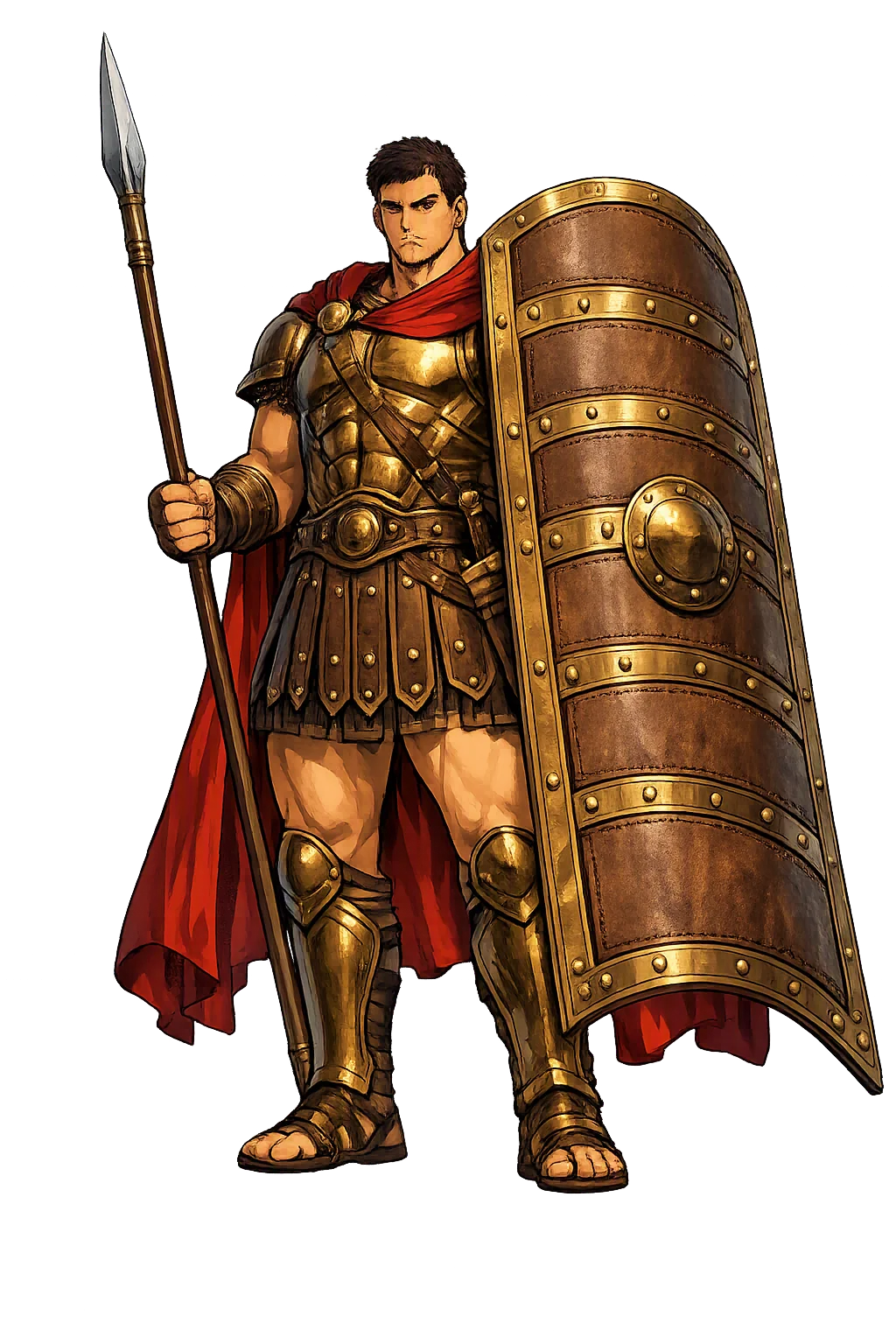
The archaic painters made Aias instantly readable: enormous, fully armed, his tower-like shield faced with seven oxhides — Homer calls it a wall. The earliest certain scene is also the boldest: the Eurytios Krater (Corinthian, ca. 600 BCE, Louvre) already shows his suicide. Exekias gave him his two canonical images — the Ajax and Achilles Playing Dice amphora (Vatican, ca. 540 BCE), the warriors bent over the gaming board under Athena's gaze, and the great suicide amphora at Boulogne-sur-Mer, where the hero plants Hector's gifted sword in the earth and falls upon it in a composition of terrible stillness. Red-figure painters added the body of Achilles borne from the fight and Tekmessa's grief; Etruscan and Roman workshops kept the suicide on gems and sarcophagi for centuries. His attributes never change: hoplite gear, the great shield, and the fateful sword.

06

Reception & Transformation

The name after its own age — transmission, translation, survival

Afterlives

Aias's transmission is the story of one play outweighing an epic. Homer gave him unbreakable honor — the Iliad's bulwark, second only to Achilles — and Sophocles' Ajax (probably 440s BCE) then made him the West's first study of wounded honor turned inward. The play's manuscript tradition, crowned by the Aldine edition of 1502, and its long translation history carried him through the Renaissance; through Ovid's arms-contest speeches (Metamorphoses 13) he entered the medieval Troy narratives and Guido delle Colonne's Historia destructionis Troiae, becoming a moral exemplum of pride's fall. Early modern England debased the name even while re-ennobling the figure: 'Ajax' was jocularly 'a jakes,' a privy, in slang, while Chapman's and then Pope's translations of the Iliad (1611; 1715–20) restored the epic warrior to literature. Nineteenth-century philhellenism and archaeology recovered his vases, and twentieth-century scholarship — from Perrotta's on — reframed Sophocles' play as an anatomy of combat trauma, the reading that governs it today.

Identifications Across Traditions

Aias was honoured as a hero at Salamis, his father's island, and at Athens, where the festival Aianteia included games in his honour. The Athenians claimed him as their own through his father Telamon's exile there. Roman writers such as Ovid retold his story, and the name Ajax passed into modern culture as a byword for physical might and tragic pride. In the twentieth century it became a brand name for cleaning products and football clubs, a long descent from the Homeric bulwark.

Modern Legacy

Aias stands at the centre of Western reflection on military honour and mental injury. Sophocles' tragedy is now read as one of the earliest literary explorations of combat trauma and the violence that shame can turn inward. The American Department of Defense has sponsored performances of the play for veterans. The Ajax football club of Amsterdam takes its name and emblem from the hero, and 'Ajax' has been used for military vehicles, ships, and spacecraft. His story reminds us that the strongest defender may be the most vulnerable when honour is denied.

07

The Meditation

What Aías means — beyond the dictionary

Aias teaches that strength without flexibility can become its own enemy. His refusal to bend before the Greek commanders is the same refusal that let him hold the ships against Hector; turned inward, it becomes the sword with which he destroys himself. The modern reader cannot easily judge him. His suicide is at once a failure of proportion and a terrible assertion of dignity.

To remember Aias is to remember the cost of asking human beings to be shields. The wall that protects others must itself bear every blow. When the wall is slighted, the whole structure of honour trembles.

08

Screen & Culture

Where Aías echoes through film, television, and games — and how

09

Frequently Asked Questions

Common questions about Aías, Warrior, Bulwark of Achaeans, and Unicode restoration

01How do you pronounce Aías?

In reconstructed pronunciation, Aías is /aí̯.aːs/ — approximately 'AH-yahs' — the first syllable is long and carries the ancient pitch rise; the final syllable is open and sustained.

02What does Aías mean?

Aías means Of the earth in the greek tradition.

03What are the symbols of Aías?

Aías is associated with Seven-fold oxhide shield (The massive tower-shield that makes Aias a living fortress and protects the whole Greek line.), Sword (The weapon with which he slays sheep in his madness and then himself in the tragedy of Sophocles.), The ships (The beached Greek fleet that Aias defends when the Trojans press it with fire.), The seashore (The place of his suicide and burial, where the waves meet the land of Troy.).

04Why restore Aías in Unicode?

Plain ASCII ajax strips the stress, length, and script that make the name specific. Unicode restoration returns the name to its original written dignity.

05What is the most important myth about Aías?

“The Defence of the Ships” — the Iliad story that anchors the mythology of Aías, told in full on the lore page.

10

Scholarly Sources

The philological foundations of this restoration

Every claim on this page is grounded in established scholarship. The orthographic restorations follow disciplinary convention. The etymological chain follows the best available reference works. This is not invention — it is resurrection through scholarship.

◈

Lexicography & Philology

  • Liddell, H. G., Scott, R., & Jones, H. S. A Greek-English Lexicon. Oxford: Clarendon Press, 9th ed. 1996.
  • Pape, W., & Benseler, G. E. Wörterbuch der griechischen Eigennamen. Braunschweig: Vieweg, 1884.
  • Beekes, R. S. P. Etymological Dictionary of Greek. Leiden: Brill, 2010.
◎

Primary Texts

  • Homer, Iliad
  • Homer, Odyssey 11.543–567; 24.43–84
  • Sophocles, Ajax
  • Pindar, Nemean Odes 7 and 8
  • Ovid, Metamorphoses 13
  • Gagarin and Woodruff, Early Greek Political Thought from Homer to the Sophists
◉

Archaeology & Art History

  • Material evidence — iconography, inscriptions, and temple archaeology — for Aías and related cults.
✦

Religious Studies

  • Aethiopis (Proclus' summary); Quintus of Smyrna, Posthomerica 3
  • Liddell-Scott-Jones Greek-English Lexicon, s.v. Αἴας
Return

The Surface Awaits

You have traced the name from its earliest attestation to its Unicode restoration. Now return to the myth. The story is where the name lives.

Back to Lore
Aías mascot