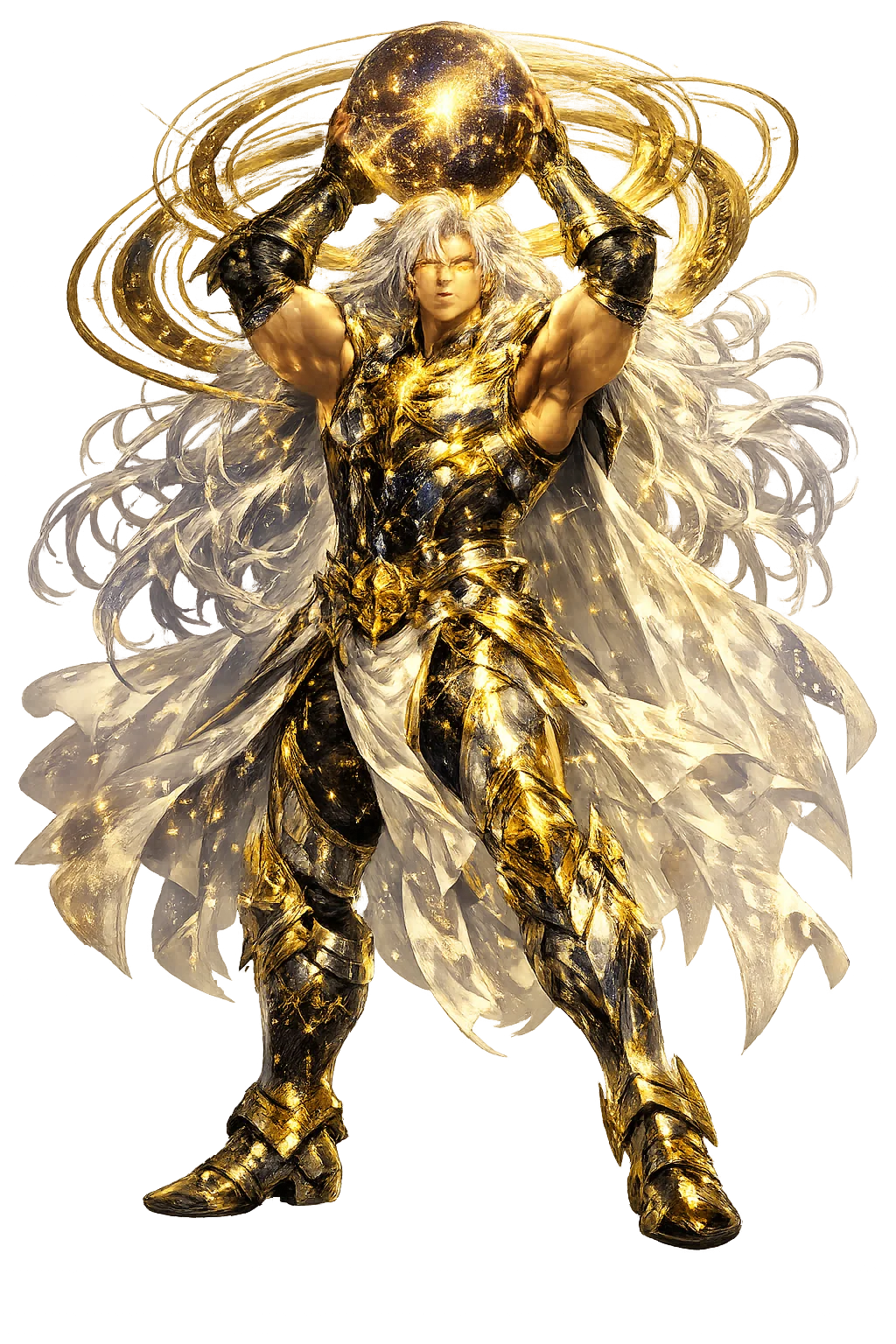
Stories of Aithḗr
Aithḗr appears at the very birth of the world, one of the first distinctions made by the yawning void. He is not a hero with a quest; he is a cosmic substance personified — the luminous layer that makes the sky sky, and later the ladder by which Greek thought climbed from myth to physics.
Hesiod gives Aithḗr the briefest of births and the grandest of pedigrees: from Chaos came Erebus and black Night; Night and Erebus, mating, produced Aithḗr and Hemera, Day (Hesiod, Theogony 123–125). He is therefore among the first things in the universe — older than the Titans, older than Olympus, a layer of the cosmos before the cosmos had furniture. Homer already breathes him: throughout the Iliad and Odyssey the aithḗr is the bright upper region through which gods travel and where the sun rides — but Homer has not yet made him a person. Hesiod's genealogy is the decisive step, yoking the shining air to Night's dark household. The pairing is exact and almost algebraic: Night couples with Darkness, and the first thing their union makes is light's medium — out of darkness the cosmos builds its own visibility, and the upper brightness is literally the child of the dark.
What exactly is Aithḗr? The tradition answers with a gradient. Below him lies aḗr, the moist, breathy lower air that mortals share with animals and weather; above him, nothing at all. Aithḗr is the pure, dry, fiery medium that fills the space between the world and the stars — the substance of the dome, the road of the sun, the region where thunderheads never reach. In the Orphic Hymn to Aither (5) he is girdled with flame, the dwelling the blessed gods inhabit, nearer to prayer than any other element. Mortals live in the fog of the lower air; the gods live in clarity. Aithḗr is the Greek name for the suspicion that the sky is not empty — that above the weather there is a purer atmosphere, breathable only by the deathless, and that it is not nothing but a someone: bright, lofty, and addressed as a god.
The Orphic ritual tradition took Aithḗr personally. The Orphic Hymn addressed to him (no. 5) hails him as the home of the sun, the moon, and the wandering stars, the pure and fiery element that receives prayer and shines with unquenchable light; in the Orphic cosmogonies preserved and argued over in the Derveni Papyrus (c. 340 BCE), aether belongs to the first generation of things — material enough to be spoken of, holy enough to be hymned. The theology is distinctive: most elements are inert scenery, but aether is addressed as a god with ears — invoked at the opening of rites, asked to receive the offering as it rises through the smoke. It is a short step from an element that hears prayers to a first principle that issues them. An element with a cult will soon be offered a universe to run.
Aristotle completed the promotion. In On the Heavens (1.2–3) he argues that the heavens cannot be built of the four terrestrial elements, for those rise and fall, corrupt and perish; the stars wheel in circles forever, so they must be made of something else — a fifth body, divine and ungenerated, which he names aithḗr. The Stoics kept the divinity and added fire: for them the cosmos is a living being woven through by aetherial pneuma, the breath that is also god (the Stoic doctrine as reported by Cicero, De Natura Deorum 2). The Neoplatonists set him just below the intelligible realm — the first body, luminous and intelligent, clothing the divine Mind. When medieval Latin spoke of the quinta essentia, the quintessence, it was still Hesiod's child, working his way upward through every system Greece produced. No other figure of the Theogony had so long and respectable a second career.
Celestial Fire, the Sky, and the Boundary of the Cosmos
Aithḗr is not the wind that rustles leaves nor the breath mortals breathe. He is the pure, fiery medium that fills the space between the world and the stars, the realm where sun, moon, and planets move. In Hesiod's cosmos he is the son of Erebus and Nyx, the luminous antithesis of darkness.
The transparent sphere that holds the stars; Aithḗr is the medium in which heavenly bodies are embedded.
The fiery radiance of the upper atmosphere, untainted by earth or sea.
The wall that separates Olympus from the lower world, keeping Tartaros outside the ordered cosmos.
Aithḗr is the element the gods breathe; mortals live in the lower, moist air.
From the original script to the living URL
Αἰθήρ
The name in its original Greek form. Aithḗr (Αἰθήρ) is attested in the source tradition — “Bright upper air”. Its aspirated consonants, long vowels, and acute accents carry the full phonetic and orthographic weight of the source tradition.
aither
Reduced to plain aither, the name loses everything that made it specific: aspirated consonants, long vowels, and acute accents. What remains is an ASCII string that machines can parse but that no longer speaks with its original voice.
Aithḗr
The Unicode restoration recovers what ASCII flattened. Aithḗr restores aspirated consonants, long vowels, and acute accents, returning the name to its original written dignity. The domain encodes to Punycode, but the browser displays the truth.
Aithḗr.com → xn--aithr-yd1b.com
The non-ASCII characters in Aithḗr are encoded while the ASCII remains visible. To the DNS, it is Punycode. To humanity, it is Aithḗr.
Owned, ideal, and ASCII forms of Aithḗr
Aithḗr
Restores Αἰθήρ. The live temple domain — aithḗr.com.
aither
Flattens Αἰθήρ. The plain ASCII fallback — what DNS and legacy systems see.
How Aithḗr was spoken
How Aithḗr travels from ancient script to the modern URL
Greek Αἰθήρ; from αἴθω “to burn, blaze"; the bright upper air.
Upper Air, Light
The Unicode restoration Aithḗr preserves Greek stress and length; the ASCII form aither loses these features.
The lore you have read is the living myth. Extended Lore opens the scholarly vault beneath it: the cult and its material remains, a history of the image, the name after antiquity, a meditation on what the name still means, and the full scholarly apparatus — etymology, orthography, sources.
Enter Extended Lore