PuniCodex

Extended Lore

Αἰθήρ Aithḗr

Etymology · Orthography · Cult · Iconography · Reception · Sources

Tier 1 Aithḗr.com
Aithḗr — Upper Air, Light
01

Quick Facts

Essential information about Aithḗr, Upper Air, Light

Original ScriptΑἰθήρ
Unicode RestorationAithḗr
Reconstructed Pronunciation/aɪ.tʰɛ́ːr/
PantheonGreek
DomainUpper Air, Light
MeaningBright upper air
ClassificationTier 1
Primary DomainAithḗr.com
Sacred SymbolsFlame, Star, Golden dome, Sun chariot, Breath of life
02

Etymology & Word Family

From original script to Unicode restoration

Proto-indo-european *h₂eidh- to burn, blaze
Original Script Αἰθήρ Aithḗr — "Bright upper air"
Unicode Restoration Aithḗr Restored stress, length, and script
Modern ASCII aither Plain-ASCII fallback

From Greek αἰθήρ 'bright upper air', derived from αἴθω 'to burn, blaze', continuing Proto-Indo-European *h₂eidh- 'to burn'.

03

Unicode Character Breakdown

Character-by-character philological analysis

CharacterUnicodeNameBlockPhonetic Role
AU+0041Latin Capital Letter ABasic LatinA uppercase
iU+0069Latin Small Letter IBasic LatinSame
tU+0074Latin Small Letter TBasic Latint same
hU+0068Latin Small Letter HBasic Latinh same
ḗU+1E17Latin Small Letter E with Macron and AcuteUnknownStress + length
rU+0072Latin Small Letter RBasic Latinr same

The Tier 1 classification reflects how much of the original phonology this restoration preserves — stress and vowel length for Greek names, distinctive letters and diacritics for every other tradition.

04

Cult & Worship

How the sacred was kept — rites, sanctuaries, remains

The Cult

Aithḗr never had a temple, and the evidence says so honestly. No polis festival, priesthood, or sanctuary is attested for him anywhere; civic cult was busy with Zeus and Apollo, while the upper air received poetry rather than sacrifice. The single exception is the Orphic ritual corpus: the Orphic Hymns, a collection probably assembled in Asia Minor in the second or third century CE, include a hymn addressed to Aithḗr (no. 5), used in the private devotions of Orphic thiasoi with fumigations and invocations of the whole cosmic company of gods. For a deity so grand in cosmogony, cult was minimal — he was worshipped mainly in the sectarian margins, and even there he was sung rather than served.

In the Earth

Aither's cosmological role is anchored by the Derveni Papyrus (Archaeological Museum of Thessaloniki, ca. 340 BCE), an Orphic theogonical commentary that invokes Aither in its exegesis of the first principles. Orphic gold tablets from Thurii and Petelia invoke the 'breath of Aither' and the dwelling of the blessed. Vase paintings of the fifth and fourth centuries BCE occasionally personify Aither as a winged figure or as the bright upper air surrounding celestial gods.

05

Iconography

How Aithḗr was imaged across the ages

The Image

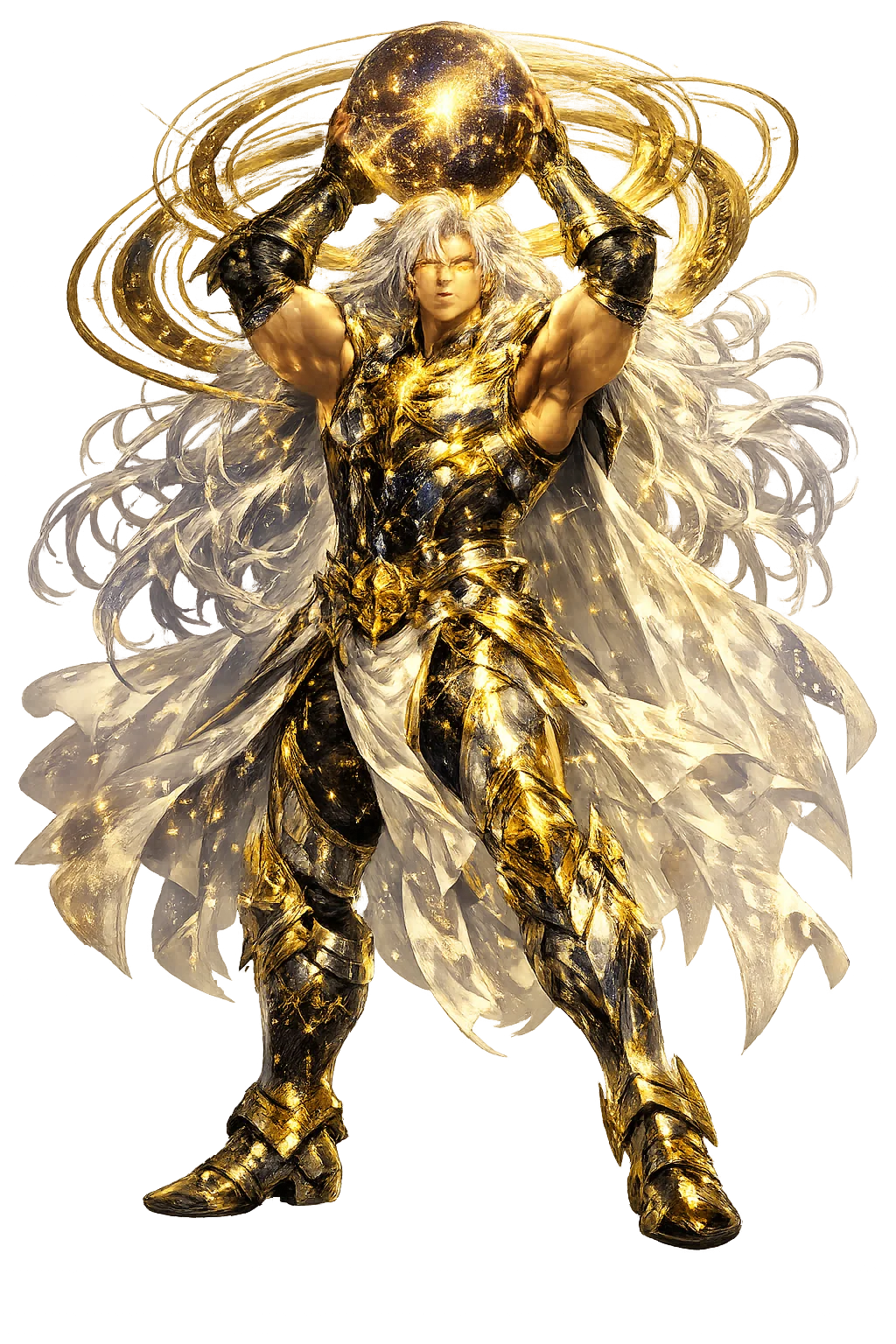
Aithḗr's image is barely a sketch. Fifth- and fourth-century vase painters occasionally set winged figures in the bright upper zone of a scene — sky-gods or personifications — but the labels are missing or ambiguous, and Aithḗr cannot be picked out with confidence. The Derveni Papyrus (Thessaloniki, ca. 340 BCE) invokes him at length, but it is a text, not an image; the Orphic gold tablets likewise give only words — the 'breath of Aithḗr' greeting the dead initiate. His canonical attributes are textual: the pure fire above the clouds, dwelling of sun, moon, and stars, the bright air the gods breathe. Securely identified surviving depictions of Aithḗr as a person simply do not exist; his iconography was never fixed because his worshippers were poets and sectaries, not image-makers.

06

Reception & Transformation

The name after its own age — transmission, translation, survival

Afterlives

Aithḗr outlived his cult to become a concept, and the journey ran through the schools. Aristotle's De Caelo promoted him to the fifth element — the incorruptible, fiery substance of the celestial spheres — and the Peripatetic cosmos passed, through Cicero's Latin aether and Vergil's hexameters, into medieval Europe, where the schoolmen rendered him quinta essentia and set him above the sphere of the moon; alchemists distilled his namesake, the quintessence. Early modern physics re-mattered him: Descartes filled all space, Newton's Opticks queried whether an ethereal medium carried light, and nineteenth-century field theory made 'the ether' the carrier of electromagnetism — until Michelson and Morley's interferometer (1887) found no wind in it and Einstein's relativity retired the medium for good. The name survives where the physics died: in 'ethereal,' in the radio operator's ether, and in every usage where an invisible medium is needed and named.

Identifications Across Traditions

Rome had no cult of Aithḗr — the Romans simply naturalized the Greek word as aether and kept it for poetry and physics. The identification that mattered was Stoic: there aether became the fiery pneuma pervading the cosmos, a half-physical god that Latin writers rendered as spiritus — the ancestor, through Christian pneumatology, of some of the Holy Spirit's own vocabulary. Early Christian writers debated whether Genesis' 'firmament' was this aether, and the Fathers kept the scaffolding: Basil of Caesarea and Augustine could argue about the waters above the heavens precisely because Greek cosmology had taught them where heaven's floor lay. Medieval scholastics set aether in the celestial spheres; alchemists distilled it as the quintessence; early modern physics — Newton to Maxwell — filled all space with 'ether' as light's carrier. The 1887 Michelson–Morley experiment emptied the vessel, but the name floated off into metaphor, where it still means the invisible medium of whatever seems immaterial.

Modern Legacy

Aithḗr outlived his mythology to become one of the most durable words in Western science and fiction. 'Ether' survives as a solvent and in the idiom 'vanish into the ether' for anything that dissipates untraceably — an oddly perfect memorial for a god of invisible brightness. Science fiction and fantasy keep the fifth element: aether as the void between worlds, the fuel of starships, the stuff mages breathe. Hesiod's child, born from Night, still names the bright medium that fills what seems empty.

07

The Meditation

What Aithḗr means — beyond the dictionary

Every glance at the sky is a meeting with Aithḗr. Not the clouds, not the weather, but the transparent depth that holds the stars — that is what the Greeks named and worshipped. In an age of light pollution and screen glare, the idea of a pure, bright upper air feels almost archaeological. Yet the moment you look up on a clear night and see the Milky Way, you are touching the same substance Hesiod sang about.

Aithḗr reminds us that the cosmos is not empty darkness interrupted by points of light. It is a continuous, living medium. The stars do not hang in nothing; they swim in a sea of fire. To restore the name Aithḗr is to restore the sense that above us is not merely space, but brightness made structural.

08

Frequently Asked Questions

Common questions about Aithḗr, Upper Air, Light, and Unicode restoration

01How do you pronounce Aithḗr?

In reconstructed pronunciation, Aithḗr is /aɪ.tʰɛ́ːr/ — approximately 'EYE-thair' — the diphthong is bright, the second syllable long and held like a held breath.

02What does Aithḗr mean?

Aithḗr means Bright upper air in the greek tradition.

03What are the symbols of Aithḗr?

Aithḗr is associated with Flame (Refined celestial fire — the substance of the upper air), Star (The fixed bodies set in Aithḗr), Golden dome (The vault of heaven), Sun chariot (Helios crossing the bright medium), Breath of life (The pure air that animates the cosmos).

04Why restore Aithḗr in Unicode?

Plain ASCII aither strips the stress, length, and script that make the name specific. Unicode restoration returns the name to its original written dignity.

05What is the most important myth about Aithḗr?

“Son of Darkness and Night” — the The Birth story that anchors the mythology of Aithḗr, told in full on the lore page.

09

Scholarly Sources

The philological foundations of this restoration

Every claim on this page is grounded in established scholarship. The orthographic restorations follow disciplinary convention. The etymological chain follows the best available reference works. This is not invention — it is resurrection through scholarship.

◈

Lexicography & Philology

  • Liddell, H. G., Scott, R., & Jones, H. S. A Greek-English Lexicon. Oxford: Clarendon Press, 9th ed. 1996.
◎

Primary Texts

  • Hesiod
  • Hesiod, Theogony 116–125
  • Orphic Hymn 5
  • Cicero, De Natura Deorum 2
◉

Archaeology & Art History

  • Material evidence — iconography, inscriptions, and temple archaeology — for Aithḗr and related cults.
✦

Religious Studies

  • Aristotle, On the Heavens 1.2–3
Return

The Surface Awaits

You have traced the name from its earliest attestation to its Unicode restoration. Now return to the myth. The story is where the name lives.

Back to Lore
Aithḗr mascot