The Living Myth
Personified Egypt, the Black Land · The Black Land Itself
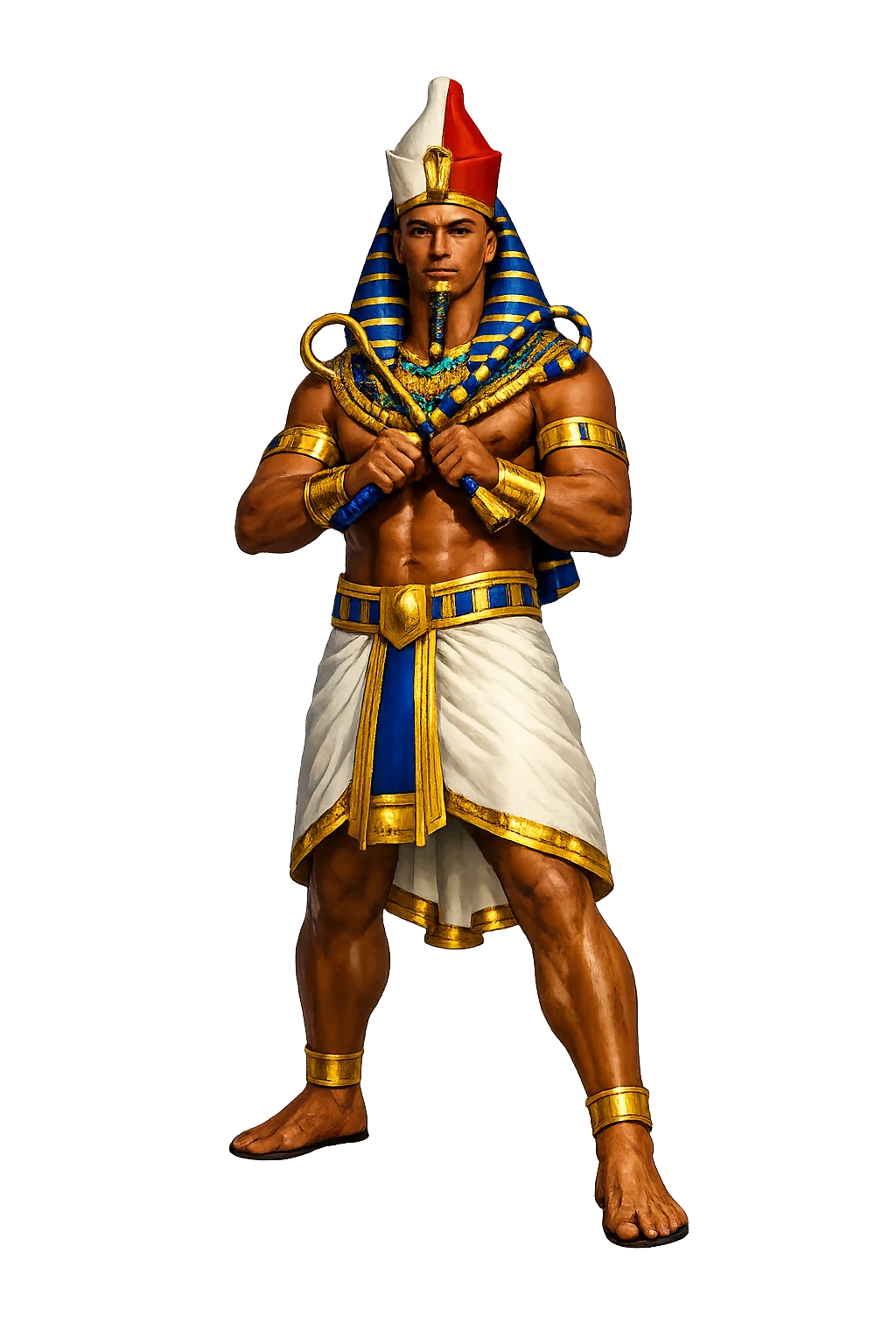
Stories of Aígyptos
Greek myth never treated Aígyptos as mere geography. The land of the Nile was woven into heroic genealogy through Io and Danaos, measured by Herodotus against the youth of Greece, and imagined by philosophers as the keeper of a wisdom older than memory — a mirror in which the Greeks saw their own antiquity.
Greek myth made Egypt a branch of the heroic family rather than a foreign land. Io, the Argive princess loved by Zeús, was transformed into a cow and driven across the world by Hēra’s jealousy until she reached the Nile delta. There, Aeschylus’ Prometheus Bound (824–852) has her finally touched by Zeús’s hand: she recovers her form and bears a son, Epaphos — ‘he of the touch’. Generations later her line produced Belos, whose two sons divided the world between them: Danaos received Libya and fled to Argos, while Aígyptos gave his name to the kingdom of the Nile (Apollodorus, Bibliotheca 2.1.3–5). The genealogy is a quiet claim of kinship: the oldest civilization on earth enters Greek story not as a stranger but as a cousin, a lost branch of the house of Inachos.
The Danaid myth turns Aígyptos from a place into a tragedy. Aígyptos the king, son of Belos and the Nile-nymph Achiroē, fathered fifty sons; his brother Danaos fathered fifty daughters. The sons pursued the daughters to force a mass marriage — the catastrophe dramatized in Aeschylus’ Suppliants, where the Danaïdes beg Argos for asylum while the Aigyptioi land with threats. Danaos surrendered, then armed each bride with a dagger: all but one slew their husbands on the wedding night. Only Hypermnēstrā spared her bridegroom Lynkeus, and from that spared pair the Argive royal line descended. The Danaïdes’ task in the underworld — filling a perforated jar — became the Greeks’ enduring image of futile penance (Plato, Gorgias 493b–c; Apollodorus 2.1.5). The myth reads Egypt as a land of excessive, violent abundance: fifty sons against fifty daughters, fertility curdled into blood.
Herodotus opens Book 2 of his Histories in a different key from every other book: Egypt, he insists, is where Greek assumptions go to be tested. The priests at Thebes, he reports (2.142), recited three hundred forty-one generations of high priests in an unbroken line — a past eleven thousand years deep, against which Greece was an infant. The Nile rises in summer flood when every other known river falls, and needs no rain to do it (2.19–27); religious practice there is older than any Greek rite (2.4–5). Herodotus never calls the Egyptians wiser; he calls them older, and lets the arithmetic do the work. The passage created the classical West’s template for Egypt: not a conquered province but an elder — a civilization against which youthful Hellene culture measured its own memory.
Plato’s Timaeus (22b–23c) stages the encounter as legend: Solon at Saïs asks the priests about ancient history, and an old priest smiles — you Greeks are always children, he says, and there is no old man among you. Egypt alone, preserved by the Nile’s regular floods when other peoples are periodically destroyed, keeps written records older than any Greek city. The priest then tells of ancient Athens and of lost Atlantis (24e–25d) — a tale set down nine thousand years before Solon. Plato is writing philosophical fiction, but the frame rests on a real Greek conviction: that the land of Aígyptos was the archive of the human race. Plutarch’s On Isis and Osiris and the Corpus Hermeticum kept the conviction alive into the Roman centuries, making Egypt’s priests the imagined teachers of Pythagoras and Orpheus.
The domain of Aígyptos
As a personified land, Aígyptos gathers what the Greeks saw when they looked south: the black silt of the Nile, the temple-name of Memphis fossilized in the country's name, the reputed wisdom of its priests, and the annual flood that re-enacted creation each year.
Aígyptos personifies the fertile Nile valley, the ‘black land’ (kmt) renewed each year by the river’s silt.
The name itself encodes Memphis theology: Ḥwt-kꜣ-ptḥ, the estate where the creator’s vital force dwells.
Greek writers from Herodotus to Plutarch imagined Egypt as a repository of primeval knowledge older than Greece.
The annual flood was creation re-enacted: without it, the Black Land returned to desert, and order collapsed.
From the original script to the living URL
Αἴγυπτος
The name in its original Greek form. Aígyptos (Αἴγυπτος) is attested in the source tradition — “From Egyptian Ḥwt-kꜣ-ptḥ ("House of the Ka of Ptah")”. Its acute accents carry the full phonetic and orthographic weight of the source tradition.
aigyptos
Reduced to plain aigyptos, the name loses everything that made it specific: acute accents. What remains is an ASCII string that machines can parse but that no longer speaks with its original voice.
Aígyptos
The Unicode restoration recovers what ASCII flattened. Aígyptos restores acute accents, returning the name to its original written dignity. The domain encodes to Punycode, but the browser displays the truth.
Aígyptos.com → xn--agyptos-7ya.com
The non-ASCII characters in Aígyptos are encoded while the ASCII remains visible. To the DNS, it is Punycode. To humanity, it is Aígyptos.
Owned, ideal, and ASCII forms of Aígyptos
Aígyptos
Restores Αἴγυπτος. The live temple domain — aígyptos.com.
aigyptos
Flattens Αἴγυπτος. The plain ASCII fallback — what DNS and legacy systems see.
How Aígyptos was spoken
How Aígyptos travels from ancient script to the modern URL
Greek Αἴγυπτος; from Egyptian Ḥwt-kꜣ-ptḥ “House of the Ka of Ptah", Hellenised through Egyptian and Semitic intermediaries.
Personified Egypt, the Black Land
The Unicode restoration Aígyptos preserves Greek stress and length; the ASCII form aigyptos loses these features.
The lore you have read is the living myth. Extended Lore opens the scholarly vault beneath it: the cult and its material remains, a history of the image, the name after antiquity, a meditation on what the name still means, and the full scholarly apparatus — etymology, orthography, sources.
Enter Extended Lore