The Living Myth
Evil, Destruction, Lies · Evil spirit, destructive mind
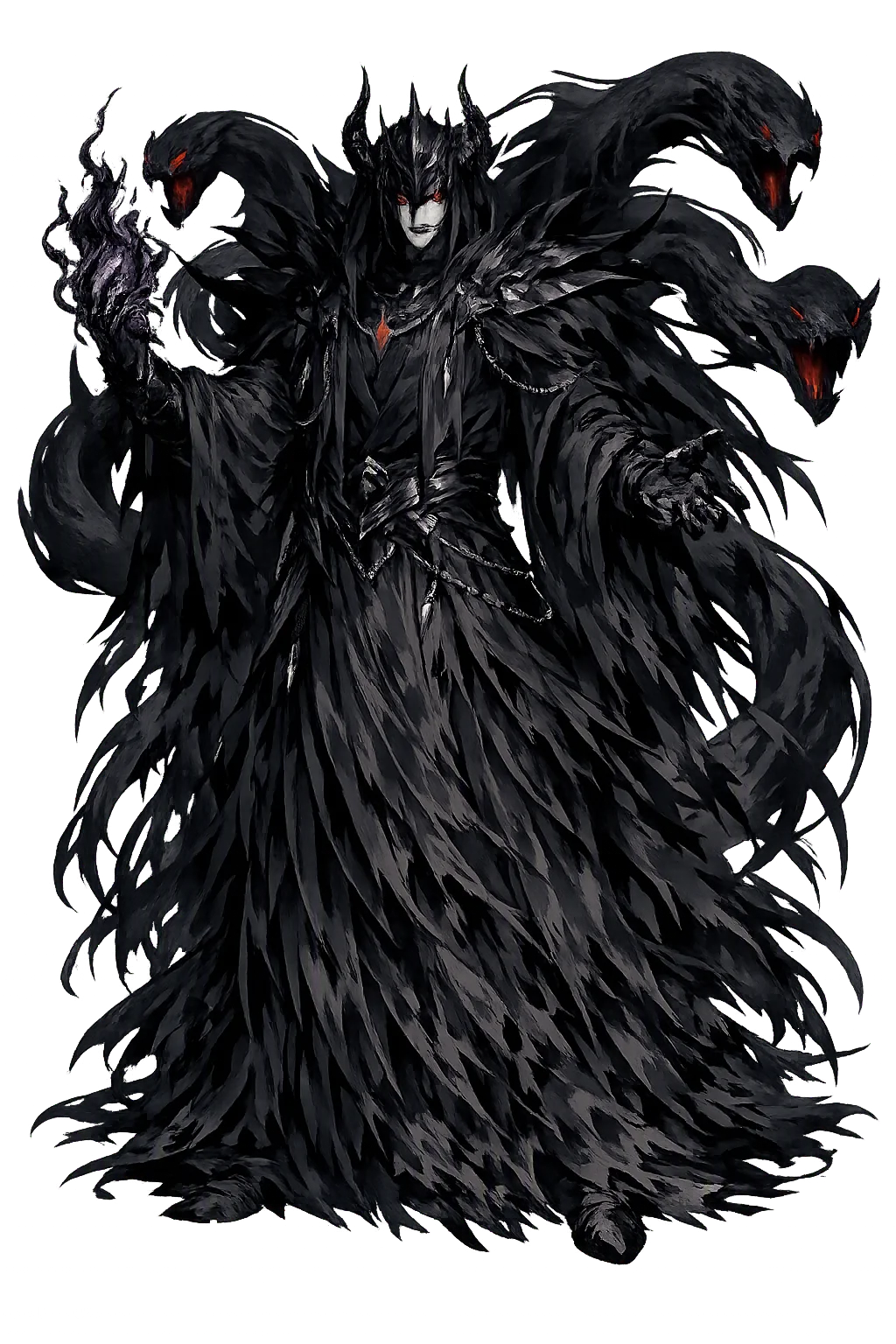
Stories of Ahriman
Ahriman's mythology is the drama of Zoroastrian dualism: a spirit of destruction who chooses evil at creation's dawn, assaults the sky, counterfeits every good thing, and is finally bound. The fullest account is the Sasanian Bundahišn; the oldest, the Gāthās of Zarathustra.
The oldest stratum of Zoroastrian scripture is not a battle story but a choice. In Yasna 30.3–5 Zarathustra hymns 'the two spirits in the beginning, the twins renowned as the Better and the Bad in thought, word, and deed... when the two spirits met, they created life and not-life, and settled that at the last the worst existence would be for the followers of the Lie, but the Best Mind for the followers of Truth.' The Bad Spirit — aŋrō mainiiuš — 'chose not-being' in the deed he performed. Later tradition hardened the twinhood into two eternities, but the Gāthās themselves insist on what scandalized later theologians: evil is primordial as a choice, not as a substance. The myth means that good and evil are first of all directions of the will, and every human soul stands where the two spirits once stood.
The Sasanian Greater Bundahišn (ch. 1) narrates the attack. Ahriman, in his darkness below, glimpses Ohrmazd's luminous creation and rises, envious, to destroy it. Ohrmazd — knowing the end belongs to him — offers peace: let the two realms keep to themselves for 9,000 years. Ahriman refuses; but at the first recitation of the Ahuna Vairya prayer he is thrown into stupor for three thousand years, from which the demoness Jahi the Whore wakes him with a shout. He smashes through the sky — egg-like boundary of the ordered world — from the north, and his demons pour in after him. Only then does Ohrmazd set creation in motion against him. The myth means that evil's first act is always an invasion of someone else's order: the Lie owns nothing it does not break into.
Ahriman's characteristic act in the Bundahišn is not creation but counterfeiting. Against Ohrmazd's sky he set the demon of winter; against water, drought and salt; against the earth, the burrowing demons; against plants, poison and the hundredfold diseases; against the sacred cattle, wolves and hunger; against man, the lie, lust, and untimely death. The text counts the diseases he fashioned at 99,999. Nothing in his inventory is original — everything is a wound answering a good thing, exactly as later doctrine says: he could not make a world of his own, and so made war on the one he found. The myth gives Zoroastrianism its sharpest answer to the problem of evil: the Devil has no substance of his own, only a talent for damage — and what can only destroy is already defeated in principle.
In Vendidad 19 the adversary comes in person against the prophet. Aŋra Mainyu, with the assembled daēvas, appears to Zarathustra in the wilderness and offers sovereignty — 'we will make you ruler of the nations' — if he will abandon the praise of the Good Spirit. Zarathustra refuses, and the chapter ends with the Lie fleeing back into hellish darkness, beaten in a contest of questions that unmasks each demon's weakness. The scene is the tradition's own counterpart to the desert temptations known from later scripture, and it fixes Ahriman's method: he never merely attacks — he offers, appealing to ambition and despair, and he loses whenever a will refuses him. The myth means his power has exactly the reach of human consent; where no one listens, the Evil Spirit is already in chains.
The end of the Bundahišn grants the adversary no pyrrhic apocalypse and no equal victory. In the last three millennia the world-born saviors — the Saošyants — lead the final assault; the dead rise and pass through the ordeal of molten metal, which scalds the wicked and is warm as milk to the just; and Ahriman and the demons are thrown back, bound, and deprived of power. Some late texts go further and have him and Ohrmazd dine together on the haoma, the lie expunged. The final state is not a truce but the frashō.kereti, the making-wonderful: evil removed from creation as completely as salt from water. Against the Norse Ragnarǫk, where the old gods die in the fire, the Iranian end refuses the romance of mutual destruction. The myth means that good is not one side of a balance but the whole scale — and evil an error being corrected.
Evil
Ahriman is the Evil Spirit of Zoroastrianism — Avestan Aŋra Mainyu, 'destructive mind' — the adversary of the wise lord Ohrmazd. He is not a rival god but the Lie made willful: choice turned against creation. The tradition is emphatic that he creates nothing, can only corrupt, and is destined to lose.
Yasna 30's two spirits, Better and Bad, choose creation and not-being at the world's first dawn — evil begins as a choice, not a birth.
His essence is the Lie — Avestan druj — deception and disorder that rot good choice; the daēvas are his servants.
Against Ohrmazd's sky, waters, plants, cattle, and man he fashioned opposites: winter, drought, poison, wolves, and death (Bundahišn).
At the Renovation he is bound and defeated, his weapons melted away — eschatology grants evil no Ragnarǫk, only erasure.
From the original script to the living URL
𐬀𐬢𐬭𐬀 𐬨𐬀𐬌𐬥𐬌𐬌𐬎
The name in its original Zoroastrian form. Ahriman (𐬀𐬢𐬭𐬀 𐬨𐬀𐬌𐬥𐬌𐬌𐬎) is attested in the source tradition — “Evil spirit, destructive mind”. Its original diacritics and script distinctions carry the full phonetic and orthographic weight of the source tradition.
ahriman
The plain ahriman form is identical to the Unicode restoration. Because this name is already written in Latin letters, no diacritics, stress, or script information were lost — only capitalization differs.
Ahriman
The Unicode restoration does not need to recover lost marks for Ahriman. Its value is canonical spelling and consistent cataloguing, not the reconstruction of erased orthography. The domain is readable as-is to both DNS and humanity.
Ahriman.com
This restoration is written entirely in ASCII letters — no Punycode encoding stands between Ahriman and the DNS. The domain reads identically to machines and to human eyes.
Owned, ideal, and ASCII forms of Ahriman
Ahriman
Restores 𐬀𐬢𐬭𐬀 𐬨𐬀𐬌𐬥𐬌𐬌𐬎. The full Unicode restoration. ahriman.com is not in the PuniCodex collection — it is watched for release; if it drops, this temple upgrades to an owned flagship.
How Ahriman was spoken
How Ahriman travels from ancient script to the modern URL
The lore you have read is the living myth. Extended Lore opens the scholarly vault beneath it: the cult and its material remains, a history of the image, the name after antiquity, a meditation on what the name still means, and the full scholarly apparatus — etymology, orthography, sources.
Enter Extended Lore