PuniCodex

Extended Lore

𐬀𐬢𐬭𐬀 𐬨𐬀𐬌𐬥𐬌𐬌𐬎 Ahriman

Etymology · Orthography · Cult · Iconography · Reception · Sources

Tier 2 Ahriman
Ahriman — Evil, Destruction, Lies
01

Quick Facts

Essential information about Ahriman, Evil, Destruction, Lies

Original Script𐬀𐬢𐬭𐬀 𐬨𐬀𐬌𐬥𐬌𐬌𐬎
Unicode RestorationAhriman
Reconstructed Pronunciation/ahriman/
PantheonZoroastrian
DomainEvil, Destruction, Lies
MeaningEvil spirit, destructive mind
ClassificationTier 2
Primary DomainAhriman
Sacred SymbolsThe dragon Aži Dahāka, Druj, the Lie, The north, Winter and drought, Wolves and xrafstars
02

Etymology & Word Family

From original script to Unicode restoration

Original Script 𐬀𐬢𐬭𐬀 𐬨𐬀𐬌𐬥𐬌𐬌𐬎 Ahriman — "Evil spirit, destructive mind"
Unicode Restoration Ahriman Canonical scholarly spelling — ASCII-identical
Modern ASCII ahriman Plain-ASCII fallback

The name Ahriman reaches the modern world through scholarly transliteration of the zoroastrian tradition. Because the conventional spelling uses only Latin letters, its Unicode and ASCII forms coincide — the tradition it carries is in the name itself, not in diacritics.

03

Unicode Character Breakdown

Character-by-character philological analysis

CharacterUnicodeNameBlockPhonetic Role
AU+0041Latin Capital Letter ABasic LatinSame
hU+0068Latin Small Letter HBasic LatinSame
rU+0072Latin Small Letter RBasic LatinSame
iU+0069Latin Small Letter IBasic LatinSame
mU+006DLatin Small Letter MBasic LatinSame
aU+0061Latin Small Letter ABasic LatinSame
nU+006ELatin Small Letter NBasic LatinSame

The Tier 2 classification here reflects fidelity to the attested tradition, not recovered diacritics: every character of Ahriman already survives in ASCII. What the restoration preserves is the canonical spelling itself — the form scholarship standardised.

04

Cult & Worship

How the sacred was kept — rites, sanctuaries, remains

The Cult

There was never a cult of Ahriman, and that absence is itself the doctrine. Zoroastrian theology made the worship of the Lie unthinkable — no sanctuary, altar, festival, or priesthood was ever dedicated to him, and no votive bearing his name has been found in Iran. His role in religious practice is precisely inverse: he is the object of cursing and exorcism. The Vendidad's purity laws target his agents, above all the corpse-demon Druj Nasu; the barashnum purification, the daily tying of the kusti, and the perpetual discipline of good thoughts, good words, and good deeds all function as standing refusals of him. The initiation of a child into the faith is framed as enlistment on Ohrmazd's side against the Lie, and orthodox Sasanian polemic spent its energy refuting the Zurvanite heresy that made him a son of Time. His only 'devotees' were the demons of his own counter-creation.

In the Earth

There is deliberately no archaeology of Ahriman: a cult of evil would have been unthinkable, and none existed. The material record is the scripture itself — the Avesta survives in manuscripts of a Sasanian archetype, the oldest substantial copy being the British Library's 'Avesta of 1323 CE'. The closest contemporary witness is linguistic rather than iconic: the Old Persian inscriptions of Darius I at Behistun and Persepolis name drauga, 'the Lie', as the cosmic enemy the king's order fights — Ahriman's essence without his name, some three centuries after Zarathustra. Sasanian iconography avoids his image entirely, and no sanctuary, altar, or votive has ever been identified with him. Evil's archaeological footprint is precisely an absence: the one god-shaped hole in Iran's religious landscape.

05

Iconography

How Ahriman was imaged across the ages

The Image

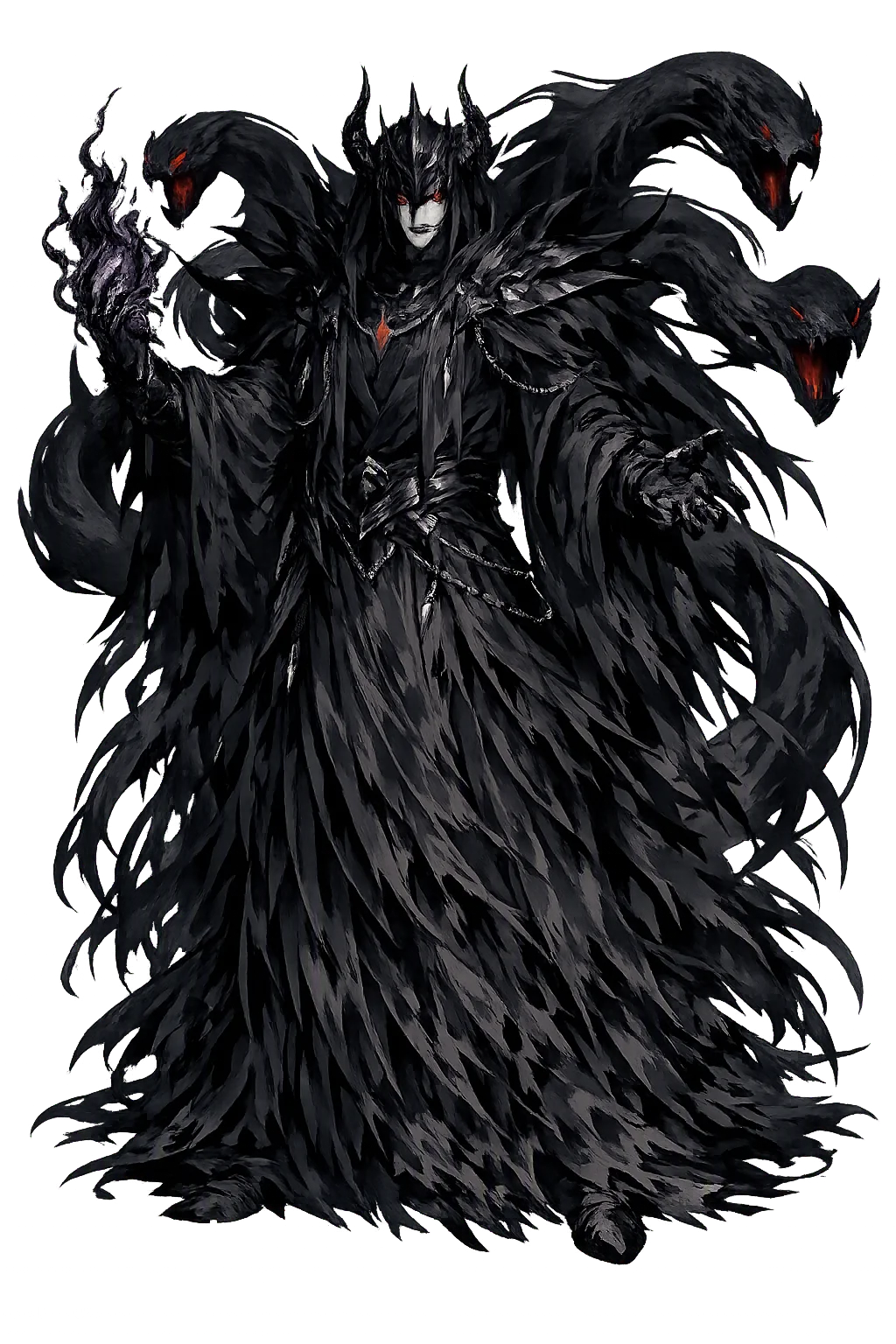
Ahriman was never imaged — deliberately. Sasanian art, rich in investiture scenes and fire altars, contains no identified figure of the Evil Spirit; to give him a body would have granted the Lie a claim on being. The texts supply his attributes instead: darkness, the cold north, winter and drought, the dragon Aži Dahāka — three mouths, three heads, six eyes — as his greatest weapon, and a counter-creation of diseases numbered in the tens of thousands. His most powerful medieval visualization is indirect. The Shahnameh's Zahaq, the Arab king on whose shoulders grow two man-eating serpents, is Aži Dahāka humanized; in illustrated manuscripts of Firdawsi's epic — the Shahnameh of Shah Tahmasp, the Great Mongol Shahnameh — Zahaq becomes the terrifying proxy-image through which Iranian art gave Ahriman a face without ever naming him.

06

Reception & Transformation

The name after its own age — transmission, translation, survival

Afterlives

Ahriman's afterlife begins with his own tradition's refusal. The Sasanian church compiled the Avesta and the Pahlavi books — Bundahišn, Dēnkard, Ardā Wirāz — that fixed him as adversary, while Zurvanite speculation, condemned yet persistent, made him a twin son of Infinite Time. Outside Iran, Plutarch recorded the Magi's good and evil daimones, naming the evil one Arimanius; a Greek magical papyrus invokes him by name for sorcery; Manichaeism carried him into Middle Persian as hrywm'n, prince of darkness in the Turfan texts, and Syriac and Armenian writers transmitted the name as Arhmn — the Zoroastrian outline feeding, many scholars argue, the developing figure of Satan in late antiquity. Islamic Iran met him as Ahriman of the New Persian epic, the instigator of evil kings from Zahaq onward. Europe rediscovered him through Anquetil du Perron's Avesta translation (1771); nineteenth-century philology — Rask, Westergaard, Geldner, Bartholomae — established the texts on scientific footing, and Boyce and Skjærvø fixed the modern portrait. From Gāthāic abstraction to Sasanian adversary to the modern world's default image of absolute evil, the name has traveled by translation and polemic rather than by cult.

Identifications Across Traditions

Medieval Zoroastrianism itself generated the most famous heresy about him: Zurvanism, attested in the Denkard's refutations and in Syriac and Armenian reports, made Ohrmazd and Ahriman twin sons of Zurvan, Infinite Time — evil suddenly genealogical rather than chosen, precisely the move orthodox theology refused. Outside Iran, Plutarch (De Iside et Osiride 46–47) reports the Magi and their good and evil daimones, naming the evil one Arimanius; the name turns up again in a Greek magical papyrus (PGM IV), invoked there by sorcery. Manichaeism took the figure into Middle Persian as hrywm'n, a hostile prince of darkness in the Turfan texts, and through late-antique Christian polemic his outline fed the developing theology of Satan — the 'devil as cosmic adversary' of the West owes much of its shape to the Persian-period encounter. The Achaemenid inscriptions are strikingly silent: Darius knows Auramazda and the Lie (drauga), but never the Evil Spirit by name.

Modern Legacy

Ahriman never had a cult — no sane theology worships the Lie — yet his legacy is immense. In New Persian ahriman became an ordinary word for devil, and in Zoroastrian liturgy his name is ritually cursed to this day. The intellectual legacy is larger: the mature Western Devil, the 'prince of darkness' of Second Temple and early Christian writing, took much of its profile from the Persian-period encounter with Zoroastrian dualism — cosmic adversary, tempter, lord of a demonic host, destined loser. In modernity, Anquetil du Perron's 1771 translation of the Avesta reintroduced Ahriman to Europe, where he became a fixture of Romantic orientalism and eventually of scholarship — Boyce's Zoroastrians made the religion legible to a general readership. He endures in games and fantasy as the stock arch-fiend, rarely credited. The name thus tracks a long migration: from Gāthāic abstraction to Sasanian adversary to the modern world's default image of absolute evil.

07

The Meditation

What Ahriman means — beyond the dictionary

Ahriman is the rarest thing in mythology: a god of evil whom his own tradition insists is not a god. The Gāthās will not let him be a second creator or an equal power; they make him a choice — the will that looked on truth and chose otherwise. What later centuries built into a towering demon-king began as something more unsettling: the recognition that evil needs no substance, only a decision, and that the decision is available to everyone, always.

This is why Zoroastrian eschatology is so strange to readers raised on Norse or Christian endings. There is no last battle whose outcome is uncertain, no twilight in which evil wins the field. Ahriman's defeat is announced at his first appearance; his entire mythology is a working-out of a foregone conclusion — which means the drama was never really about him. It is about us, standing where he stood, asked the question he was asked, and answering.

08

Frequently Asked Questions

Common questions about Ahriman, Evil, Destruction, Lies, and Unicode restoration

01How do you pronounce Ahriman?

In reconstructed pronunciation, Ahriman is /ahriman/ — approximately Say "ahriman" with the stress and length implied by the scholarly restoration "Ahriman".

02What does Ahriman mean?

Ahriman means Evil spirit, destructive mind in the zoroastrian tradition.

03What are the symbols of Ahriman?

Ahriman is associated with The dragon Aži Dahāka (The three-mouthed, three-headed, six-eyed dragon he loosed against creation (Yasna 9.8; Yašt 9) — winter and lie made monster), Druj, the Lie (Deception as his true weapon — the dark counterpart of Aša, the order and truth that hold the good creation together), The north (The direction of his assault on the sky: he broke in from the north, the realm of cold and darkness (Bundahišn)), Winter and drought (His counter-creations against sky and water — the killing seasons raised against Ohrmazd's order), Wolves and xrafstars (The noxious creatures of his making — predators and vermin set against cattle, the good man's wealth).

04Why restore Ahriman in Unicode?

Ahriman is written entirely in ASCII letters, so its restoration is about canonical fidelity rather than recovered diacritics: the temple fixes the name in its scholarly standard spelling, attested in the source tradition, instead of leaving it to drift.

05What is the most important myth about Ahriman?

“The Two Spirits at the First Dawn” — the Yasna 30 story that anchors the mythology of Ahriman, told in full on the lore page.

09

Scholarly Sources

The philological foundations of this restoration

Every claim on this page is grounded in established scholarship. The orthographic restorations follow disciplinary convention. The etymological chain follows the best available reference works. This is not invention — it is resurrection through scholarship.

◈

Lexicography & Philology

  • AirWb
  • Bartholomae
◎

Primary Texts

  • Zarathustra, Gāthās: Yasna 30 (the two spirits) and 45 (the better and the bad)
  • Vendidad 19 (the temptation of Zarathustra)
◉

Archaeology & Art History

  • Material evidence — iconography, inscriptions, and temple archaeology — for Ahriman and related cults.
✦

Religious Studies

  • Greater Bundahišn, trans. Agostini & Thrope, The Bundahišn (Oxford, 2020)
  • Boyce, Mary, Zoroastrians: Their Religious Beliefs and Practices (1979)
  • Skjærvø, Prods Oktor, The Spirit of Zoroastrianism (2012)
  • Shaked, Shaul, Dualism in Transformation: Varieties of Religion in Sasanian Iran (1994)
Return

The Surface Awaits

You have traced the name from its earliest attestation to its Unicode restoration. Now return to the myth. The story is where the name lives.

Back to Lore
Ahriman mascot