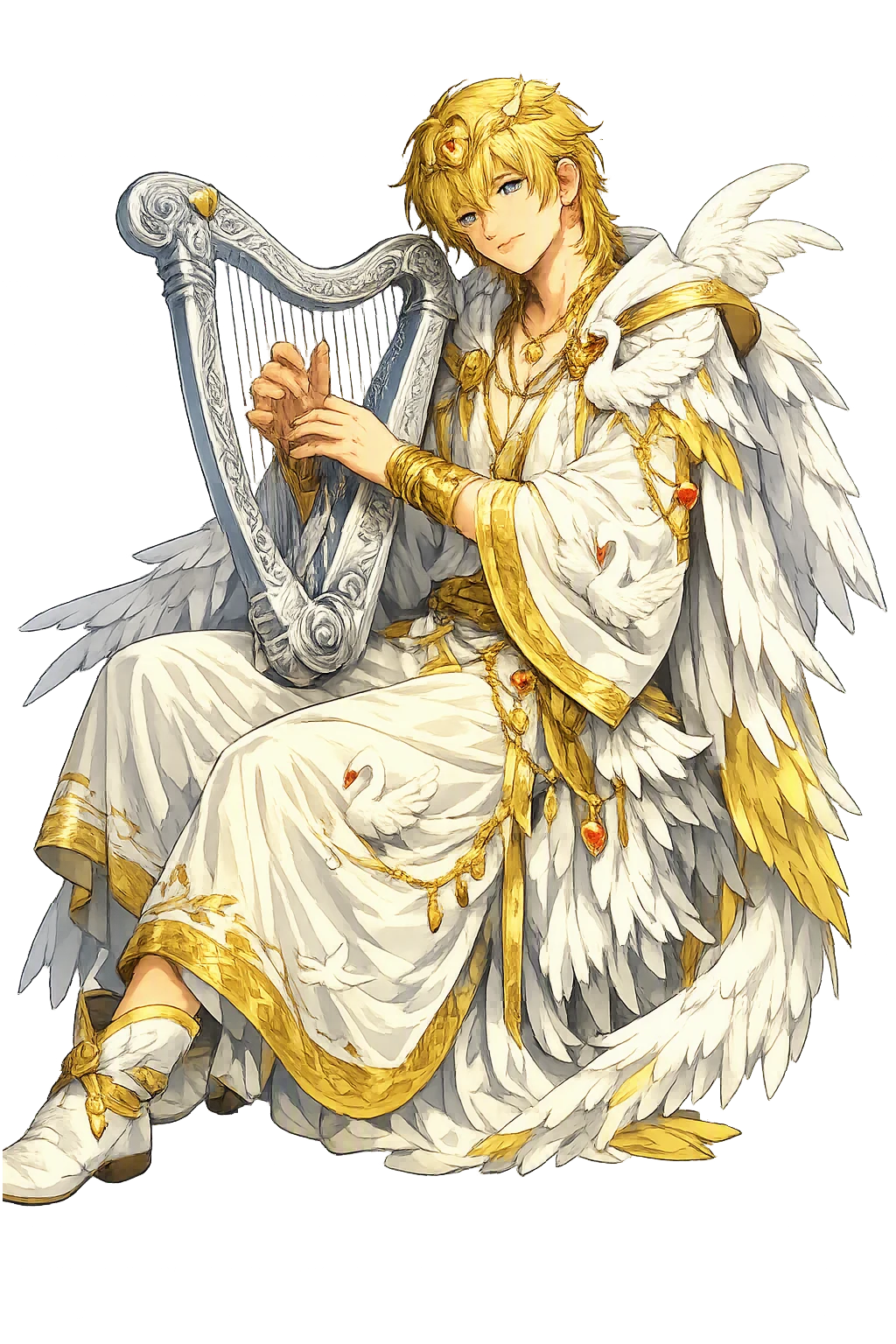
Stories of Aengus
Aengus's mythology is a study in winning without fighting. The three great set-pieces — his birth inside a stopped day, his taking of the Brug, and the dream-quest for Caer Ibormeith — are all victories of time: time held still, time parsed, time waited out. The counselor and the host follow: the son whose wit saves his father, and the keeper of the Brug who shelters Étaín when all Ireland has no safer room.
The Dagda desired Bóand, the wife of Elcmar of the Brug, and sent Elcmar away on a day's errand to Bres. To hide what followed, the tale says, the Dagda made the sun stand still: nine months passed, and the world reckoned it a single day — so the child was conceived and born within one day, and Elcmar came home none the wiser. They named the boy Óengus, but the story gave him the name that stuck: mac ind Óc, 'the son of the young', because young was the day that bore him.
The episode fixes the god's signature before he can speak: he is a child of bent time. Bóand, the Boyne itself made goddess, is his mother; the Dagda, the All-Father, his sire; and his first house is the river-bend his father stole a day to give him. The fosterage that followed — with Midir of Brí Léith — placed him among the proudest of the Túatha Dé Danann and set up every tale that came after. A birth concealed inside a stretched day becomes the charter of a god whose entire career will be spent stretching time further.
When the Dagda divided the síd-mounds of Ireland among the Túatha Dé Danann, Óengus was away fostered with Midir and received nothing. He came home to claim his share, and the Dagda, having no mound left to give, granted him Brú na Bóinne — the Dagda's own house — for a day and a night. When the term was spent and the Dagda asked for his Brug back, Óengus answered that it is in days and nights that the whole world is spent, and so the grant had no end. The All-Father lost the argument, and the greatest mound in Ireland passed to the son who had read the fine print.
The tale is told with a straight face, but its logic is the logic of the síd itself: the Otherworld does not run on mortal clocks. A god born inside a single stretched day is the natural owner of a house held on a day without a term. Irish law prized the exact word; Óengus's first deed makes etymology into real estate, and it never has to be defended with a weapon.
A maiden came to Óengus in sleep, playing a timpán, the sweetest music he had heard; for a year she came, and he could never hold her, and when she ceased to come he wasted with love-sickness. Bóand searched Ireland for a year and found nothing; the Dagda searched a year and found nothing; then Bodb Derg, king of the síd of Munster, searched, and at the year's end found her: Caer Ibormeith, daughter of Ethal Anbuail of síd Uaman in Connacht.
But Caer lived under a rhythm no bargain could break: one year in girl's shape and one as a swan among thrice fifty swans on Loch Bél Dracon, each pair linked by a silver chain and Caer's own of gold, and the change came at Samain. Óengus went to the lake at Samain and called to her, and she answered that she would go with him only if he took the swan-shape beside her. He entered the water, became a swan, and the two flew three times around the lake — and their music put every listener to sleep for three days and three nights — then away to Brú na Bóinne, where the singing of the two swans became part of the mound's music ever after.
When the jealous Fuamnach struck Étaín with a rod of scarlet quicken-tree and made her a pool of water, then a worm, then a purple fly, the fly that was Étaín came at last to Brú na Bóinne, to the hall of Óengus. He knew her — the fly's music and its radiance were hers — and he built her a grianán, a sun-bower of crystal filled with healing herbs and the bloom of every field, and she stayed with him there, and the window of the bower let her pass in and out as she pleased.
It could not last. Fuamnach followed the rumor of the fly's good fortune and raised a magic wind that swept Étaín out of the bower and across Ireland for seven years, until she fell into the cup of Étar's wife at the Bay of Cíú and was drunk, conceived, and born again a thousand and twelve years after her first birth. Óengus's shelter is one of the gentlest episodes in the cycle: the young god keeping one hunted woman safe in the safest house in Ireland, against a malice even his Brug could not finally exclude.
Under the tyranny of Bres the Dagda was set to building the usurper's forts, and the satirist Cridenbél taxed him the three best bits of every ration, until the greatest of the gods was failing from hunger — for no one dared refuse a satirist whose curse raised blisters on the face. Óengus came to his father and gave him the counsel that turned the trap: demand of Bres the pick of the cattle of Ireland as wages, and hide three gold coins in the porridge portion meant for the satirist. Cridenbél swallowed greed and gold together and died of it; and when Bres demanded the Dagda's death for the killing, the dead man's own belly gave the verdict — cut open, it held the gold, proof that greed and not the Dagda had killed him.
The episode is the tradition's clearest pairing of father and son: the Dagda's patience carrying the labor, Óengus's wit carrying the case. The young god does not raise a weapon in the whole of Cath Maige Tuired, and does not need to — his contribution to the war that freed the Túatha Dé Danann was a sentence spoken at the right fireside.
The Mac Óc — the Son of the Young, god of Brú na Bóinne
Aengus — Old Irish Óengus, the mac ind Óc, 'son of the young' — is the ever-young god of the Túatha Dé Danann, son of [[dagda|the Dagda]] and Bóand. His power is the strangest in the corpus: not the club or the spear, but the dream, the bargain, and the unaging house. He was born inside a single day, won the greatest mound in Ireland on a grammar quibble, and found his wife in a dream.
In the Aislinge Óenguso a maiden comes to him in sleep with music; he sickens for love of a woman he has never seen awake, and the dream must be hunted like a quarry.
Caer Ibormeith lives one year as a girl and one as a swan among thrice fifty swans on Loch Bél Dracon; to win her, Óengus takes the swan-shape himself.
The Brug on the Boyne — síd in Broga, the mound the world calls Newgrange — his Otherworld house, won from the Dagda for 'a day and a night' and kept ever since.
Asked when he would surrender the mound lent 'for a day and a night', he answered that the whole world is spent in days and nights — and the answer has never been overturned.
From the original script to the living URL
Aengus
The name survives in scholarly transliteration. Aengus is the standard Celtic romanisation, documented in academic sources — “One vigor, true strength”. Because the spelling uses only Latin letters, the form is the same in both ASCII and Unicode.
No indigenous writing system is securely attested for individual celtic names. The form shown is a modern scholarly transliteration.
aengus
The plain aengus form is identical to the Unicode restoration. Because this name is already written in Latin letters, no diacritics, stress, or script information were lost — only capitalization differs.
Aengus
The Unicode restoration does not need to recover lost marks for Aengus. Its value is canonical spelling and consistent cataloguing, not the reconstruction of erased orthography. The domain is readable as-is to both DNS and humanity.
Aengus.com
This restoration is written entirely in ASCII letters — no Punycode encoding stands between Aengus and the DNS. The domain reads identically to machines and to human eyes.
Owned, ideal, and ASCII forms of Aengus
Aengus
The full Unicode restoration. aengus.com is not in the PuniCodex collection — it is watched for release; if it drops, this temple upgrades to an owned flagship.
How Aengus was spoken
How Aengus is preserved in writing
No indigenous writing system is securely attested for individual celtic names. The form shown is a modern scholarly transliteration.
Contribute scholarly provenance →The lore you have read is the living myth. Extended Lore opens the scholarly vault beneath it: the cult and its material remains, a history of the image, the name after antiquity, a meditation on what the name still means, and the full scholarly apparatus — etymology, orthography, sources.
Enter Extended Lore