
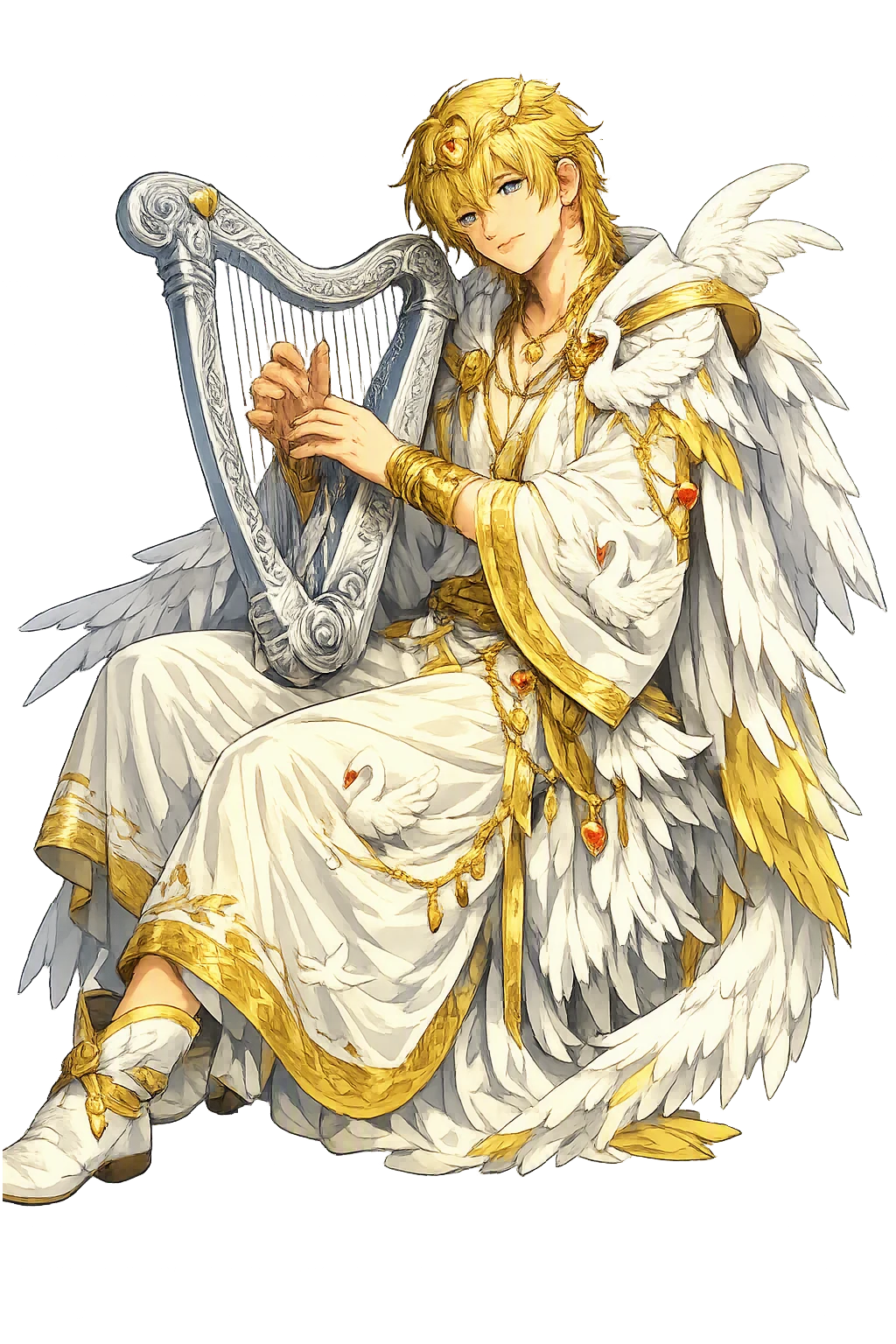
How Aengus got its accent back
The ASCII form aengus is missing something. Aengus restores the marks the source language used to distinguish this name from a thousand others — and those marks change how the name is read, pronounced, and understood. This post explains, with the full scholarly record behind it, what each restored mark preserves: the Celtic transcription evidence, the reconstructed sound, the myths the name carries, and the classification logic that separates Tier 1 restorations from Tier 2. By the end, the marks in Aengus will look less like ornaments and more like what they are — recovered evidence, pinned back in its proper place.
At a Glance
- Restored name: Aengus
- ASCII form: aengus
- Meaning: "One vigor, true strength"
- Domain of influence: Love, Youth, Poetry
- Pantheon: Celtic
- Classification: Tier 2
Overview
Aengus (aengus) — Love, Youth, Poetry · One vigor, true strength — is the Óengus mac ind Óc of medieval Irish tradition: the ever-young god of the Túatha Dé Danann, son of the Dagda and Bóand, the goddess of the Boyne, and lord of Brú na Bóinne, the mound the world calls Newgrange. His dossier is the strangest kind of power in the Irish corpus — not the club or the spear but the dream, the bargain, and the unaging house: conceived and born within a single day the sun was made to hold still; winner of the greatest mound in Ireland on the quibble that a grant of 'a day and a night' has no end; lover of a girl he had seen only in sleep, found by searching every lake in Ireland for a year.
The name is a transparent Old Irish compound: óen, 'one', plus gus, 'vigor, force' — 'one vigor', a single strength held undivided. The later spelling Aengus drops the fada, and the Anglicized Angus carried the theonym into the roll of Scottish given names.
PuniCodex restores the name as Aengus — identical to the ASCII input, because the Middle Irish spelling the temple follows writes no diacritic. The mechanical rule therefore places it in Tier 2: nothing distinctive is lost in transit, a statement about orthography and never about the god. No domain is claimed: the plain-ASCII aengus.com is registered to a third party outside the collection and is watched for release.
The Name
The theonym is attested in Old Irish as Óengus (later Aengus, Aonghus), and the tradition understood what it was made of: óen, 'one', plus gus, 'vigor, force' — 'one vigor', or in the fuller gloss, one true strength. The eDIL and Vendryes' LEIA record both elements; the compound is of the ordinary Old Irish type that joins a numeral or adjective to a noun of quality, and it was common enough as a masculine personal name before it was famous as a god's.
His mythic style matters as much as his name. The tales call him mac ind Óc, 'the son of the young' — explained by the birth-story itself, in which the Dagda held the sun still so that the boy was conceived and born within a single day: young was the day that bore him. The shortened form Mac Óc, 'the Young Son', became his standing title in the later tradition. The unaccented Middle Irish spelling Aengus is the form this temple follows; Modern Irish Aonghus and Scottish Gaelic Aonghas continue the living name, and the Anglicized Angus made a theonym into an ordinary Scottish given name.
The ASCII form aengus loses nothing, because the restored spelling is already plain Latin letters; the restoration is a matter of canonical reference, not rescued diacritics, and the name is classified Tier 2 by the project's mechanical rule.
The letter-by-letter transformation runs:
- a → A — Same, capitalized
- e → e — Same
- n → n — Same
- g → g — Same
- u → u — Same
- s → s — Same
The project holds no domain for this name: aengus.com is registered to a third party outside the PuniCodex collection and is watched for release. The temple lives at its canonical lexicon address.
The Original Script
The name is preserved in medieval Irish manuscripts in the Latin alphabet as Óengus — Old Irish in Insular script, attested from the early medieval period in the glosses and in the codices that preserve Tochmarc Étaíne (the twelfth-century Lebor na hUidre) and, in later manuscripts, the Aislinge and De Gabáil in t-Sída. The earlier monumental alphabet, ogham, predates the manuscript tradition; it knows the personal name but no attestation of the theonym has ever been read on an ogham stone, so the manuscript form remains the primary witness.
The scholarly rendering proceeds step by step:
- Old Irish was written in the Latin alphabet using Insular minuscule; the spelling Óengus carries a síneadh fada marking the long Ó.
- The name is a transparent compound: óen, 'one', plus gus, 'vigor, force' — the analysis the etymological dictionaries record.
- The Middle Irish spelling Aengus drops the fada; Modern Irish Aonghus and Scottish Gaelic Aonghas continue the living form, and the Anglicized Angus completes the drift.
- The Unicode restoration follows the unaccented Middle Irish form: Aengus is identical to the ASCII input apart from the capital, and the temple form is a canonical reference, not a rescued spelling.
One caution attaches to the record: the manuscript tradition's accented Óengus is the more exact Old Irish form, and this edition cites it wherever the manuscripts are quoted; the temple's unaccented Aengus is a matter of the project's naming convention, not a claim about the manuscripts.
Pronunciation
The reconstructed pronunciation of the name is /ˈoːŋ.ɡus/ — Old Irish Reconstruction.
Phoneme by phoneme:
- Óe- — Long close back vowel [oː], stressed on the first syllable as in all Old Irish; the fada of the manuscript form marks exactly this length
- -n- — Velar nasal [ŋ], the n drawn back before g, as in English 'singer'
- -g- — Voiced velar stop [g], kept hard after the nasal; lenition does not soften this cluster
- -us — Short back [u] with voiceless [s], the unstressed masculine ending
For the modern speaker, the closest approximation is: 'OHN-gus' — one long open 'oh', the ng of 'singer', a hard g, and a short unstressed 'us'. Modern Irish Aonghus and Scottish Aonghas have worn the first vowel toward a diphthong and then a plain vowel — the Anglicized Angus is the end of that road.
Kindred and historical forms of the name:
- Old Irish — Óengus, with the fada; styled mac ind Óc, 'son of the young'
- Middle Irish — Aengus, the unaccented spelling the temple follows
- Modern Irish / Scottish Gaelic — Aonghus / Aonghas, the living Gaelic forms
- Anglicized — Angus, the theonym as a Scottish given name
Aengus is Tier 2 because the restoration preserves nothing ASCII loses: the letters of the temple form are the letters of the keyboard. The capital alone marks the canonical form.
Mythology
Aengus's mythology is a study in winning without fighting: the three great set-pieces — his birth inside a stopped day, his taking of the Brug, and the dream-quest for Caer Ibormeith — are all victories of time.
The Day the Sun Stood Still (Tochmarc Étaíne)
The Dagda desired Bóand, wife of Elcmar of the Brug, and sent Elcmar away on a day's errand; and to hide what followed he made the sun stand still, so that nine months passed and the world reckoned it a single day. The child conceived that morning was born before that night — Óengus, called mac ind Óc, the son of the young, because young was the day that bore him. He was fostered by Mídir of Brí Léith.
A Day and a Night (De Gabáil in t-Sída)
When the Dagda divided the síd-mounds of Ireland among the Túatha Dé Danann, Óengus was away at fosterage and received nothing. He came home and asked for land, and the Dagda, having no mound left, granted him Brú na Bóinne for a day and a night. When the term was spent and the Dagda asked for his house back, Óengus answered that it is in days and nights that the whole world is spent — and kept the greatest mound in Ireland on the quibble.
The Dream of Óengus (Aislinge Óenguso)
A maiden came to Óengus in sleep playing a timpán; for a year she came, and when she ceased he wasted with love-sickness. Bóand searched Ireland for a year and found nothing; the Dagda searched a year and found nothing; Bodb Derg, king of the Munster síd, searched and found her: Caer Ibormeith, daughter of Ethal Anbuail of síd Uaman in Connacht. She lived one year as a girl and one as a swan among nine score swans on Loch Bél Dracon, changing at Samain. Óengus went to the lake at Samain, called to her, and accepted her condition — that he take the swan-shape beside her. They flew three times around the lake singing a music that put all listeners to sleep for three days and nights, then away to Brú na Bóinne.
The Bower of the Purple Fly (Tochmarc Étaíne)
When Fuamnach's jealousy had made Étaín a pool, a worm, and at last a purple fly, the fly came to Brú na Bóinne, and Óengus knew her. He built her a grianán, a sun-bower of crystal filled with healing herbs and every field's bloom, and kept her safe until Fuamnach's wind swept her across Ireland for seven years, to fall into the cup of Étar's wife and be born again.
The Satirist's Three Gold Coins (Cath Maige Tuired)
Under Bres' tyranny the satirist Cridenbél taxed the Dagda the three best bits of every meal until the god was failing; Óengus gave his father the counsel that turned the trap — the pick of the cattle of Ireland as wages, and three gold coins hidden in the satirist's porridge. Cridenbél died of the gold, and the gold in his belly was itself the verdict that greed, not the Dagda, had killed him. The young god does not raise a weapon in the whole of Cath Maige Tuired, and does not need to.
Symbols & Iconography
Aengus carries no weapons and no regalia; his attributes are a house, a shape, a dream, and a sentence — the lightest equipment of any great Irish god:
- Brú na Bóinne — The Brug on the Boyne, síd in Broga, his unaging Otherworld house — the mound the world calls Newgrange
- The swan-shape — The form he takes at Samain on Loch Bél Dracon to win Caer Ibormeith: love answered in kind, shape for shape
- The dream (aisling) — The maiden's nightly visit with her timpán: desire that arrives before its object and must be pursued into the waking world
- The day and the night — The quibble that holds the Brug forever: a loan parsed as a grant without a term
- The crystal bower — The grianán he built at the Brug for Étaín in her fly-shape: shelter given to a hunted woman when no one else in Ireland could hold her
Archaeology & Evidence
Aengus is a textual god — no ogham stone names him and no votive inscription invokes him — but his mythic address is the single most famous piece of prehistoric architecture in Ireland. Brú na Bóinne, the palace of the Boyne, is a UNESCO World Heritage landscape, and the passage tomb of Newgrange (c. 3200 BCE), older than Stonehenge and the pyramids, has been identified with the tales' síd in Broga, Óengus's Brug, since the medieval topographical tradition. The mound's roof-box, which admits the rising sun into the chamber on the mornings around the winter solstice, was excavated and documented by Michael J. O'Kelly between 1962 and 1975 — a real solar alignment behind the mythology of a god born of a stopped sun.
The witnesses to the texts are exact: Tochmarc Étaíne is preserved in the twelfth-century Lebor na hUidre and later manuscripts, while Aislinge Óenguso survives in the fifteenth-century British Library MS Egerton 1782, the basis of Shaw's edition. For the comparative figure, the material record is Romano-British: altars dedicated to Apollo Maponus from the military north, including the Corbridge series, with the Ravenna Cosmography's locus Maponi completing the map of the Divine Son's cult — comparative evidence, never identification.
Realm & Domain
Aengus is catalogued under the domain 'Love, Youth, Poetry' — three words the medieval dossier earns in an unfamiliar order, for his love is reached through dream and his poetry arrives as sleep.
Love
The Aislinge Óenguso is the corpus's one great love-quest: a maiden who comes in sleep with a timpán, a year of wasting, a search of every lake in Ireland by Bóand, by the Dagda, and by Bodb Derg, and a union won on the girl's own terms — he takes the swan-shape beside Caer Ibormeith at Loch Bél Dracon. The popular handbooks' 'Irish Eros' points at this tale; the text itself gives patience, not arrows.
Youth
He is mac ind Óc, the son of the young, born of a day that never aged; his title is youth itself, and the comparative tradition — Gaulish Maponos, Welsh Mabon — is built on the same ever-young son.
Poetry
The dream arrives with music, and the union ends in it: the two swans circle the lake three times singing a strain that puts every listener to sleep for three days and nights — the aisling resolved into song.
The Lord of the Interval
Across all three, the signature is the same: time parsed, held, and waited out — the day and night that holds the Brug, the year of the dream, the Samain of the change.
Across Cultures
The comparison the handbooks prefer for Óengus runs to Gaul and Wales rather than to Rome. The Gaulish Maponos, 'the Divine Son' — known from dedications to Apollo Maponus in the Roman north of Britain and from the Ravenna Cosmography's locus Maponi — is the same figure-type: the ever-young son of a greater divine parent. Mac Cana and Sjoestedt set Maponos beside both Óengus and the Welsh Mabon ap Modron, the hunter-youth of Culhwch ac Olwen whose name is built on the same Proto-Celtic words makwos, 'son', and mātīr, 'mother'.
The popular handbooks go further and call Óengus 'the Irish Eros'; the medieval texts give a stranger and more specific figure — a god of dream, youth, and cunning whose one love-story is won by patience and shape-changing rather than by arrows. Within the Irish tradition his closest structural kin are his own house: the Dagda, whose patience he inherits and whose mound he wins; Mídir, his foster-father, whose wooing of Étaín frames the tale that gives Óengus his birth; and Bodb Derg, the searcher who finds what the parents could not. The comparisons are structural and instructive; no inscription identifies him, and the equation of Maponos with Mabon is itself a scholarly argument, not a fact.
Cultural Legacy
No Irish god had a better literary afterlife than the young one. W. B. Yeats made him a byword for longing itself in 'The Song of Wandering Aengus' (1899) — the hazel wand, the fire in the head, the glimmering girl with apple blossom in her hair who called his name and ran — a poem that poured the Aislinge into the bloodstream of modern English verse. James Stephens gave him moods and speaking parts in The Crock of Gold (1912), where Angus Og wanders the Irish countryside being wise and young.
In the later Gaelic tradition he never faded: the Fenian tale of Diarmaid and Gráinne keeps him at Brú na Bóinne as Diarmaid's fosterer and protector, and Irish folklore kept the Brug as his house into the modern period. His name took a second, quieter path: worn to Angus, it became one of the most familiar masculine names in Scotland — a theonym hiding in plain sight. And his address became the most visited prehistoric site in Ireland: Newgrange, where five thousand winters of sun have entered the chamber the tales assigned to the son of the young.
The Scholarly Record
The account of Aengus given in this edition rests on the witnesses and reference works listed below. Tochmarc Étaíne supplies the birth and the bower; De Gabáil in t-Sída the winning of the Brug; the Aislinge the dream-quest; Cath Maige Tuired the counsel; the etymological dictionaries secure the name; the Gaulish material is cited for comparison only.
- Bergin, Osborn, and R. I. Best, ed. and trans., 'Tochmarc Étaíne', Ériu 12 (1938), 137–196.
- Hull, Vernam, ed. and trans., 'De Gabáil in t-Sída', Zeitschrift für celtische Philologie 19 (1933).
- Shaw, Francis, ed., The Dream of Óengus (Aislinge Óenguso) (Dublin, 1934).
- Gray, Elizabeth A., ed. and trans., Cath Maige Tuired: The Second Battle of Mag Tuired, Irish Texts Society 52 (Naas: Irish Texts Society, 1982).
- Macalister, R. A. S., ed. and trans., Lebor Gabála Érenn, 5 vols. (Dublin: Irish Texts Society, 1938–56).
- Dictionary of the Irish Language (Dublin: Royal Irish Academy, 1913–76; electronic ed. eDIL 2019), s.v. óengus, gus.
- Vendryes, Joseph (gen. ed.), Lexique étymologique de l'irlandais ancien (Dublin: Dublin Institute for Advanced Studies, 1959–96), s.v. gus.
- Thurneysen, Rudolf, A Grammar of Old Irish, trans. D. A. Binchy and Osborn Bergin (Dublin: Dublin Institute for Advanced Studies, 1946).
- Mac Cana, Proinsias, Celtic Mythology (London: Hamlyn, 1970).
- Sjoestedt, Marie-Louise, Gods and Heroes of the Celts, trans. Myles Dillon (London: Methuen, 1949).
- MacKillop, James, A Dictionary of Celtic Mythology (Oxford: Oxford University Press, 1998), s.v. Aengus, Óengus.
- Koch, John T., ed., Celtic Culture: A Historical Encyclopedia, 5 vols. (Santa Barbara: ABC-CLIO, 2006), s.v. Óengus, Brú na Bóinne.
- Jackson, Kenneth H., A Celtic Miscellany (London: Routledge and Kegan Paul, 1951).
- Gantz, Jeffrey, trans., Early Irish Myths and Sagas (Harmondsworth: Penguin, 1981).
- O'Kelly, Michael J., Newgrange: Archaeology, Art and Legend (London: Thames and Hudson, 1982).
- McManus, Damian, A Guide to Ogam, Maynooth Monographs 4 (Maynooth: An Sagart, 1991).
- Yeats, W. B., 'The Song of Wandering Aengus', in The Wind Among the Reeds (London: Elkin Mathews, 1899).
- Stephens, James, The Crock of Gold (London: Macmillan, 1912).
A Meditation
Aengus is the god of the interval — the stretch of time between wanting and having, and his whole dossier asks what can be done with it. His father held the sun still for nine months to make a day large enough to be born in; the son learned the lesson and spent his career proving that time is a text to be parsed, not a wall to be stormed. A loan of a day and a night is forever, if you read it right. A dream that comes nightly for a year is an address, if you are willing to search every lake in Ireland for it. The name says the same: óen-gus, one vigor, a single strength held undivided — no club, no cauldron, no host, just the one force applied without distraction.
That is why his love-story is the corpus's gentlest. Every other divine wooing in Irish myth is a raid, a riddle, or a revenge; Óengus's is a search. He does not seize Caer Ibormeith; he finds her, asks her, accepts her condition, and meets her in her own shape — a god who becomes a swan because the girl is one. The music the two swans make, which puts the world to sleep for three days, is the dream coming back around: the aisling that began as a haunting ends as a harmony. Youth, in this mythology, is not the season of appetite. It is the season before resignation — the one vigor that has not yet learned to stop looking.
The Unicode Restoration
Aengus is classified as Tier 2: the restoration needs no distinctive letters or diacritics its ASCII form would lose. The ASCII fallback aengus still resolves everywhere, but it is the restored form that carries the name's full information. That is the whole thesis of this temple: the marks are the message.
Why This Restoration Matters
The marks in Aengus were never lost; they were only waiting for a carrier that could hold them. Now that the carrier exists, the burden flips: every use of aengus is a choice to leave evidence on the table. The PuniCodex temple keeps the restored form in circulation — as a domain, a dataset entry, and a scholarly argument — so that the choice to use it stays easy. Accent by accent, macron by macron, that is how the original names come back: not with a single grand gesture, but with a spelling that finally works everywhere.
Explore Further
This post is one doorway into the temple. The home page carries the full character breakdown and the ambient canvas; the lore page tells the myths in long form; the Scholarly Edition preserves the sources, pronunciation data, and revision history; and the patron wall supports the restoration directly. For the wider map, browse the Lexicon, explore the Pantheon, or return to the PuniCodex blog.
Related Names
Sources
The full scholarly apparatus — every citation, revision, and review — lives in the Scholarly Edition. Key references for this post:
- Bergin, Osborn, and R. I. Best, ed. and trans., 'Tochmarc Étaíne', Ériu 12 (1938), 137–196.
- Shaw, Francis, ed., The Dream of Óengus (Aislinge Óenguso) (Dublin, 1934).
- Hull, Vernam, ed. and trans., 'De Gabáil in t-Sída', Zeitschrift für celtische Philologie 19 (1933).
- Dictionary of the Irish Language (Dublin: Royal Irish Academy, 1913–76; electronic ed. eDIL 2019), s.v. óengus, gus.
- Lexicon authorities for this entry: Lebor Gabála, MacKillop.