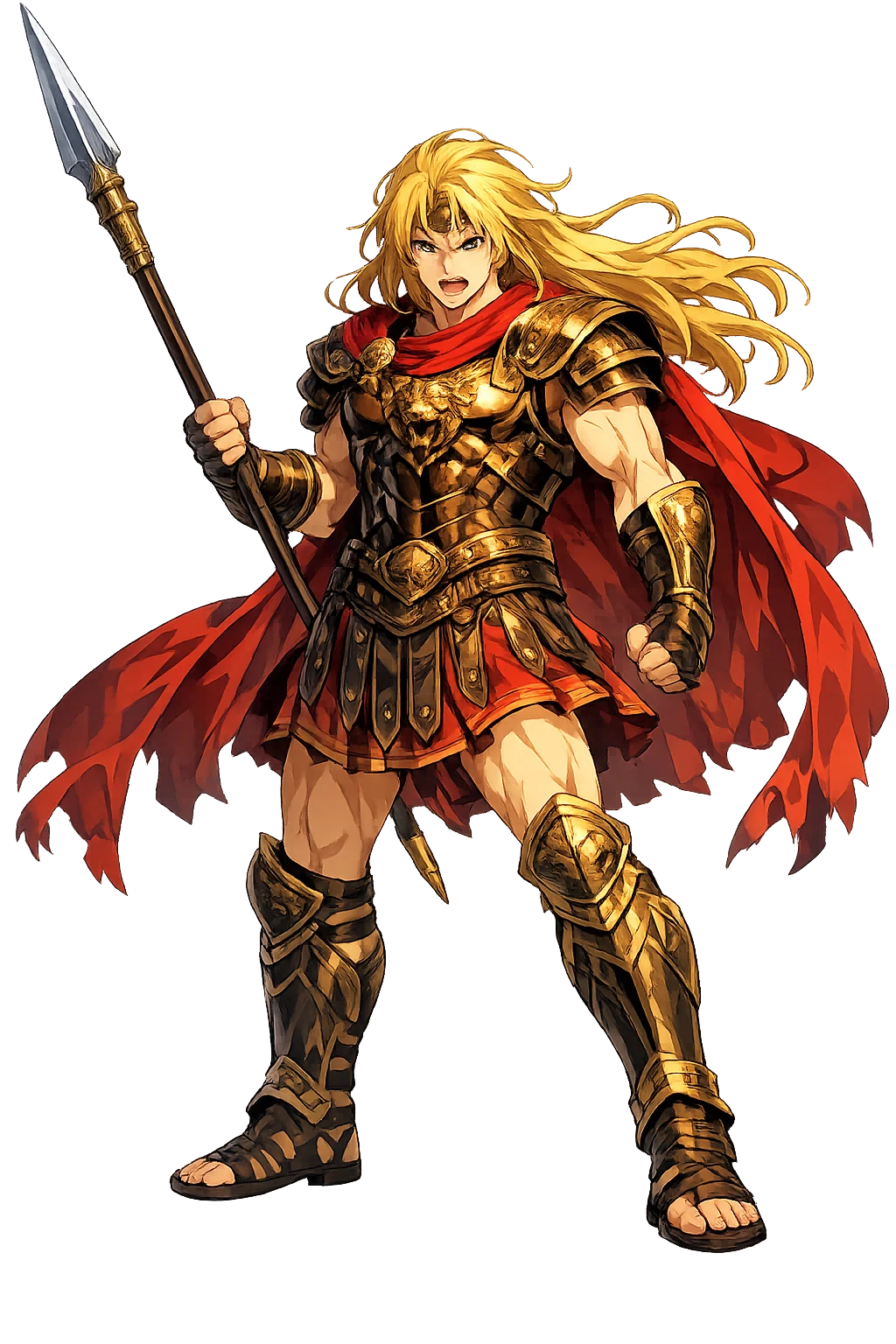
Stories of Achilleús
Son of the mortal Pēleús and the sea-goddess Thetis, Achilleús stands exactly between god and man: the strongest argument the Greeks ever made that excellence cannot cancel mortality.
Book 9 of the Iliad stages the first great decision scene of Western literature. Agamemnon's embassy — Odysseus, Aias, and old Phoinix, bearing the offer of treasure, one of Agamemnon's daughters, and restored honor — finds Achilleús in his tent, singing “the famous deeds of men” to his lyre (9.186–189). His answer is the speech every later hero rehearses: his mother has told him he carries two fates — “if I stay here and fight around the city of the Trojans, my return home is lost, but my fame will be imperishable; if I sail back to my dear fatherland, my noble fame is lost, but my life will be long” (9.412–416). He refuses the gifts, unconverted even by Phoinix's tale of Meleager, and chooses, in effect, to wait for Patroklos. The scene matters because the choice is made aloud, with the cost stated first: Achilleús never trades his life by accident — he prices it, in public, every time.
When Patroklos begged to enter the fighting in Achilleús' armor, the hero warned him: drive the Trojans from the ships and come back — do not press on to Troy (16.87–96). Patroklos drove them, pressed on, and Hektōr killed him in the borrowed armor, prophesying with his dying breath that Achilleús would soon die beneath the same wall (16.816–854). Achilleús' grief was absolute: Thetis found him face-down in the dust, groaning, holding his head while he chose revenge and death together (18.23–126). Hephaistos forged him new armor — the shield whose rim is Ocean, the most famous description in Greek verse (18.468–613) — and he returned a changed thing, “raging, grim,” his own horses weeping for Patroklos (19.392–424). He killed Hektōr, tied the corpse to his chariot, and dragged it round his friend's tomb (22.395–404; 24.14–18) — until Priam came alone to the tent at night, kissed the hands that had killed his sons, and the two enemies wept together, one for Pēleús and Patroklos, one for Hektōr (24.468–676). The Iliad's argument completes itself here: wrath becomes grief, grief becomes pity, and the hardest man in the poem learns the one thing strength cannot seize.
The Iliad never tells Achilleús' death; it keeps only arranging the appointment. Hektōr, dying, foretells it — “the day will come when Paris and Phoibos Apóllōn destroy you at the Scaean gates” (22.358–360) — and the hero himself tells the doomed Lykāon that not even he will come home (21.110–113). The full story belonged to the lost Cypria, whose outline Proclus preserves: Achilleús, struck at the Scaean gates by Paris with Apóllōn guiding the shaft; a late variant sends him down in Apóllōn's own temple, marrying Polyksenē. The invulnerability is a Roman refinement: Statius, in the unfinished Achilleid (1.269–270), tells how Thetis dipped the infant in the Styx, so that every part of him “drank in deathlessness” except where her fingers covered his heel — and the spear that later grazed him there left a wound that would not close. The myth's precision is its point: the one mortal point of the deathless boy is the exact place his mother held — vulnerability as the footprint of love.
The Odyssey's underworld gives Achilleús the most quoted anti-epitaph in Greek: better to be a living serf than king of the dead (Od. 11.488–491). But the Black Sea refused to leave him there. On Leukē, “White Island,” at the Danube's mouth, sailors believed the hero lived on — some said with Helen for his consort; Pausanias reports the belief as current in his own day (3.19.11–13), and Arrian's Periplus (21–23) describes the island's temple, its heaps of offerings, and the god appearing to sailors: a cult with a real address, provisioned for centuries. Around the Euxine he accumulated the title Pontarchēs, “Lord of the Pontus”: dedications to Achilleús Pontarchēs are known from Olbia and the surrounding coast, and Philostratus' Heroicus still has Protesilaos trading gossip about him with a Phoenician sailor. This is kleos aphthiton made literal — fame so successful it required real estate: an afterlife plotted, charted, and stocked by the sailors who needed him at the head of their sea.
War, Glory, Rage, and the Short Bright Life
Achilleús is the hero the Iliad is named around: the man who chose a short life with imperishable fame (kleos aphthiton) over a long life in obscurity. His wrath is the poem's first word — mēnin — and his heel is the world's oldest named weakness.
The Iliad opens on his mēnis — a rage that costs the Achaeans thousands of lives and remakes epic poetry.
The single unarmoured point of an otherwise deathless fighter; the West's shorthand for a fatal flaw.
Imperishable fame — the bargain every brand strikes: burn briefly and be remembered forever.
His afterlife island in the Black Sea, where sailors left offerings to the hero for a thousand years.
From the original script to the living URL
Ἀχιλλεύς
The name in its original Greek form. Achilleús (Ἀχιλλεύς) is attested in the source tradition — “Possibly 'grief of the people' (from ἄχος + λαός), or a pre-Greek name”. Its aspirated consonants, diphthongs, and acute accents carry the full phonetic and orthographic weight of the source tradition.
achilleus
Reduced to plain achilleus, the name loses everything that made it specific: aspirated consonants, diphthongs, and acute accents. What remains is an ASCII string that machines can parse but that no longer speaks with its original voice.
Achilleús
The Unicode restoration recovers what ASCII flattened. Achilleús restores aspirated consonants, diphthongs, and acute accents, returning the name to its original written dignity. The domain encodes to Punycode, but the browser displays the truth.
Achilleús.com → xn--achilles-u5a.com
The non-ASCII characters in Achilleús are encoded while the ASCII remains visible. To the DNS, it is Punycode. To humanity, it is Achilleús.
Owned, ideal, and ASCII forms of Achilleús
Achilleús
Restores Ἀχιλλεύς. The live temple domain — achilleús.com.
achilleus
Flattens Ἀχιλλεύς. The plain ASCII fallback — what DNS and legacy systems see.
How Achilleús was spoken
How Achilleús is preserved in writing
A bespoke provenance study for Achilleús is being prepared by the PUNICODEX scholarly team.
Contribute scholarly provenance →The lore you have read is the living myth. Extended Lore opens the scholarly vault beneath it: the cult and its material remains, a history of the image, the name after antiquity, a meditation on what the name still means, and the full scholarly apparatus — etymology, orthography, sources.
Enter Extended Lore