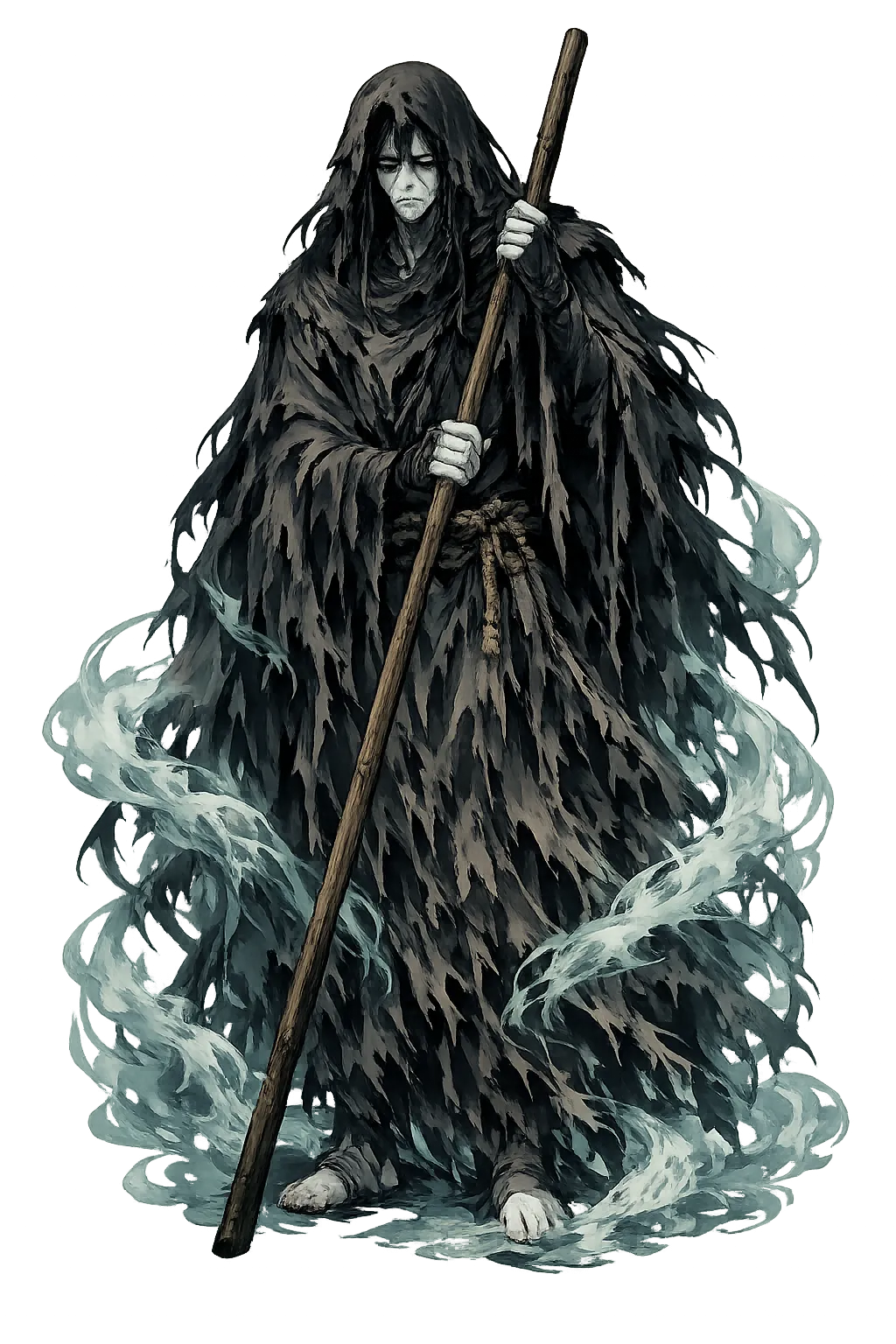
Stories of Achérōn
Achérōn is less a character than a place of passage. Its mythology is the geography of death: where the rivers flow, who ferries the dead, and what must be left behind.
Hesiod never gives the river a genealogy — the catalogue of the sons of Oceanus and Tethys in the Theogony does not name Achérōn — and the fullest ancient map of it is not epic but philosophical. In the Phaedo (112e–113e), Socrates describes three great rivers running beneath the earth: Oceanus, which circles the world at its outermost rim; Pyriphlegethon, which flows through fire into the volcanic lakes of the world above; and Achérōn, ‘which flows in the opposite direction’ through desolate regions, plunges into the Acherusian Lake, and there joins the deep-flowing Styx. Into that lake, Plato says, the souls of the dead gather and are judged: the curable are purified and released, the incurable cast into Tartarus, ‘whence they never come out’. The river is therefore the drainage system of the moral universe — every soul of the dead eventually arrives at its shore, carried to it by the geography of the life it lived.
In Odyssey 10, Circe sends Odysseus to the limits of Ocean where the Cimmerians sit in permanent mist, ‘near the boundaries of the world where Hades’ house is’; it was later tradition, and the geography of Thesprotia, that anchored the hero’s necromancy at the river Achérōn itself. There Odysseus digs a trench with his sword, pours libations of milk, honey, wine, and water, and vows sacrifice to the dead; the shades come up out of Erebus, and only after drinking the dark blood can they speak. He questions the seer Tiresias about the road home, and tries three times to embrace the shade of his mother Anticleia, who slips through his arms ‘like a shadow or a dream’. The episode is the first descent to the dead in Western literature, and its river is the membrane it crosses: blood for speech, loss for knowledge, a living man standing ankle-deep in the boundary between epic and the underworld. Grief, the myth insists, is navigable — but only at the cost of touching what cannot be held.
The Acheron was not only mythic but operational: on its Thesprotian bank stood an oracle of the dead, and even hard-headed tyrants consulted it. Herodotus (5.92) tells that Periander of Corinth, bereft of his wife Melissa, sent messengers ‘to the oracle of the dead on the river Achérōn’ to ask her where she had hidden a stranger’s deposit. Melissa’s ghost appeared, but refused to answer: she was cold and naked, she said, because although her clothes had been buried with her, they had never been burnt and were therefore useless to her. When the messengers reported this, Periander had all the Corinthians’ clothes gathered into a pit and burned — and the appeased ghost revealed the hiding place. The story is a rare ancient account of a psychomanteion at work, and it makes two sober points: the dead retain their grievances and their dignity, and the boundary between the worlds is maintained not by terror but by correct ritual payment. Even a tyrant could not cross it without settling accounts.
Virgil gathers the rivers at the threshold. At the entrance of the underworld flows the dark Achérōn, into which Cocytus, ‘lamentation’, and Phlegethon, ‘burning’, pour their waters; about it grow the mournful poplars, and from its bank old Charon ferries the souls whose bodies have received due burial (Aeneid 6.295–330). Dante, translating the whole system into Christian geography, makes the Achérōn the first river of Hell: across it Charon carries the damned, while on its near shore flutter the wretched souls of those ‘who lived without infamy and without praise’, stung by wasps and chasing banners of nothing (Inferno 3). From Plato’s moral lake through Homer’s blood trench to Dante’s river of the uncommitted, the Achérōn accumulated meanings the way rivers accumulate tributaries — and its final message is the bleakest: the worst company on its banks is kept not by the damned but by those who never chose a life at all.
Underworld Boundary, Grief, Passage
Achérōn is the river of woe, one of the great boundary rivers of the Greek underworld. Real in Epirus and mythic in Hades, it marks the place where the living must stop and the dead begin their journey.
One of the rivers that separate the world of the living from the dead.
Its waters are identified with ἄχος, the Greek word for pain and sorrow.
The Thesprotian Acheron was believed to be an entrance to the underworld.
The dead must cross its waters, sometimes by Charon's boat.
From the original script to the living URL
Ἀχέρων
The name in its original Greek form. Achérōn (Ἀχέρων) is attested in the source tradition — “River of woe”. Its aspirated consonants, long vowels, and acute accents carry the full phonetic and orthographic weight of the source tradition.
acheron
Reduced to plain acheron, the name loses everything that made it specific: aspirated consonants, long vowels, and acute accents. What remains is an ASCII string that machines can parse but that no longer speaks with its original voice.
Achérōn
The Unicode restoration recovers what ASCII flattened. Achérōn restores aspirated consonants, long vowels, and acute accents, returning the name to its original written dignity. The domain encodes to Punycode, but the browser displays the truth.
Achérōn.com → xn--achrn-dsa51e.com
The non-ASCII characters in Achérōn are encoded while the ASCII remains visible. To the DNS, it is Punycode. To humanity, it is Achérōn.
Owned, ideal, and ASCII forms of Achérōn
Achérōn
Restores Ἀχέρων. The live temple domain — achérōn.com.
acheron
Flattens Ἀχέρων. The plain ASCII fallback — what DNS and legacy systems see.
How Achérōn was spoken
How Achérōn is preserved in writing
A bespoke provenance study for Achérōn is being prepared by the PUNICODEX scholarly team.
Contribute scholarly provenance →The lore you have read is the living myth. Extended Lore opens the scholarly vault beneath it: the cult and its material remains, a history of the image, the name after antiquity, a meditation on what the name still means, and the full scholarly apparatus — etymology, orthography, sources.
Enter Extended Lore