The Living Myth
Sky, Thunder, King of Gods · Lord of the Sky · Wielder of the Thunderbolt
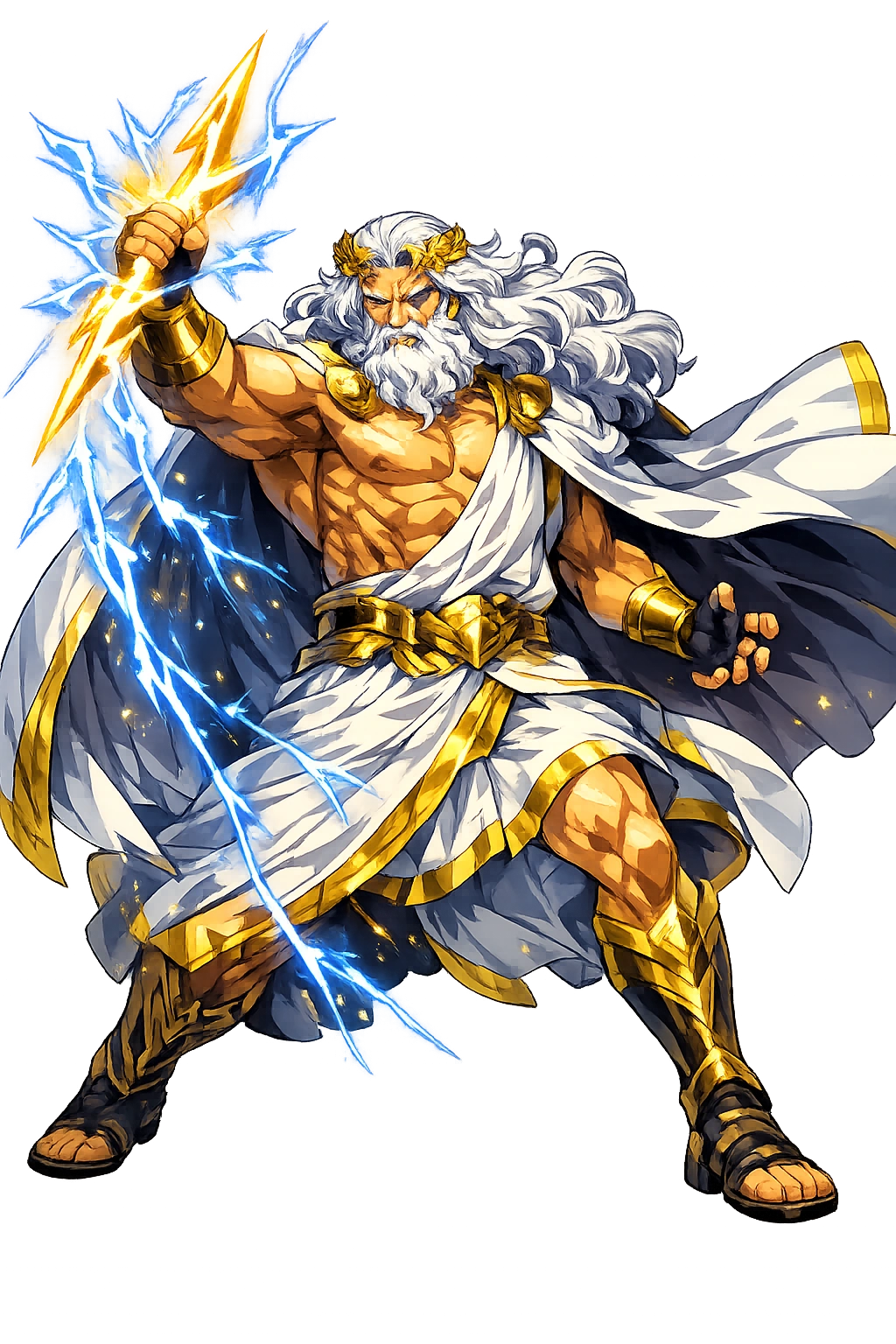
Stories of Zeús
The mythology of Zeús is dominated by two great struggles: his overthrow of the Titans and his defense of cosmic order against every subsequent threat. He is the last son of Kronos, the only one not swallowed at birth, and nearly every Greek cosmogony moves toward his throne.
Kronos swallowed each of his children at birth, convinced by a prophecy that a son would dethrone him. Rhea, pregnant with her youngest, appealed to her parents Gaia and starry Ouranos, who hid the infant Zeus in a cave 'in the rich land of Crete' (Hesiod, Theogony 453–491). To deceive Kronos, Rhea wrapped a great stone in swaddling clothes; he gulped it down, supposing he had swallowed Zeus. The child grew rapidly in secret — most accounts say he was nursed by the wild goat Amaltheia — while the Kouretes or Korybantes clashed spear on shield to drown his cries. The sources disagree about the cave: Mount Ida and Mount Dikte both claimed the honor, and both peaks yield ancient sanctuary remains. They agree on the pattern: the future king survives only through secrecy and maternal cunning. And the stone Kronos swallowed became an object of cult at Delphi, where the Pythia anointed it daily — a reminder that sovereignty begins not in strength but in concealment.
Grown to strength, Zeus forced Kronos to disgorge his siblings — Hestia, Demeter, Hera, Hades, and Poseidon, with the stone disgorged last — and led the younger gods in a war against the Titans that raged for ten full years, 'a terrible battle' in which neither side could prevail (Hesiod, Theogony 617–735). The Cyclopes armed Zeus with thunder and lightning, Poseidon with the trident, Hades with the cap of invisibility, and the three hundred-handed Hekatonkheires pelted the Titans with mountains. The Titans fell and were bound in misty Tartaros, where the Hekatonkheires now stand guard. Zeus then apportioned the cosmos by lot: the sky to himself, the sea to Poseidon, the underworld to Hades, the earth and Olympus held in common (Theogony 881–885; Iliad 15.187–193). The war's lesson is political: Olympian order was not eternal or natural but won by violence — and then, decisively, rationalized into law.
Even after the Titans fell, Gaia bore one final challenger: Typhôn, a hundred-headed, fire-breathing monster before whom the gods fled in terror to Egypt, all except Athena (Hesiod, Theogony 820–868). Zeus met him alone, hurling thunderbolts until the sea boiled and the mountains burned, then cast him down to Tartaros; in later tradition the monster lies pinned beneath Mount Etna, and the volcano's eruptions are his breath (Pindar, Pythian 1.15–28; Aeschylus, Prometheus Bound 351–372). The tradition allows moments of real danger: in some accounts Typhôn wrested the sinews from Zeus's limbs and hid them in a cave until Hermes and the god Aigipan stole them back. The myth insists that cosmic order stands perpetually on trial. Zeus's kingship is not a settled fact but a defended achievement, and the thunderbolt is not a symbol of that defense — it is the instrument itself.
Disgusted by the violence and impiety of the Bronze Age race of men, Zeus resolved to drown humanity beneath a flood (Pseudo-Apollodorus, Bibliotheca 1.7.2; Ovid, Metamorphoses 1.251–415, our fullest account). Prometheus warned his son Deukalion, who built an ark and boarded it with his wife Pyrrha; for nine days and nights they drifted over a world-drowning sea while the fish swam through the branches of drowned oaks. Landing on Mount Parnassos, they received an oracle of Themis instructing them to cast behind them the 'bones of their mother.' Guessing that the mother was Gaia and the bones stones, they obeyed: the stones Deukalion threw became men, those of Pyrrha became women. The myth shares its architecture with the Mesopotamian flood of Utnapishtim, the Hebrew Noah's close relative. It frames Zeus as both destroyer of a failed humanity and, through a single pious couple, author of a new one.
Prometheus, the Titan who had sided with Zeus in the war, stole fire from heaven in a fennel stalk and gave it to mortals — hiding it, in Hesiod's harsher version, after Zeus had hidden the means of life from mankind (Hesiod, Theogony 535–616; Works and Days 47–105). Zeus retaliated on both parties at once. He had Hephaistos fashion the first woman, Pandora, whose jar loosed every affliction upon the world, and he had Prometheus chained to a crag in the Caucasus, where an eagle devoured his ever-regenerating liver. Aeschylus' Prometheus Bound dramatizes the captive's defiance and his secret — that a marriage would one day unseat Zeus — which finally moves the tyrant to negotiate rather than destroy. The myth is the Greek meditation on the price of progress: fire, the foundation of every technology, is contraband from the gods, and its giver is punished by the very king whose throne his counsel had saved.
Kingship, Thunder, Oath, and Order
Zeús is not merely the king of the gods; he is the principle of cosmic and social order. His domain is the sky, his weapon the thunderbolt, his guarantee the oath. Every legitimate authority on earth — kingship, law, hospitality — traces its sanction to him.
Ruler of Olympus and arbiter of divine disputes; his will is fate's executive.
The weapon forged by the Cyclopes; it strikes oath-breakers, hubristic mortals, and Titans alike.
Protector of suppliants, guests, and kings; Themis and Díkē attend him.
Even Zeús cannot fully reverse Moira, but he directs its fulfillment through gods and oracles.
From the original script to the living URL
Ζεύς
The name in its original Greek form. Zeús (Ζεύς) is attested in the source tradition — “Bright, day (from Proto-Indo-European *dyēus)”. Its diphthongs and acute accents carry the full phonetic and orthographic weight of the source tradition.
zeus
Reduced to plain zeus, the name loses everything that made it specific: diphthongs and acute accents. What remains is an ASCII string that machines can parse but that no longer speaks with its original voice.
Zeús
The Unicode restoration recovers what ASCII flattened. Zeús restores diphthongs and acute accents, returning the name to its original written dignity. The domain encodes to Punycode, but the browser displays the truth.
Zeús.com → xn--zes-9na.com
The non-ASCII characters in Zeús are encoded while the ASCII remains visible. To the DNS, it is Punycode. To humanity, it is Zeús.
Owned, ideal, and ASCII forms of Zeús
Zeús
Restores Ζεύς. The live temple domain — zeús.com.
zeus
Flattens Ζεύς. The plain ASCII fallback — what DNS and legacy systems see.
How Zeús was spoken
How Zeús travels from ancient script to the modern URL
From Proto-Indo-European *dyēws 'sky, daylight, sky-god'. Cognates: Sanskrit Dyáuṣ Pitā, Latin Juppiter (*dyēws ph₂tḗr), Germanic *Tīwaz (English Tuesday).
King of the Olympian gods; god of the sky, thunder, law, kingship, and cosmic order.
The Unicode restoration Zeús preserves the acute accent and long diphthong; the macron-only form Zeus is an accepted fallback. The domain encodes to Punycode while displaying the Greek-accented Latin form.
The lore you have read is the living myth. Extended Lore opens the scholarly vault beneath it: the cult and its material remains, a history of the image, the name after antiquity, a meditation on what the name still means, and the full scholarly apparatus — etymology, orthography, sources.
Enter Extended Lore