PuniCodex

Extended Lore

Ζέφυρος Zéphyros

Etymology · Orthography · Cult · Iconography · Reception · Sources

Tier 2 Zéphyros.com
Zéphyros — West Wind
01

Quick Facts

Essential information about Zéphyros, West Wind

Original ScriptΖέφυρος
Unicode RestorationZéphyros
Reconstructed Pronunciation/ˈzdɛ.pʰy.ros/
PantheonGreek
DomainWest Wind
MeaningThe west wind
ClassificationTier 2
Primary DomainZéphyros.com
Sacred SymbolsGarland of Flowers, Wings, Swift Horses, The Swallow, Billowing Sail
02

Etymology & Word Family

From original script to Unicode restoration

Original Script Ζέφυρος Zéphyros — "The west wind"
Unicode Restoration Zéphyros Restored stress, length, and script
Modern ASCII zephyros Plain-ASCII fallback

The name Zéphyros carries the orthographic signature of the greek tradition: Ζέφυρος. Unicode restoration recovers what ASCII flattens.

03

Unicode Character Breakdown

Character-by-character philological analysis

CharacterUnicodeNameBlockPhonetic Role
ZU+005ALatin Capital Letter ZBasic LatinZ uppercase
éU+00E9Latin Small Letter E with AcuteLatin-1 SupplementAcute on e
pU+0070Latin Small Letter PBasic Latinp same
hU+0068Latin Small Letter HBasic Latinh same
yU+0079Latin Small Letter YBasic Latiny same
rU+0072Latin Small Letter RBasic Latinr same
oU+006FLatin Small Letter OBasic Latino same
sU+0073Latin Small Letter SBasic Latins same

The Tier 2 classification reflects how much of the original phonology this restoration preserves — stress and vowel length for Greek names, distinctive letters and diacritics for every other tradition.

04

Cult & Worship

How the sacred was kept — rites, sanctuaries, remains

The Cult

Zéphyros received cult as one of the winds, not as an individual Olympian. Pausanias records a sanctuary with an altar of the Winds at Titanē in Sikyonia, where a priest sacrificed to them annually. In Athens the Horologion of Andronikos Kyrrhestēs, the Tower of the Winds of the first century BCE, gave him a sculptural place in the Roman Agora as the mild west wind scattering flowers. Roman gardens sometimes included a zephyr shrine or fountain, and the gentle spring wind was invoked in planting rituals and seasonal festivals. Modern commemoration is meteorological and poetic rather than religious: his name survives in weather reports and in the notion of a balmy western breeze.

In the Earth

Zéphyros's most famous monument is the Tower of the Winds (Horologion of Andronikos Kyrrhestēs, 1st c. BCE) in the Roman Agora of Athens, whose octagonal frieze personifies the eight winds — Zéphyros on the west face as a youth scattering flowers from his folded cloak. Pausanias (2.12.1) records a sanctuary with an altar of the Winds at Titanē in Sikyonia, where a priest sacrificed to them annually — one of the few attested cult sites for the Anemoi as a group. In Rome, his cult life ran through his bride: the temple of Flora near the Circus Maximus and the games of the Floralia.

05

Iconography

How Zéphyros was imaged across the ages

The Image

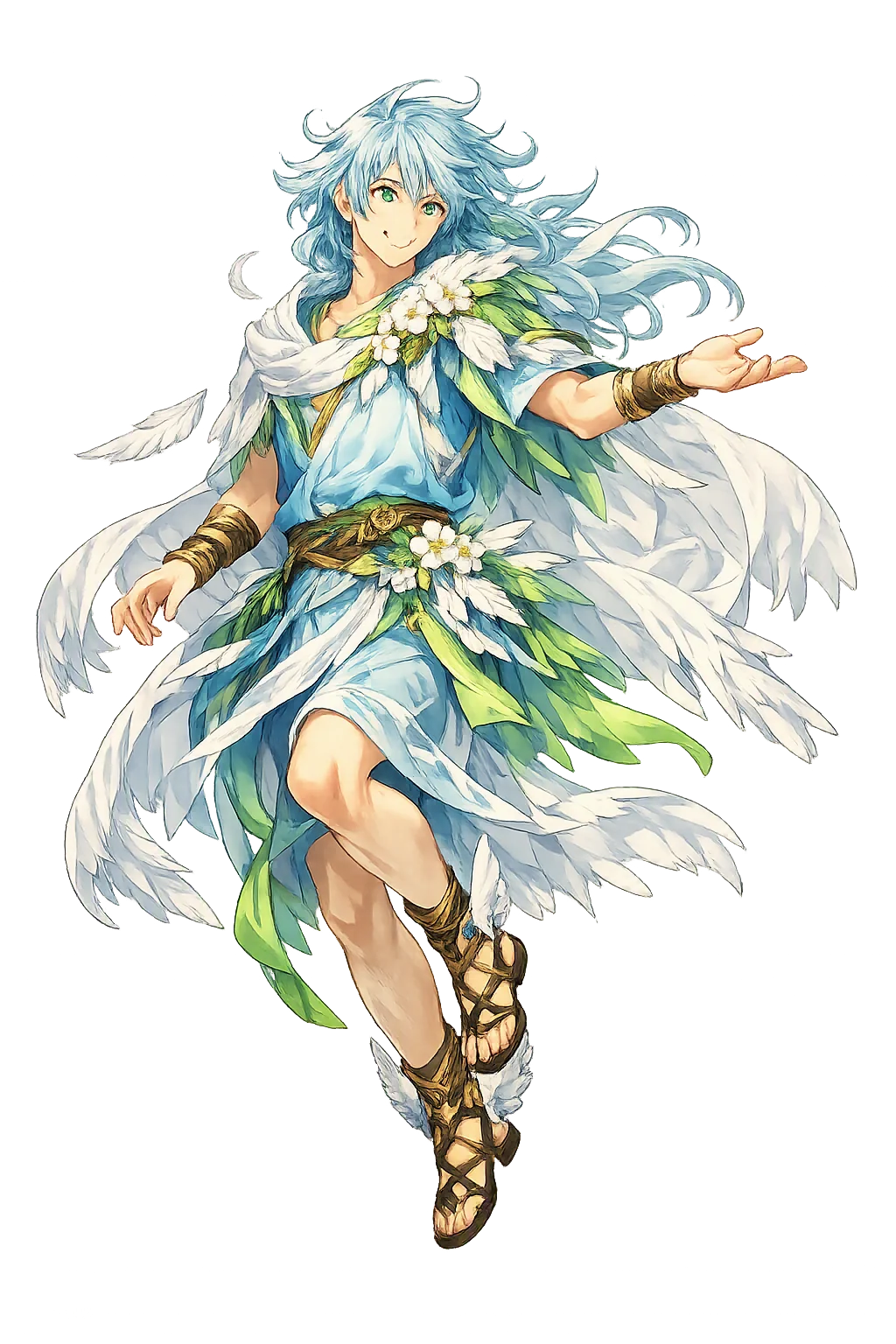
Zéphyros's most famous image is the west face of the Tower of the Winds in Athens: a youthful figure with loose drapery, scattering flowers from the fold of his cloak. Greek vase painters more often rendered winds as bearded, winged men with puffed cheeks — anemobates — blowing from the corners of the scene. Roman floor mosaics and garden paintings continued the personification, while Renaissance and Baroque art preferred the softer, flower-bearing Zephyr who attend the birth of Venus and the triumph of Flora. In later European painting, from Botticelli onward, he is the warm west wind of spring, a visual convention still used in calendars and botanical illustration.

06

Reception & Transformation

The name after its own age — transmission, translation, survival

Afterlives

The Greek word for the west wind became the ordinary term for a gentle breeze in Latin and the Romance languages, and from there entered English as zephyr. This meteorological afterlife is far more widespread than any mythological one: poets from Virgil to Shelley invoke the zephyr as the breath of spring, and botanists have named delicate plants after it. The name was also borrowed for the Zephyr train, Zephyr sports cars, and countless brands promising lightness and speed. In the history of art the zephyr became a conventional personification of the gentle spring wind, blowing flowers and drapery in countless pastoral and birth-of-Venus scenes. Classical scholarship treats the wind-gods as a case study in Greek personification, while modern weather forecasting still uses zephyr for a light westerly, preserving his oldest association.

Identifications Across Traditions

The Romans called him Favōnius, from favēre, 'to favor' — the propitious wind — and married him to their own flower-goddess Flōra, whose festival, the Floralia, kept the Greek Chlōris-marriage alive in cult. Horace (Odes 1.4) sings winter loosening 'under the welcome west wind', and Virgil lets Favonius breathe through the Georgics as the air that unbinds the fields. Through Latin poetry the name passed intact into every European vernacular: the gentle west wind of Greece became the zephyr of the modern world.

Modern Legacy

English zephyr — 'a soft, gentle breeze' — descends directly from his name through Latin zephyrus, and has been a staple of English verse since Chaucer opened the Canterbury Tales with 'Zephirus… with his sweete breeth' quickening the spring crops. The word also gave its name to a fine, light yarn and to anything featherweight. Few Greek wind-gods survive so completely: not as a character, but as the very word English reaches for when the air turns kind.

07

The Meditation

What Zéphyros means — beyond the dictionary

The Greeks did not usually worship the winds with temples and myths of their own — they felt them, and feeling was enough. Zéphyros is the clearest case of a natural force crossing into personality precisely because it was pleasant: the storm winds stay brute daimones, but the wind that opens the flowers earned a wife, a marriage bed, and children. His ambivalence is quiet but real — the same wind that breeds Achilles's immortal horses also breeds the speed that carries the hero toward death. For the Greeks the west wind was proof that the divine could be gentle without ceasing to be power: a daimon you pray to by opening the orchard gate.

08

Frequently Asked Questions

Common questions about Zéphyros, West Wind, and Unicode restoration

01How do you pronounce Zéphyros?

In reconstructed pronunciation, Zéphyros is /ˈzdɛ.pʰy.ros/ — approximately 'ZDEH-phee-ros' — stress the first syllable; begin with the 'zd' of 'wisdom', and let the phi puff air like an English 'up-hill', not an 'f'.

02What does Zéphyros mean?

Zéphyros means The west wind in the greek tradition.

03What are the symbols of Zéphyros?

Zéphyros is associated with Garland of Flowers (On the Tower of the Winds in Athens, Zéphyros is carved as a youth whose folded cloak spills blossoms — his spring-bearing nature made visible in stone.), Wings (Like all the Anemoi, he is winged in Greek and Roman art; the winds fly, and their wings mark them as powers of the air rather than ordinary gods.), Swift Horses (By Pódargē the harpy he fathered Xánthos and Bálios, the immortal horses of Achilles — the wind's own speed given equine form.), The Swallow (The swallow's return was proverbially bound to the west wind's season; both were the first messengers that winter had broken.), Billowing Sail (A kind wind for sailors: steady, mild, and western — the breeze that fills canvas without violence and carries ships home.).

04Why restore Zéphyros in Unicode?

Plain ASCII zephyros strips the stress, length, and script that make the name specific. Unicode restoration returns the name to its original written dignity.

05What is the most important myth about Zéphyros?

“Son of Dawn and the Starry Sky” — the Birth of the Winds story that anchors the mythology of Zéphyros, told in full on the lore page.

09

Scholarly Sources

The philological foundations of this restoration

Every claim on this page is grounded in established scholarship. The orthographic restorations follow disciplinary convention. The etymological chain follows the best available reference works. This is not invention — it is resurrection through scholarship.

◈

Lexicography & Philology

  • Liddell, H. G., Scott, R., & Jones, H. S. A Greek-English Lexicon. Oxford: Clarendon Press, 9th ed. 1996.
◎

Primary Texts

  • Homer
  • Hesiod, Theogony 378–380
  • Homer, Iliad 16.148–151; 19.404–417
  • Homer, Odyssey 7.112–132; 10.1–79 (Aiolos and the winds)
  • Ovid, Fasti 5.195–214
  • Pausanias 2.12.1 (sanctuary of the Winds at Titanē)
◉

Archaeology & Art History

  • Material evidence — iconography, inscriptions, and temple archaeology — for Zéphyros and related cults.
✦

Religious Studies

  • Hyginus, Fabulae
Return

The Surface Awaits

You have traced the name from its earliest attestation to its Unicode restoration. Now return to the myth. The story is where the name lives.

Back to Lore
Zéphyros mascot