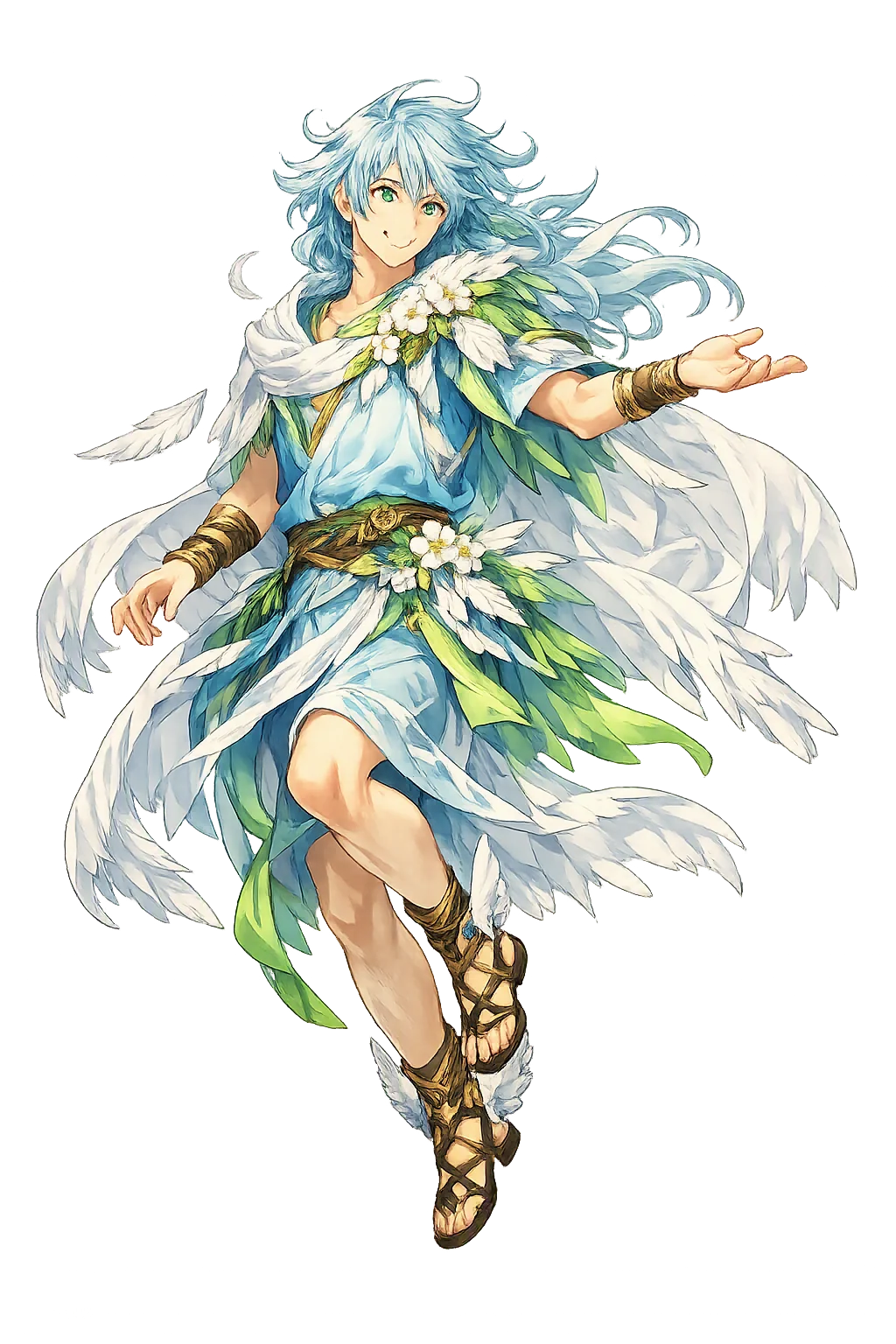
Stories of Zéphyros
Zéphyros is a minor god with an outsized poetic life: born of Dawn, lover of flowers, father of the fastest horses ever to run. His myths are few but luminous — each one binds the west wind to speed, desire, and the returning spring.
In Theogony 378–380, Hesiod records that Eōs (Dawn) bore to Astraios, the starry dusk, the mighty winds: Zéphyros, Bóreas, and Nótos — 'a goddess lying in love with a god'. The genealogy is exact for Hesiod's purpose: the clearing west wind is the child of first light and the star-field, born at the seam where night opens into day. A breeze, the passage implies, is a child of the light's borderlands — and its gentleness is inherited, for what is born at the edge of dawn has no quarrel with the world. It is the one wind Homer and Hesiod can both praise without irony, because its parentage is the softest in the whole divine family tree.
In Iliad 16 (149–151), Patroklos harnesses Achilles's immortal pair, Xánthos and Bálios, 'whom Pódargē, the harpy swift of foot, bore to Zéphyros the west wind as she grazed in a meadow beside the stream of Ōkeanos'. A wind coupling with a storm-snatcher in a meadow: Homer makes the horses' supernatural speed a literal inheritance. It is Xánthos, this same wind-begotten colt, who later speaks with a human voice to foretell Achilles's death (Iliad 19, 404–417). The Iliad thus makes wind-begotten speed carry the hero to Troy, and the same wind-lineage makes the horse who warns him of the end: inherited speed, inherited doom — the wind's gift and the wind's price in one stable.
In Ovid's Fasti 5 (195–214), the goddess Flora tells her own story: 'I who am now called Flora was once Chlōris… Zéphyros saw me, desired me, and carried me off' — then made her his lawful wife and gave her dominion over every flower, so that in her garden 'it is always spring'. Hyginus (Fabulae) preserves the fruit of the union: their son Karpós, 'Fruit' itself, the harvest that follows blossom. The marriage, as Ovid tells it, is abduction made lawful by love and gifts — the Roman compromise between force and desire that Greek myth rarely needed — and it fixes the west wind in Western imagination as the season's bridegroom, the breath that turns maiden into goddess and petal into fruit.
In Odyssey 7 (112–132), the garden of King Alkinoös on Scheria — fruit upon fruit, pear ripening on pear, never failing winter or summer — is kept in perpetual bearing because 'the breath of Zéphyros, ever blowing, causes some fruits to swell and others to ripen'. Homer needs no allegory here: the west wind simply is the climate of paradise, the mildest air imaginable, made divine. The detail completes the god's character across both epics: in Homer he is no warrior's portent but a gardener's weather — theology and meteorology as the same science, and the good life defined as a garden the west wind never abandons.
The West Wind, Gentlest of the Anemoi
Zéphyros is the west wind of the Greeks — the mildest of the four Anemoi, the breeze that loosens winter and calls up the flowers. Where Bóreas rages and Nótos drowns ships in rain, Zéphyros is the wind the poets loved: the steady, fruit-bearing breath that fans the orchards of the blessed and carries spring north into the human world.
Gentlest of the Anemoi, his west wind loosens winter’s grip and brings the swallow season home.
With the harpy Podarge he sires Xánthos and Bálios, the immortal, wind-swift horses of Achilles (Iliad 16.148–151).
Roman poets wed him to Flora; Ovid lets her recall she was the nymph Chloris until Zéphyros took her as his bride (Fasti 5.195–212).
The keeper of winds gives Odysseus all the winds tied in an oxhide bag — Zéphyros first, the fair wind home (Odyssey 10.1–79).
From the original script to the living URL
Ζέφυρος
The name in its original Greek form. Zéphyros (Ζέφυρος) is attested in the source tradition — “The west wind”. Its aspirated consonants and acute accents carry the full phonetic and orthographic weight of the source tradition.
zephyros
Reduced to plain zephyros, the name loses everything that made it specific: aspirated consonants and acute accents. What remains is an ASCII string that machines can parse but that no longer speaks with its original voice.
Zéphyros
The Unicode restoration recovers what ASCII flattened. Zéphyros restores aspirated consonants and acute accents, returning the name to its original written dignity. The domain encodes to Punycode, but the browser displays the truth.
Zéphyros.com → xn--zphyros-bya.com
The non-ASCII characters in Zéphyros are encoded while the ASCII remains visible. To the DNS, it is Punycode. To humanity, it is Zéphyros.
Owned, ideal, and ASCII forms of Zéphyros
Zéphyros
Restores Ζέφυρος. The live temple domain — zéphyros.com.
zephyros
Flattens Ζέφυρος. The plain ASCII fallback — what DNS and legacy systems see.
How Zéphyros was spoken
How Zéphyros is preserved in writing
A bespoke provenance study for Zéphyros is being prepared by the PUNICODEX scholarly team.
Contribute scholarly provenance →The lore you have read is the living myth. Extended Lore opens the scholarly vault beneath it: the cult and its material remains, a history of the image, the name after antiquity, a meditation on what the name still means, and the full scholarly apparatus — etymology, orthography, sources.
Enter Extended Lore