PuniCodex

Extended Lore

陰陽 Yīnyáng

Etymology · Orthography · Cult · Iconography · Reception · Sources

Tier 1 Yīnyáng.com · Yīn-yáng.com
Yīnyáng — Cosmic Duality
01

Quick Facts

Essential information about Yīnyáng, Cosmic Duality

Original Script陰陽
Unicode RestorationYīnyáng
Reconstructed Pronunciation/in˥ jaŋ˧˥/
PantheonTaoist
DomainCosmic Duality
MeaningInterdependence of opposites
ClassificationTier 1
Primary DomainYīnyáng.com
Sacred SymbolsThe taijitu, Broken and solid lines, Sun and moon, Tiger and dragon, Water and fire
02

Etymology & Word Family

From original script to Unicode restoration

Original Script 陰陽 Yīnyáng — "Interdependence of opposites"
Unicode Restoration Yīnyáng Restored stress, length, and script
Modern ASCII yinyang Plain-ASCII fallback

The name Yīnyáng carries the orthographic signature of the taoist tradition: 陰陽. Unicode restoration recovers what ASCII flattens.

03

Unicode Character Breakdown

Character-by-character philological analysis

CharacterUnicodeNameBlockPhonetic Role
YU+0059Latin Capital Letter YBasic LatinSame, capitalized
īU+012BLatin Small Letter I with MacronLatin Extended-AMacron: level tone
nU+006ELatin Small Letter NBasic LatinSame
yU+0079Latin Small Letter YBasic LatinSame
áU+00E1Latin Small Letter A with AcuteLatin-1 SupplementSecond tone
nU+006ELatin Small Letter NBasic LatinSame
gU+0067Latin Small Letter GBasic LatinSame

The Tier 1 classification reflects how much of the original phonology this restoration preserves — stress and vowel length for Greek names, distinctive letters and diacritics for every other tradition.

04

Cult & Worship

How the sacred was kept — rites, sanctuaries, remains

The Cult

Yin and Yang were never adored — no temple, idol, or priesthood served them — but they governed how China worshipped. The state's grandest liturgies were calibrated by the pair: the Suburban Sacrifice, offered to Heaven at the southern border on the winter solstice and to Earth at the northern on the summer solstice, balanced the cosmos's two poles, a scheme codified in the Book of Rites. Court diviners chose days by their interplay, and the Hongfan chapter made reading the balance of forces part of the ruler's sacred duty; Daoist priests later mapped altars, processions, and exorcisms by directional yin and yang. What the pair possessed was not a cult but a liturgy of proportion — devotion expressed as the correct alignment of sacrifice, season, and ruler.

In the Earth

The oldest layer of yin-yang thought is embedded in the Yijing itself, transmitted through Warring States bamboo and silk manuscripts such as the Mawangdui silk Yijing (c. 168 BCE) and the Guodian Chu slips (c. 300 BCE). The Zuo Zhuan preserves early medical and astrological uses of yin-yang terminology, while Han dynasty tomb texts and visual art pair the two principles with the Four Spirits and the five phases. The iconic two-tone taijitu diagram is a Song-era visual innovation, though the conceptual pairing it depicts is ancient.

05

Iconography

How Yīnyáng was imaged across the ages

The Image

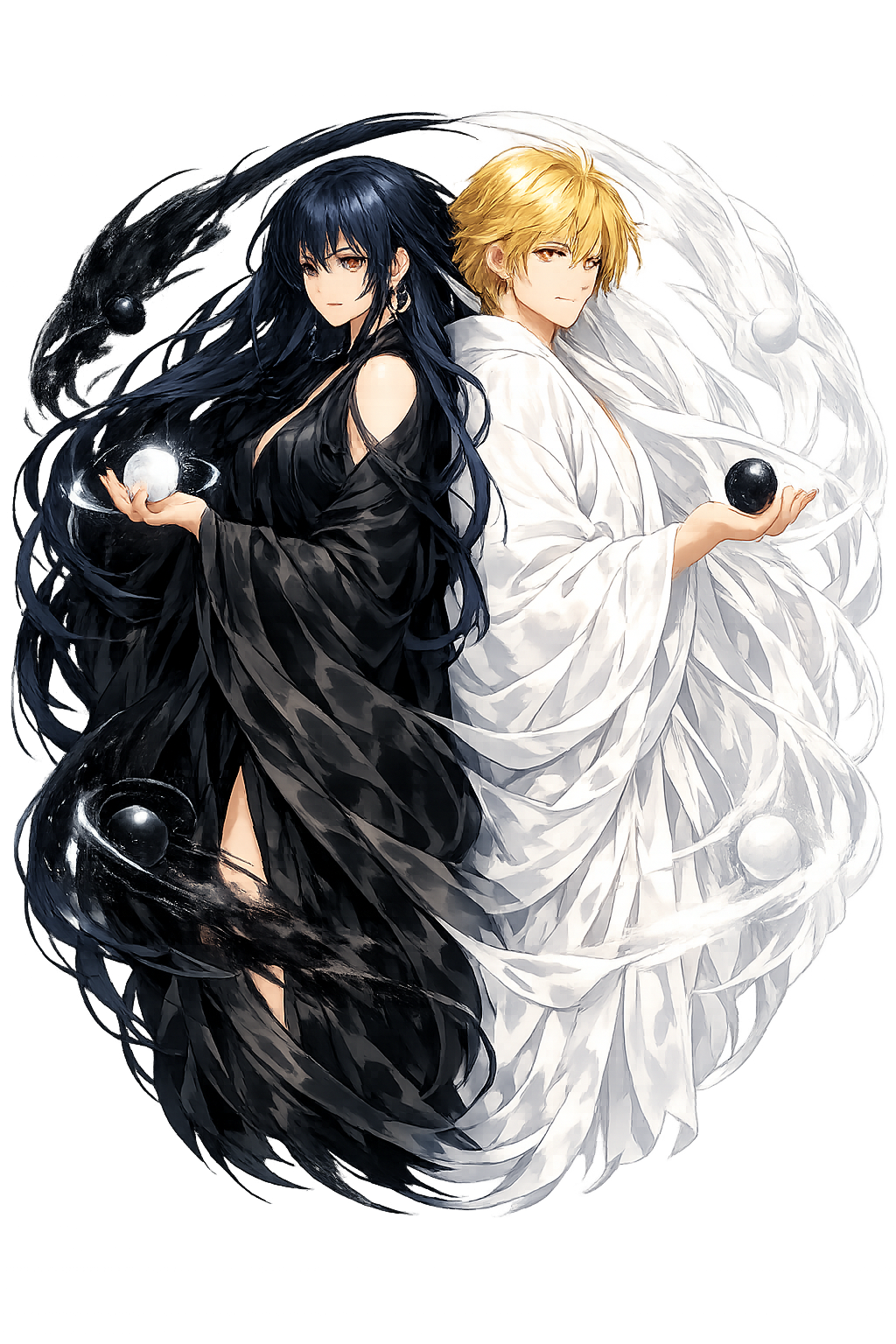
The pair's earliest images are not the famous emblem. Warring States and Han art imagined them as powers of direction and season: the Fuxi-and-Nüwa couple — serpent-bodied, he with the carpenter's square, she with the compass — coils across Han tomb murals, the painted tomb of Bu Qianqiu at Luoyang being the classic example, as the ordering male-and-female of the cosmos. Han bronze 'TLV mirrors' weld the same grammar to the sky, their lattices pinning the azure dragon, vermilion bird, white tiger, and entwined warriors of the four quarters. The Mawangdui silk manuscripts, sealed in 168 BCE, already chart the rhythms in cosmic diagrams. The two-tone taijitu — each half swallowing its opposite and bearing its seed — is the Song-to-Ming codification of all this, and by the Ming the pair had become the most reproduced cosmogram on earth.

06

Reception & Transformation

The name after its own age — transmission, translation, survival

Afterlives

Yin and Yang climbed to philosophy from the landscape — the shady and sunny slopes of hills — and moved fast once they arrived. The Zuo Zhuan preserves the physician He, in 541 BCE, explaining illness as imbalance among wind, rain, darkness, and light; by the third century BCE the Xici appendix could declare 'one yin and one yang: this is called the Dao,' and Zou Yan's school turned the pair, with the five phases, into an engine of history. Dong Zhongshu gave the dyad a moral charge, reading cosmic imbalance as Heaven's warning to the throne. Song Neo-Confucians folded yin-yang into Tàijí and principle, converting omen-lore into metaphysics, and the medical classic Huangdi Neijing had long since made the pair the diagnostic bedrock of the body. Europe met the dyad first through Jesuit letters, then through translation: Legge's I Ching (1882) rendered the Xici into stately English; Richard Wilhelm's German version (1924) carried it to C. G. Jung, who wrote its celebrated foreword; and Joseph Needham's Science and Civilisation taught the twentieth century to call this 'correlative' rather than causal thinking.

Identifications Across Traditions

Yīnyáng traveled with Chinese civilization into Korea (eum-yang), Japan (in'yō), and Vietnam (âm-dương), where it shaped local medicine, martial arts, and geomancy. In the early modern West, Leibniz saw in the Yijing's broken and solid lines a precursor to binary arithmetic, while Hegel read yin and yang as an early dialectic. Contemporary New Age culture has turned yin-yang into a universal emblem of balance, often severed from its technical roles in medicine and divination. The symbol also appears in Unicode as ☯ (U+262F), one of the most widely recognized non-Western glyphs in digital culture.

Modern Legacy

Every acupuncture needle, feng shui compass, and tai chi form is a working application of yin-yang theory. In Traditional Chinese Medicine, diagnosis begins by asking whether a symptom is hot or cold, deficient or excess, interior or exterior, yin or yang. Martial artists use yin to absorb and yang to strike. Architects orient buildings to capture yang light and yin shade. The concept has also entered global popular culture as a shorthand for balance, duality, and counterculture — surfacing in music, fashion, tattoo art, and even psychology, where 'shadow' work loosely parallels the yin within yang. Yet the most rigorous legacy remains clinical: yin-yang is still the organizing axis of a living medical tradition.

07

The Meditation

What Yīnyáng means — beyond the dictionary

Yīnyáng is an invitation to stop choosing sides. It says that what looks like opposition is really relationship: day has no meaning without night, speaking has no meaning without silence, strength has no meaning without vulnerability. The small dot in each half of the taijitu is the most radical part of the symbol: nothing is pure; everything carries the seed of its seeming opposite.

This is not relativism. Yin and yang are real, measurable, and consequential — but they are not moral categories. To call something yin is not to demean it; to call something yang is not to praise it. The question is always one of balance: too much yang burns, too much yin stagnates. The wise move, in medicine as in life, is to notice which way the scales are tipping and to restore the dynamic exchange.

08

Frequently Asked Questions

Common questions about Yīnyáng, Cosmic Duality, and Unicode restoration

01How do you pronounce Yīnyáng?

In reconstructed pronunciation, Yīnyáng is /in˥ jaŋ˧˥/ — approximately YIN-YAHNG — first syllable high and level, second syllable rising from mid to high.

02What does Yīnyáng mean?

Yīnyáng means Interdependence of opposites in the taoist tradition.

03What are the symbols of Yīnyáng?

Yīnyáng is associated with The taijitu (The black-and-white emblem of interpenetrating yin and yang, each with a dot of the other), Broken and solid lines (Yin (broken) and yang (solid) as the grammar of the Yijing), Sun and moon (The brightest yang and the darkest yin luminaries), Tiger and dragon (Two paired energies, often yin and yang, in martial and alchemical symbolism), Water and fire (The canonical yin and yang elements in the body and cosmos).

04Why are there different spellings of Yīnyáng?

Each form is a historically attested restoration rather than a mistake: Yīn-yáng is the owned form (Owned domain form with hyphen). PUNICODEX registers the full set so the tradition is preserved under every defensible spelling.

05Why restore Yīnyáng in Unicode?

Plain ASCII yinyang strips the stress, length, and script that make the name specific. Unicode restoration returns the name to its original written dignity.

06What is the most important myth about Yīnyáng?

“One Yin, One Yang” — the Yijing story that anchors the mythology of Yīnyáng, told in full on the lore page.

09

Scholarly Sources

The philological foundations of this restoration

Every claim on this page is grounded in established scholarship. The orthographic restorations follow disciplinary convention. The etymological chain follows the best available reference works. This is not invention — it is resurrection through scholarship.

◈

Lexicography & Philology

  • I Ching
  • Chinese classics
◎

Primary Texts

  • Primary sources in the taoist tradition for Yīnyáng.
◉

Archaeology & Art History

  • Material evidence — iconography, inscriptions, and temple archaeology — for Yīnyáng and related cults.
✦

Religious Studies

  • Yijing (Book of Changes), Xici zhuan (Appended Statements)
  • Laozi, Daodejing, ch. 42
  • Zuo Zhuan, Duke Zhao, year 1 (541 BCE)
  • Dong Zhongshu, Chunqiu fanlu
  • Graham, A. C., Disputers of the Tao (1989)
  • Unschuld, Paul U., Medicine in China: A History of Ideas (1985)
  • Baxter & Sagart, Old Chinese Reconstruction (2014)
Return

The Surface Awaits

You have traced the name from its earliest attestation to its Unicode restoration. Now return to the myth. The story is where the name lives.

Back to Lore
Yīnyáng mascot