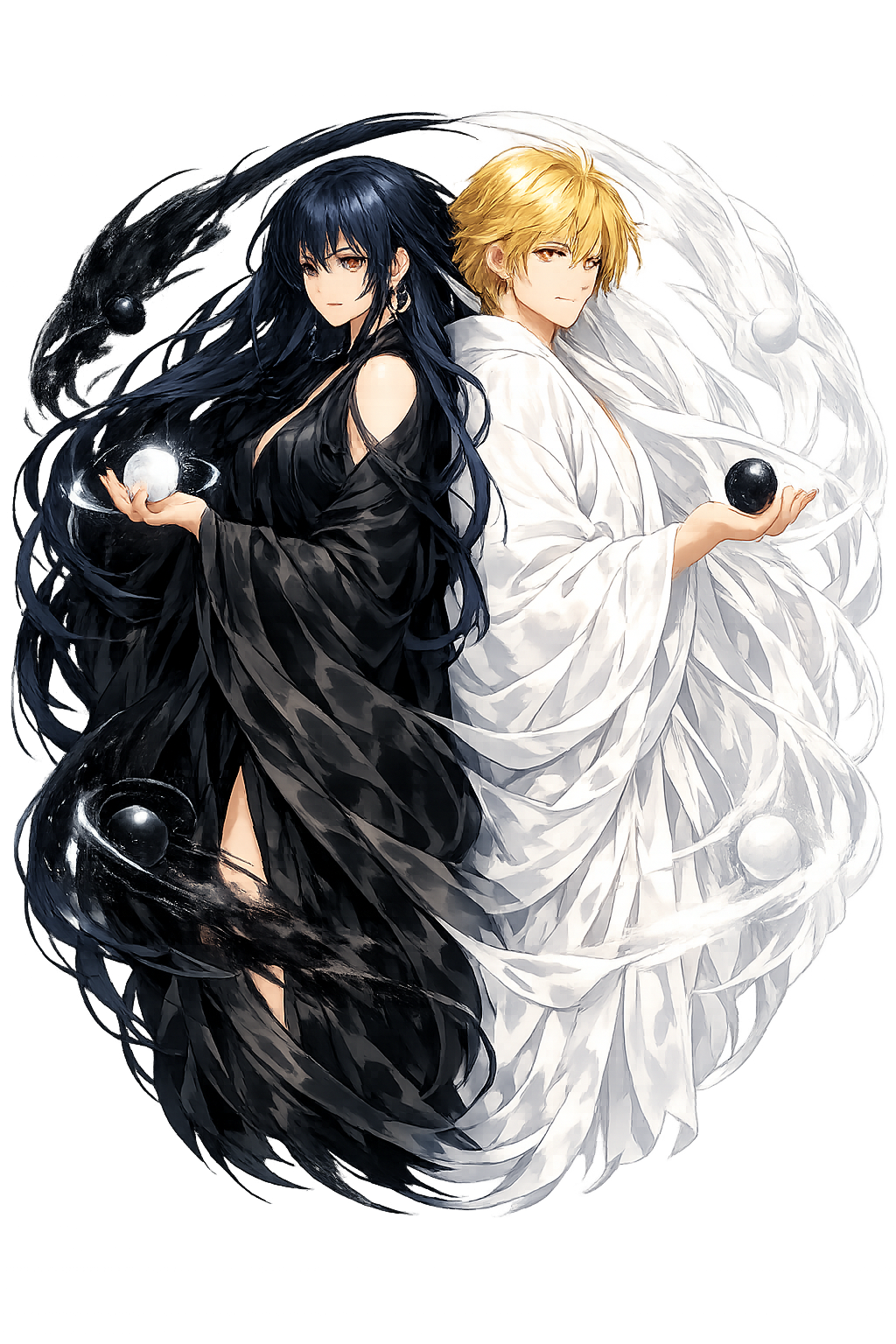
Stories of Yīnyáng
Yīnyáng has no origin myth in the usual sense. It is a lens through which Chinese thinkers read the origin of everything. Its stories are therefore cosmological and medical rather than biographical — a sequence of texts, from divination manual to Daoist classic to Han statecraft, each of which made the pair do more work.
The Xici — the Appended Statements, the philosophical commentary attached to the Yijing by the third century BCE — comes as close to a creed as the tradition allows: 'One yin and one yang: this is called the Dao' (Xici, Part A, §5). The cosmos, in this reading, is not governed by a personal deity but by the alternation of two modes, and the hexagrams of the classic are nothing more than snapshots of that alternation — sixty-four positions in the endless turning. Divination is therefore not fortune-telling but diagnosis: the stalks are cast to learn where one stands in the cycle, and the answer assumes that knowing the pattern is enough to act within it. It is one of the great minimalist creation accounts: the world needs no maker if it has rhythm, and no judge if imbalance announces itself as disorder. The Yijing gives the pair its earliest full metaphysics — and never once asks who set the rhythm going.
The Daodejing (ch. 42) compresses the whole cosmogony into nine characters of arithmetic: 'The Dao gives birth to One; the One gives birth to Two; the Two give birth to Three; the Three give birth to the ten thousand things.' Then it locates the pair inside every creature: 'The ten thousand things carry yin on their backs and embrace yang in their arms, and achieve harmony by blending the empty breath' (chongqi). Yin and yang are thus not external forces but the internal structure of existence — every thing is a standing negotiation between its dark and its light, and harmony is not a state but a blending, a continual mixing of the vital breath. Where the Yijing watches the pair from outside, the Daodejing finds it within: creation is not manufacture but equilibrium, and the world is not a machine made once but a chord kept sounding.
By the sixth century BCE, yin-yang had become clinical. The Zuo Zhuan (Duke Zhao, year 1, 541 BCE) preserves what may be the first case history in Chinese literature: the ruler of Jin lies ill, and the court proposes ghosts and spoiled food as causes; the physician He, summoned from Qin, rejects both. Illness, he says, comes from the imbalance of the six qi of heaven — yin, yang, wind, rain, darkness, and light — which descend to produce the five flavors, the five colors, and the five tones, and which, when any one runs to excess, disorder the body. He names the ruler's own excesses as the diagnosis. The scene matters because it is argumentative: a physician lecturing a duke that his sickness has a natural, impersonal mechanism — qi, not curse — and a lifestyle for a remedy. Yin-yang thought enters world literature not as mysticism but as the first rational medicine, and its founding document is a doctor politely telling a king the truth.
In the second century BCE, Dong Zhongshu — chief scholar of Emperor Wu's court — welded yin-yang cosmology onto Confucian statecraft in the Chunqiu fanlu ('Luxuriant Dew of the Spring and Autumn'). Heaven, humanity, and state now formed a single responding body: the treatises on cosmic resonance (ganying) argued that droughts, eclipses, and earthquakes were heaven's admonitions to a misgoverning ruler, and the paired treatises on yin and yang gave the mechanism — the cosmic duality running through seasons, music, punishments, and rites alike, each side with its proper season and sphere. The theory made cosmology into a constitution: the emperor ruled under heaven's critique, and the scholar's job was to read the weather as the minutes of heaven's review. It is the most consequential application the pair ever received — and its double edge is visible from the start. The same doctrine that let remonstrating officials argue against the throne also taught that harmony meant hierarchy, yang honored and yin in its place. Yin-yang became the grammar of empire, for emperors and for their critics alike.
Complementary Cosmic Duality
Yīnyáng is not a battle between good and evil. It is the Chinese understanding that every phenomenon is shaped by the pull of two complementary tendencies: dark and bright, still and active, receptive and assertive, earth and heaven. The earliest meanings of the words were topographical — yīn the shady north side of a hill, yáng the sunny south side — and from that concrete root grew a cosmology that underlies medicine, statecraft, martial arts, and divination.
What makes yin and yang powerful is not their opposition but their interdependence. Each contains a seed of the other, and each turns into the other at its extreme.
Yin is not merely dark; it is the capacity to receive, to hold, to rest. Yang is not merely bright; it is the capacity to act, to extend, to warm.
At its height, yang becomes yin; at its depth, yin becomes yang. This is the engine of seasons, days, and human fortunes.
Health, harmony, and good government all depend on keeping yin and yang in dynamic equilibrium rather than crushing one side.
Traditional Chinese medicine reads illness as yin-yang imbalance: too much heat, too little moisture, excess above, deficiency below.
From the original script to the living URL
陰陽
The name in its original Taoist form. Yīnyáng (陰陽) is attested in the source tradition — “Interdependence of opposites”. Its macron-length vowels and acute stress marks carry the full phonetic and orthographic weight of the source tradition.
yinyang
Reduced to plain yinyang, the name loses everything that made it specific: macron-length vowels and acute stress marks. What remains is an ASCII string that machines can parse but that no longer speaks with its original voice.
Yīnyáng
The Unicode restoration recovers what ASCII flattened. Yīnyáng restores macron-length vowels and acute stress marks, returning the name to its original written dignity. The domain encodes to Punycode, but the browser displays the truth.
Yīnyáng.com → xn--ynyng-zqa92c.com
The non-ASCII characters in Yīnyáng are encoded while the ASCII remains visible. To the DNS, it is Punycode. To humanity, it is Yīnyáng.
Owned, ideal, and ASCII forms of Yīnyáng
Yīnyáng
Restores 陰陽. The live temple domain — yīnyáng.com.
Yīn-yáng
Restores 陰陽. A second live spelling — yīn-yáng.com.
yinyang
Flattens 陰陽. The plain ASCII fallback — what DNS and legacy systems see.
How Yīnyáng was spoken
How Yīnyáng travels from ancient script to the modern URL
Chinese 陰陽 Yīnyáng; from 陰 yīn “shady, dark" + 陽 yáng “bright, sunny"; the interdependence of complementary cosmic forces.
Cosmic Duality
The Unicode restoration Yīnyáng preserves the Mandarin tone mark; the ASCII form loses tone.
The lore you have read is the living myth. Extended Lore opens the scholarly vault beneath it: the cult and its material remains, a history of the image, the name after antiquity, a meditation on what the name still means, and the full scholarly apparatus — etymology, orthography, sources.
Enter Extended Lore