PuniCodex

Extended Lore

仙 Xiān

Etymology · Orthography · Cult · Iconography · Reception · Sources

Tier 1 Xiān.com
Xiān — Immortal, Transcendent
01

Quick Facts

Essential information about Xiān, Immortal, Transcendent

Original Script仙
Unicode RestorationXiān
Reconstructed Pronunciation/ɕjɛn˥˥/
PantheonChinese
DomainImmortal, Transcendent
MeaningImmortal
ClassificationTier 1
Primary DomainXiān.com
Sacred SymbolsCrane, Peach of immortality, Gourd, Clouds and mist
02

Etymology & Word Family

From original script to Unicode restoration

Original Script 仙 Xiān — "Immortal"
Unicode Restoration Xiān Restored stress, length, and script
Modern ASCII xian Plain-ASCII fallback

The name Xiān carries the orthographic signature of the chinese tradition: 仙. Unicode restoration recovers what ASCII flattens.

03

Unicode Character Breakdown

Character-by-character philological analysis

CharacterUnicodeNameBlockPhonetic Role
XU+0058Latin Capital Letter XBasic LatinSame, capitalized
iU+0069Latin Small Letter IBasic LatinSame
āU+0101Latin Small Letter A with MacronLatin Extended-ALong vowel
nU+006ELatin Small Letter NBasic LatinSame

The Tier 1 classification reflects how much of the original phonology this restoration preserves — stress and vowel length for Greek names, distinctive letters and diacritics for every other tradition.

04

Cult & Worship

How the sacred was kept — rites, sanctuaries, remains

The Cult

The xiān were never a priesthood with temples of their own; they are what Daoist practice hopes to produce. Worship, where it attaches to them, is retrospective and personal — shrines raised at a perfected adept's supposed site, from Lǚ Dòngbīn's altars on Mount Lú to village temples of the Eight Immortals enshrined beside the Three Pure Ones, served with ordinary incense, fruit, and spirit-money. The engine of the whole idea was practice, codified not by priests but by scholar-adepts: Gé Hóng's Bàopōu zǐ (c. 320 CE) prescribes elixirs, diet, breath, and merit, and the Shàngqīng revelations of the fourth and fifth centuries made inward visualization the core discipline. Monastic Daoism later folded the pursuit of immortality into its training, and palace and village alike kept birthday feasts for the famous immortals. The honest distinction: xiān are venerated as exemplars and helpers, not worshipped as a class with a cult.

In the Earth

The xiān tradition is attested in Warring States and Han dynasty texts, tomb art showing feathered immortals ascending to heaven, and the Mawangdui tomb manuscripts on longevity and breath cultivation. Medieval Daoist caves and temple murals depict the Eight Immortals and other transcendent figures. Alchemists' stoves, elixir recipes, and neidan manuals survive in the Daozang and in archaeological contexts from the Han through the Song dynasties.

05

Iconography

How Xiān was imaged across the ages

The Image

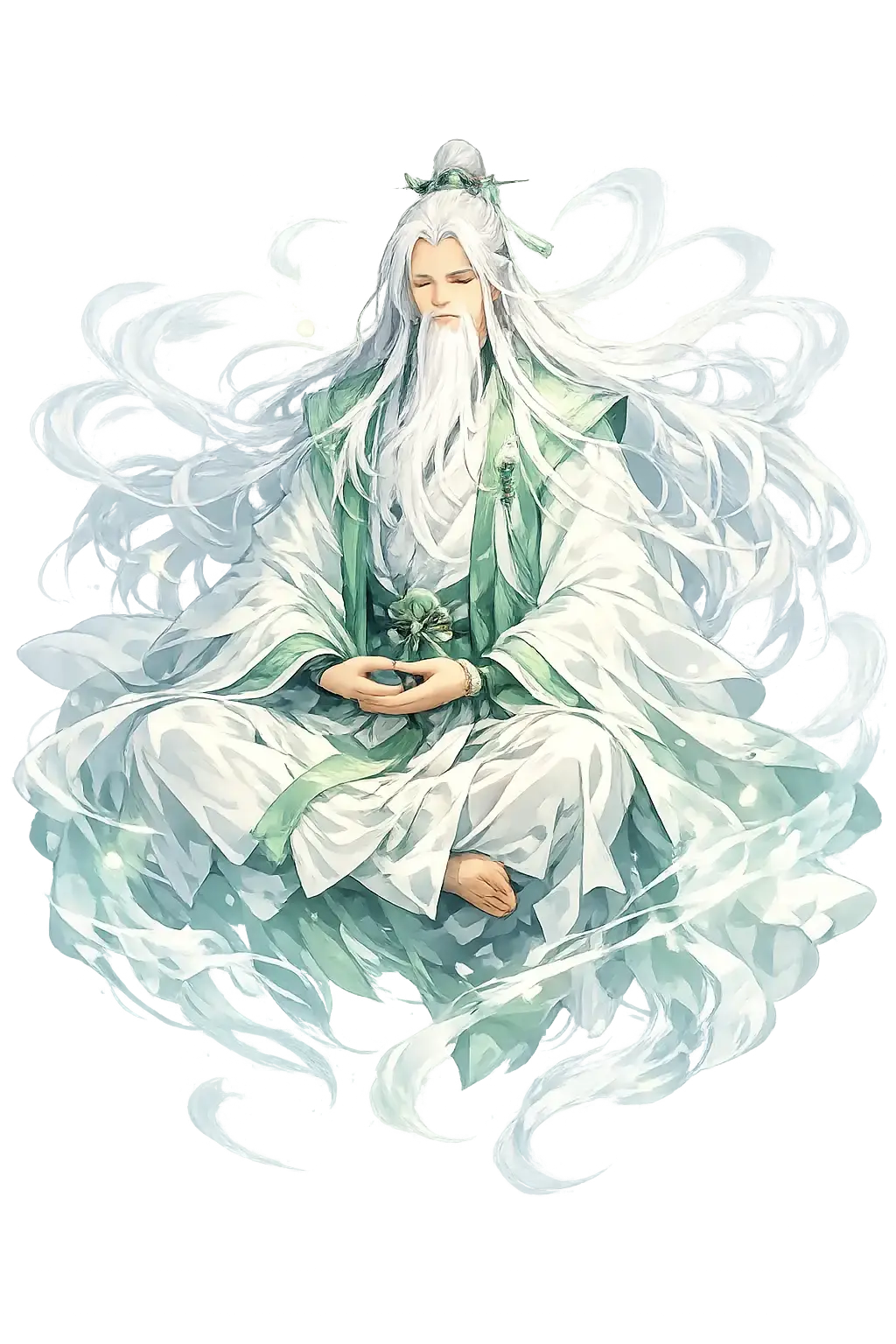
One of the oldest recognizable silhouettes in Chinese art is the feathered immortal. Warring States and Hàn tomb art already shows airborne figures with winged shoulders rising through clouds — the body literally changed, as the graph 仙, person plus mountain, promises. By the Six Dynasties the canonical kit is fixed: flowing robes, staff or gourd, a crane or deer for a mount, mist underfoot. Painting made the type famous — the immortal as a tiny figure on a vast misty peak became one of the central conventions of Chinese landscape itself. The Bāxiān acquired their attributes with the Míng: Lǐ Tiěguǎi's gourd and crutch, Hán Xiāngzì's flute, Zhāng Guǒlǎo's paper donkey, fixed forever in woodblock New Year prints. The earliest evidence is funerary — tomb banners and reliefs carry the ascending figures — because the image's first job was to show where the dead had gone.

06

Reception & Transformation

The name after its own age — transmission, translation, survival

Afterlives

The file opens with the Zhuāngzǐ's divine person and was kept open by hagiography. The Lièxiàn zhuàn, compiled under the name of Liú Xiàng in the first century BCE, founded the genre — birth omen, eccentric practice, wondrous departure — which Gé Hóng theorized and which Táo Hóngjǐng's Zhēngāo and Dù Guāngtíng's tenth-century Yǒngchéng jíxiān lù kept expanding until the catalog ran to hundreds of lives. Buddhism's arrival forced a taxonomy crisis: scholastics demoted immortals to a lower heaven while popular practice simply absorbed them. The Sòng crystallized the pantheon everyone now knows — the Eight Immortals take shape between the Jìn and the Yuán and are fixed for all later art by the Míng novel. The West met the xiān through Jesuit letters and nineteenth-century sinology; the twentieth century made them an academic subject — Joseph Needham treated alchemy as proto-chemistry in Science and Civilisation, and modern Daoist studies, from Kristofer Schipper's The Taoist Body onward, read the immortals as the tradition's own ideal of the human. Contemporary qìgōng movements now practice the ancient goal in new dress — the longest-running self-cultivation program on earth.

Identifications Across Traditions

The xiān tradition absorbed many influences. Indigenous Chinese quest for longevity merged with shamanic flight, alchemical experimentation, and Buddhist meditation techniques. The figure of the wandering immortal influenced Chan Buddhism, Confucian self-cultivation, and Chinese poetry and painting. In popular religion, local spirits and historical figures were posthumously enrolled as xiān. The West knows the xiān chiefly through the Eight Immortals and martial-arts films, where they appear as eccentric sages with superhuman powers. Modern Daoist lineages continue to practice neidan in pursuit of the same goal.

Modern Legacy

Xiān permeate Chinese culture. They appear in landscape painting as tiny figures on misty peaks, in New Year prints carrying peaches and gourds, and in countless novels, operas, and films. The aspiration to longevity shapes Chinese medicine, diet, and exercise practices such as tai chi and qigong. The word xiān is also used for extraordinary people: a great cook is a 'food immortal,' a beautiful woman a 'fairy.' In global spirituality, the xiān offers an alternative to Western heaven: not a reward after death but a transformation of life itself, achieved through sustained practice.

07

The Meditation

What Xiān means — beyond the dictionary

Xiān is the promise that the human body is not a prison. Unlike religions that split soul from flesh, Daoist immortality aims to refine the body until it becomes light, durable, and free. The xiān does not escape the world; the world loses its grip.

This is a demanding hope. It requires decades of breath, diet, meditation, and moral care. It asks whether we are willing to treat our own embodiment as a craft rather than a given. The immortal on the crane is not a tourist in transcendence but an artisan of spirit. To name a domain Xiān is to claim that the highest human possibility is not power or knowledge but freedom — the freedom that comes from having made oneself compatible with the Dao.

08

Frequently Asked Questions

Common questions about Xiān, Immortal, Transcendent, and Unicode restoration

01How do you pronounce Xiān?

In reconstructed pronunciation, Xiān is /ɕjɛn˥˥/ — approximately SHYEHN — a high, level tone held steady, with a light 'sh' that touches the palate.

02What does Xiān mean?

Xiān means Immortal in the chinese tradition.

03What are the symbols of Xiān?

Xiān is associated with Crane (The mount and companion of immortals; a thousand-year lifespan.), Peach of immortality (The fruit of the Queen Mother of the West's garden, ripening every three thousand years.), Gourd (The bottle that holds elixirs, medicines, and the boundless space of the Dao.), Clouds and mist (The medium through which immortals travel and the boundary between mortal and transcendent realms.).

04Why restore Xiān in Unicode?

Plain ASCII xian strips the stress, length, and script that make the name specific. Unicode restoration returns the name to its original written dignity.

05What is the most important myth about Xiān?

“The Divine Person of Mount Gūshè” — the Zhuāngzǐ story that anchors the mythology of Xiān, told in full on the lore page.

09

Scholarly Sources

The philological foundations of this restoration

Every claim on this page is grounded in established scholarship. The orthographic restorations follow disciplinary convention. The etymological chain follows the best available reference works. This is not invention — it is resurrection through scholarship.

◈

Lexicography & Philology

  • Daoist Canon
  • Chinese folklore
◎

Primary Texts

  • Primary sources in the chinese tradition for Xiān.
◉

Archaeology & Art History

  • Material evidence — iconography, inscriptions, and temple archaeology — for Xiān and related cults.
✦

Religious Studies

  • Zhuāngzǐ, ch. 1
  • Lièxiàn zhuàn (attributed to Liú Xiàng, Han)
  • Gé Hóng, Bāpōu zǐ, Nèipiān ch. 2
  • Táo Hóngjǐng, Zhēngāo
  • Dù Guāngtíng, Yǒngchéng jíxiān lù
  • Míng novel Dōngyóu jì
Return

The Surface Awaits

You have traced the name from its earliest attestation to its Unicode restoration. Now return to the myth. The story is where the name lives.

Back to Lore
Xiān mascot