Stories of Xiān
Xiān mythology is a vast gallery of individual adepts, each with a distinctive method of transcendence — and a long argument, running from the Zhuāngzǐ to the Míng novel, about what exactly escapes when a human being escapes death.
The xiān blueprint is drawn before the word has fully settled. In the first chapter of the Zhuāngzǐ the philosopher describes the shénrén, the divine person of Mount Gūshè: skin like frost and snow, gentle as a maiden, who does not eat the five grains but sucks the wind and drinks the dew, mounts the clouds and mist, rides the flying dragon, and roams beyond the four seas (Zhuāngzǐ, ch. 1). Nothing here requires doctrine — no elixir, no scripture, no school. The figure simply is what perfect alignment with the Dào looks like from outside: weightless, unhurried, ungovernable. Later Daoism would attach the label xiān to precisely this silhouette and then spend two thousand years working out the mechanics of achieving it. The myth’s power lies in its refusal to explain itself: transcendence first appears in Chinese literature not as a promise but as a description, offered in passing, of a person the world cannot hold.
The Hàn scholar Liú Xiàng — or the circle writing in his name — assembled the Lièxiàn zhuàn, Biographies of Exemplary Immortals: the tradition’s founding hagiography, some seventy lives of the transcendent. Its gallery is startlingly democratic. Chìsōngzǐ, Master Redpine, rain-master to the god-king Shénnóng, who entered the fire and ascended; Wángzi Qiáo, the crown prince who abandoned his throne to play the shēng mouth-organ on a mountain, and who was last seen riding a white crane skyward; woodcutters, courtiers, silkworm-tenders — each perfected by an idiosyncratic path (Lièxiàn zhuàn, Hàn dynasty). The collection fixed the genre’s grammar — birth omen, eccentric practice, wondrous departure — that every later Daoist hagiography would reuse. Its quiet revolution was sociological: the gods had always taken offerings, but immortality, it turned out, could be earned by almost anyone, including people history would otherwise never have recorded.
The fourth-century alchemist Gé Hóng gave transcendence a laboratory. In the Bāpōu zǐ, ‘Master Who Embraces Simplicity,’ he grades the achievement: the highest adepts rise bodily into heaven; middling ones roam the mountains as earthly immortals; the lowest attain liberation by shedding the corpse — and all three ranks are earned through elixirs compounded from cinnabar, gold, mica, and jade (Gé Hóng, Bāpōu zǐ, Nèipiān ch. 2). The logic is explicit in the text: he who takes gold lives as long as gold. The programme was lethal as often as liberating — mercury poisoning claimed many a sincere adept — but its audacity is the point: immortality treated not as grace but as technology, with recipes, dosages, and quality control. Chinese alchemy never split from its sacred purpose; the furnace was an altar, and the elixir a sacrament you could get wrong.
The strangest road to heaven leaves a body behind. Shījié, ‘liberation from the corpse,’ is the rite of the substituted body: the adept appears to die and is buried with full honours, while the corpse in the coffin — revealed later to be a sword, a staff, or a bamboo tube — was never flesh at all (Gé Hóng, Bāpōu zǐ, Nèipiān ch. 2; cases recorded in Táo Hóngjǐng’s Zhēngāo). Gé Hóng ranks it frankly as the lowest grade of transcendence, and the medieval church catalogued its abuses — charlatans seeding tombs with props to gull the grieving. Yet the motif solves a real theological knot: if the Dào transforms the whole person, what happens to the body the villagers watched grow old? The answer is a decoy. The tomb is left as evidence for those who need evidence, and the xiān walks out of his own funeral into a lifespan measured in centuries — the only exit from mortality that requires, first, a convincing death.
The most beloved xiān are a team, and a late one. The Eight Immortals — Lǚ Dòngbīn the scholar, Zhōnglí Quán the general, Zhāng Guǒlǎo on his mule, Hé Xiāngū the maiden, Lán Cǎihé of ambiguous gender, Hán Xiāngzǐ, Cáo Guójiù, and Lǐ Tiěguǎi the lame beggar with an iron crutch — crystallised as a set only in the Yuán and Míng, after the Táng cataloguer Dù Guāngtíng had already gathered the raw material in his Yǒngchéng jíxiān lù (10th c.). Their signature episode is the crossing of the sea: forbidden the clouds, each crosses by throwing a personal token into the waves — a flower-basket, a gourd, castanets — and riding it across, giving Chinese its proverb ‘the Eight Immortals cross the sea, each showing their divine skill’ (Míng novel Dōngyóu jì). The myth’s message is the team’s composition itself: transcendence is not a caste but a trade guild, open to beggars, soldiers, and courtiers alike, provided each brings one impossible skill.
Transcendence, Daoist Practice, and Celestial Freedom
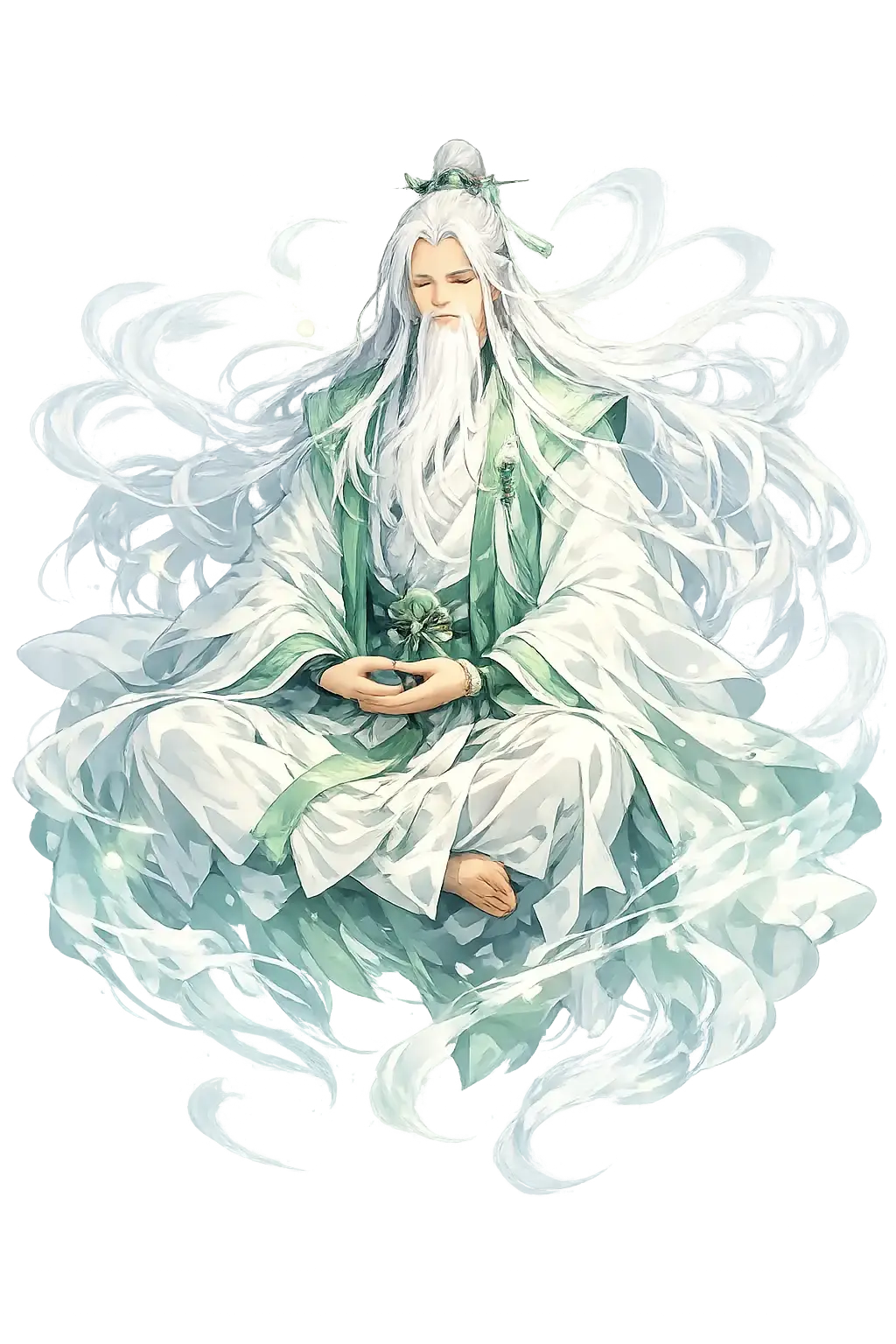
Xiān is the Chinese immortal: a human being who has refined body and spirit until death no longer applies. Unlike the gods of popular religion, who receive offerings and grant petitions, the xiān has escaped the bureaucracy of heaven and earth. He or she dwells in mountains, rides clouds or cranes, and appears unpredictably to those who have cultivated the Dao.
The path to becoming xiān is not faith but practice: meditation, breath control, diet, alchemy, and moral discipline. Immortality is an achievement, not a gift.
The xiān has overcome ageing and death through disciplined transformation of the body.
Immortals withdraw to peaks and grottoes where the qi is pure and the world is far.
Neidan refines the three treasures — jīng, qì, shén — into an immortal embryo.
Unlike gods bound by celestial office, the xiān wanders freely between realms.
From the original script to the living URL
仙
The name in its original Chinese form. Xiān (仙) is attested in the source tradition — “Immortal”. Its macron-length vowels carry the full phonetic and orthographic weight of the source tradition.
xian
Reduced to plain xian, the name loses everything that made it specific: macron-length vowels. What remains is an ASCII string that machines can parse but that no longer speaks with its original voice.
Xiān
The Unicode restoration recovers what ASCII flattened. Xiān restores macron-length vowels, returning the name to its original written dignity. The domain encodes to Punycode, but the browser displays the truth.
Xiān.com → xn--xin-2oa.com
The non-ASCII characters in Xiān are encoded while the ASCII remains visible. To the DNS, it is Punycode. To humanity, it is Xiān.
Owned, ideal, and ASCII forms of Xiān
Xiān
Restores 仙. The live temple domain — xiān.com.
xian
Flattens 仙. The plain ASCII fallback — what DNS and legacy systems see.
How Xiān was spoken
How Xiān is preserved in writing
A bespoke provenance study for Xiān is being prepared by the PUNICODEX scholarly team.
Contribute scholarly provenance →The lore you have read is the living myth. Extended Lore opens the scholarly vault beneath it: the cult and its material remains, a history of the image, the name after antiquity, a meditation on what the name still means, and the full scholarly apparatus — etymology, orthography, sources.
Enter Extended Lore