PuniCodex

Extended Lore

Veles

Etymology · Orthography · Cult · Iconography · Reception · Sources

Tier 2 Veles
Veles — Cattle, Commerce, Underworld
01

Quick Facts

Essential information about Veles, Cattle, Commerce, Underworld

Scholarly TransliterationVeles
Unicode RestorationVeles
Reconstructed Pronunciation/veles/
PantheonSlavic
DomainCattle, Commerce, Underworld
MeaningCattle god, possibly wool
ClassificationTier 2
Primary DomainVeles
Sacred SymbolsCattle horns, The serpent, The bear, Gusli (harp), Wet earth and roots
02

Etymology & Word Family

From original script to Unicode restoration

Scholarly Transliteration Veles Veles — "Cattle god, possibly wool"
Unicode Restoration Veles Canonical scholarly spelling — ASCII-identical
Modern ASCII veles Plain-ASCII fallback

The name Veles reaches the modern world through scholarly transliteration of the slavic tradition. Because the conventional spelling uses only Latin letters, its Unicode and ASCII forms coincide — the tradition it carries is in the name itself, not in diacritics.

03

Unicode Character Breakdown

Character-by-character philological analysis

CharacterUnicodeNameBlockPhonetic Role
VU+0056Latin Capital Letter VBasic LatinSame
eU+0065Latin Small Letter EBasic LatinSame
lU+006CLatin Small Letter LBasic LatinSame
eU+0065Latin Small Letter EBasic LatinSame
sU+0073Latin Small Letter SBasic LatinSame

The Tier 2 classification here reflects fidelity to the attested tradition, not recovered diacritics: every character of Veles already survives in ASCII. What the restoration preserves is the canonical spelling itself — the form scholarship standardised.

04

Cult & Worship

How the sacred was kept — rites, sanctuaries, remains

The Cult

Veles left no temple, no statue, and no feast day — his cult was sworn, not built. The one verbatim ritual text of pre-Christian Rus' is an oath in his name: the Rus'-Byzantine treaty of 944, copied into the Primary Chronicle, has the envoys swear by 'Perun and Volos,' and a later copyist glosses the fading name for his readers — 'Volos, that is, the cattle god.' The formula's division of labor is the cult: Perun witnesses the warriors' clauses, Volos alone underwrites everything touching livestock — sale, theft, compensation — the peasant's entire fortune, animal by animal. Oaths need somewhere to be sworn, and Novgorod supplied it: birchbark letters of the eleventh and twelfth centuries give addresses on Volosova ulica, 'Volos's street,' the market quarter — a god kept in the townscape two centuries after the conversion. The hostile chronicle also preserves the cult at its darkest: in the famine of 1024, wandering volkhvy blamed Veles and demanded a human sacrifice, for which the bishop of Rostov drowned them in the Volga. Probably aniconic, certainly oath-bound, the cult survived longest where wealth was counted in horns. Modern revival movements rebuild his rites from these fragments; the attested cult remains the oath, the street, and the chronicle's horror.

In the Earth

No temple of Veles has been identified, and his material dossier is thin — fitting for a god of hidden things. The anchor is textual-archaeological: birchbark letters from eleventh–twelfth-century Novgorod address creditors and debtors on Volosova ulica, 'Volos's street', the market quarter — proof that the cult left footprints in urban topography even where no shrine survives. Riverside hoards and water-logged deposits are sometimes laid at the door of the underworld god, but the attribution is unprovable, and no figurine or amulet bears his name. The honest summary is that Veles's archaeology is his absence: the god of concealment kept himself concealed, and the street sign is the whole monument.

05

Iconography

How Veles was imaged across the ages

The Image

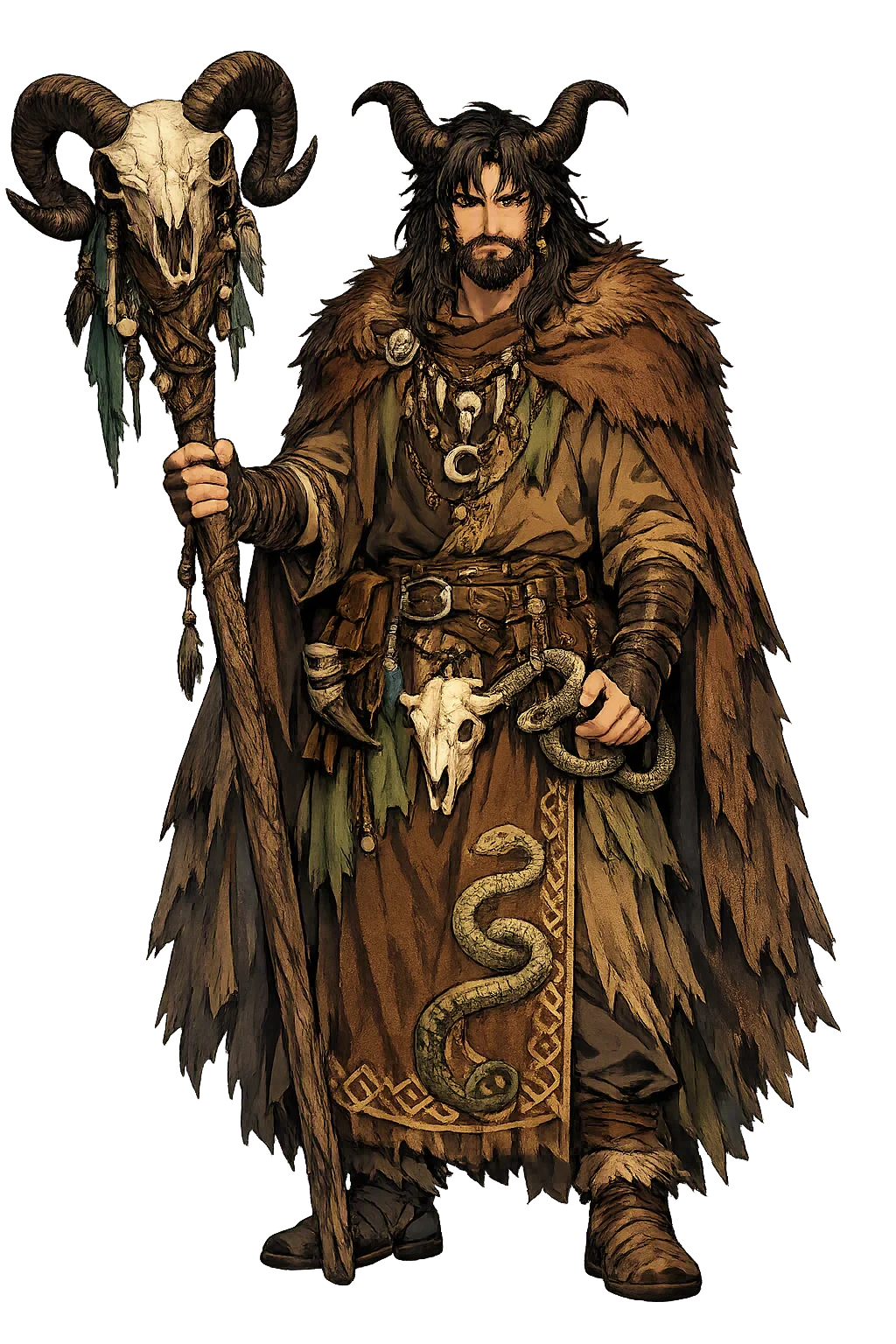
Not one image of Veles survives, and the little we know suggests none was made: a god of oaths and hidden wealth kept himself unportrayed, and the chronicles that swear by him never describe his face. The attributes come from texts and much later folklore — the horns of cattle, the serpent that is his disguise in the modern reconstruction, the gusli of the singer he patronizes, the bear of the wilderness — a wardrobe assembled from functions rather than a portrait. The temptation to fill the gap has been fatal once: the so-called Book of Veles, publicized in the 1950s with its wooden tablets and vivid scenes, is now universally judged a forgery, and its pictures tell us more about twentieth-century longing than about Slavic gods. The honest summary is brief: Veles was imagined, if at all, at the bottom of things — in the roots, the herd, the waterlogged hoard — and the faithful seem to have left the imagining to him.

06

Reception & Transformation

The name after its own age — transmission, translation, survival

Afterlives

Veles's transmission is an archaeological feat: his dossier was buried in one chronicle and one street, and both had to be excavated. The Primary Chronicle — compiled in the early twelfth century and preserved complete in the fourteenth-century Laurentian codex — kept the oath of 944 and the famine of 1024; Novgorod kept his street beneath a millennium of pavement, until post-war archaeology recovered the birchbark letters naming Volosova ulica and let philologists read his name in the handwriting of debtors. The Christian centuries folded him into the calendar rather than erasing him — Saint Vlasiy's February feast, with cattle blessed in his name, kept the herders' god on an official date, a parallel the Balkans repeated as Sveti Vlaho. Comparative scholarship then rebuilt him: Brückner's 1924 manual gathered the folklore; the Ivanov–Toporov reconstruction of 1974 set him opposite Perun in a myth-cycle read across every Indo-European thunder-serpent duel; and Toporov's Veles–Varuna hypothesis made him a standing test-case for how far comparison may go. The forged Book of Veles, now universally condemned, ironically proved the reconstruction's fame — no one forges tablets for a forgotten god. He arrived at modernity with no epic, no image, and no temple, and scholarship had to supply all three — which is, properly, what scholarship is for.

Identifications Across Traditions

Veles's Christian afterlife ran through the saints of the herd. In the Balkans he survives in Sveti Vlaho — Saint Blaise — the Dalmatian patron of cattle whose feast ends with animals blessed in his name; in Russia the same role fell to Saint Vlasiy, whose name is simply Veles re-clothed. The divine adversary was absorbed too: the serpent of the myth-cycle slithered into dragon-slayer legends, and Perun's spring victory was reassigned to Saint George and Elijah. Byzantine-educated writers performed interpretatio on the pantheon as a whole, while comparative scholarship drew bolder lines — Toporov's Veles–Varuna, the Norse Óðinn of poetry and the dead, Hermes as god of herds and boundary-crossings — each a hypothesis about what sort of god this was: sovereign of everything the sky does not see. Demonized in the languages (Czech veles gave way to čert for 'devil'), he remained the underworld's landlord in folklore down to the modern era.

Modern Legacy

Veles endures most durably in words: toponyms like Volosovo across the Russian north, the Dalmatian cult of Sveti Vlaho, the devil-haunted velnias of Lithuanian folklore, and the root itself in Slavic speech. Folklore kept his portfolio — treasure guarded by a chthonic serpent, the magic fiddle of the singer who bargains below, oaths sworn over a herd at market. The nineteenth and twentieth centuries were less kind: the so-called Book of Veles, publicized in the 1950s, purports to be a pre-Christian epic of his people and is now universally judged a modern forgery — a tribute, of a crooked kind, to how badly moderns wanted the lost god back. Rodnover communities today honor Veles as lord of wisdom, wealth, and the written word, and his serpent still guards vaults in banks' logos and fantasy novels alike.

07

The Meditation

What Veles means — beyond the dictionary

Veles is the god of the other economy. Perun owns everything visible — the strike, the oath, the battle won — but Veles owns what accumulates quietly: calves, coins, verses, graves. He is the patron of everyone who works below the threshold of glory: the herder, the merchant, the poet, the sorcerer, the dead. His mythology, reconstructed stitch by stitch by modern scholars, tells of a being who is defeated every spring and never finally destroyed — which is exactly the biography of wealth, and of life itself returning from underground. There is something subversive in his survival. The chronicles drown his sorcerers in the Volga, demonize his name, and reassign his cattle to Saint Blaise; and meanwhile ordinary Novgorodians keep doing business on his street, in writing, for centuries. Veles teaches that the underworld is not the opposite of prosperity but its storehouse: everything valuable is buried for a season, and the god of the deep is the one who remembers where.

08

Frequently Asked Questions

Common questions about Veles, Cattle, Commerce, Underworld, and Unicode restoration

01How do you pronounce Veles?

In reconstructed pronunciation, Veles is /veles/ — approximately 'VEH-les', two quick syllables; the stress falls forward, as in the modern South Slavic reflexes of the name.

02What does Veles mean?

Veles means Cattle god, possibly wool in the slavic tradition.

03What are the symbols of Veles?

Veles is associated with Cattle horns (The herds that were his treasure and the sign under which herders and merchants swore), The serpent (His disguise in the myth-cycle: low, wet, and close to the earth — the eternal adversary of the eagle), The bear (His chthonic animal in the alternating lore of the Slavic year — master of the wilderness beyond the fence), Gusli (harp) (The instrument of the singer he protects; in folklore the magic fiddle makes even the forest dance), Wet earth and roots (The moist underworld into which he withdraws and from which wealth returns).

04Why restore Veles in Unicode?

Veles is written entirely in ASCII letters, so its restoration is about canonical fidelity rather than recovered diacritics: the temple fixes the name in its scholarly standard spelling, attested in the source tradition, instead of leaving it to drift.

05What is the most important myth about Veles?

“Sworn by Volos” — the Oath-text story that anchors the mythology of Veles, told in full on the lore page.

09

Scholarly Sources

The philological foundations of this restoration

Every claim on this page is grounded in established scholarship. The orthographic restorations follow disciplinary convention. The etymological chain follows the best available reference works. This is not invention — it is resurrection through scholarship.

◈

Lexicography & Philology

  • Miklosich
◎

Primary Texts

  • The Primary Chronicle (Povest’ vremennykh let); the Hypatian Codex; East Slavic chronicle tradition and South Slavic folk invocations.
◉

Archaeology & Art History

  • Material evidence — iconography, inscriptions, and temple archaeology — for Veles and related cults.
✦

Religious Studies

  • Primary Chronicle / Povest' vremennykh let, s.a. 944, 1024
  • Novgorod birchbark letters (Volosova ulica, 11th–12th c.)
  • Ivanov, Vyacheslav, and Vladimir Toporov, 'Le mythe indo-européen du dieu de l'orage poursuivant le serpent' (1974)
  • Toporov, V. N., studies on Veles and Varuna
  • Ivanits, Linda J., Russian Folk Belief (1989)
  • Brückner, Aleksander, Mitologia słowiańska i polska (1924)
Return

The Surface Awaits

You have traced the name from its earliest attestation to its Unicode restoration. Now return to the myth. The story is where the name lives.

Back to Lore
Veles mascot