Stories of Veles
Veles has no surviving epic. His dossier is a chronicle oath here, a famine there, and — towering over the fragments — the modern reconstruction by Ivanov and Toporov of the myth-cycle in which he is the thunderer's eternal adversary. Read together, the fragments describe a god of everything that grows, burrows, and accrues out of sight.
The Rus'-Byzantine treaty of 944, copied into the Primary Chronicle, has left the only verbatim ritual text of pre-Christian Rus'. For the clauses of war the envoys swear by Perun; for everything touching livestock — sale, theft, compensation — they swear by Volos alone, and the curse on the perjurer is total: 'may we be cursed by the god in whom we believe, by Perun and Volos, the furred one... may we not be protected by our shields, may we be slain by our own swords, may we be shot by our own arrows.' A later copyist glossed the unfamiliar name for his readers: 'Volos — that is, the cattle god.' The division of labor is the myth in miniature: the sky-god witnesses between warriors, while the god of herds and wealth underwrites the peasant's entire fortune, animal by animal. Where your property lives, there your god is invoked.
In the terrible famine year of 1024, the Primary Chronicle (s.a. 6532) tells how wandering sorcerers came to Suzdal' and announced the cause of the people's misery: 'It is the god Veles who is angry.' The volkhvy demanded the sacrifice of a youth — a red-haired one, they specified, from a particular kin — and when the killing was done, they ate the body. The bishop of Rostov rode in, arrested the sorcerers, and drowned them in the Volga. The tale is told by Christian enemies, and its details are horrific precisely in order to damn the old religion; yet its center is precious evidence. A generation after the baptism, when the official gods were Perun's rivals long drowned, it was still Veles whose name a prophet reached for when the earth would not feed her children. The underworld god was the one who explained hunger.
In the reconstruction of Ivanov and Toporov, Slavic mythology's central cycle runs like this: Veles, dwelling in the underworld beneath the world-tree, commits a crime against the sky — he steals Perun's cattle, his treasure, sometimes his bride. Perun descends in pursuit, hurling his bolts; Veles transforms and wriggles — serpent, catfish, black eel — and each spring the thunderer strikes him down, and the rain returns to the herds. No East Slavic manuscript tells this story; it survives in the pairing of the gods in the treaty oaths, in wedding laments where the bride weeps for a brother struck or drowned, in South Slavic spring songs, and in the universal Indo-European pattern of the storm-god and the serpent. The scholars who built it were explicit that they were reconstructing — and the pieces fit with a stubbornness no rival hypothesis has matched.
Novgorod kept Veles in its very street plan. Birchbark letters of the eleventh and twelfth centuries — mundane shopping lists and debt notes scratched by ordinary citizens — give addresses on Volosova ulica, 'Volos's street', the commercial quarter by the market. No chronicle mentions it; the god's presence in the townscape was simply assumed, a neighborhood named for him the way others were named for craftsmen. When we read a debtor promise to pay on Volos's street, we watch the cult outliving the conversion in the least sacred of registers: commerce. Perun got treaties, curses, and weeping crowds; Veles got the marketplace — which may be the more honest monument, since people swore by the thunderer but they lived by the herder. A street, unlike a statue, has to be used to survive — and Volosova ulica was used every market day for a hundred years after the gods went under.
Cattle
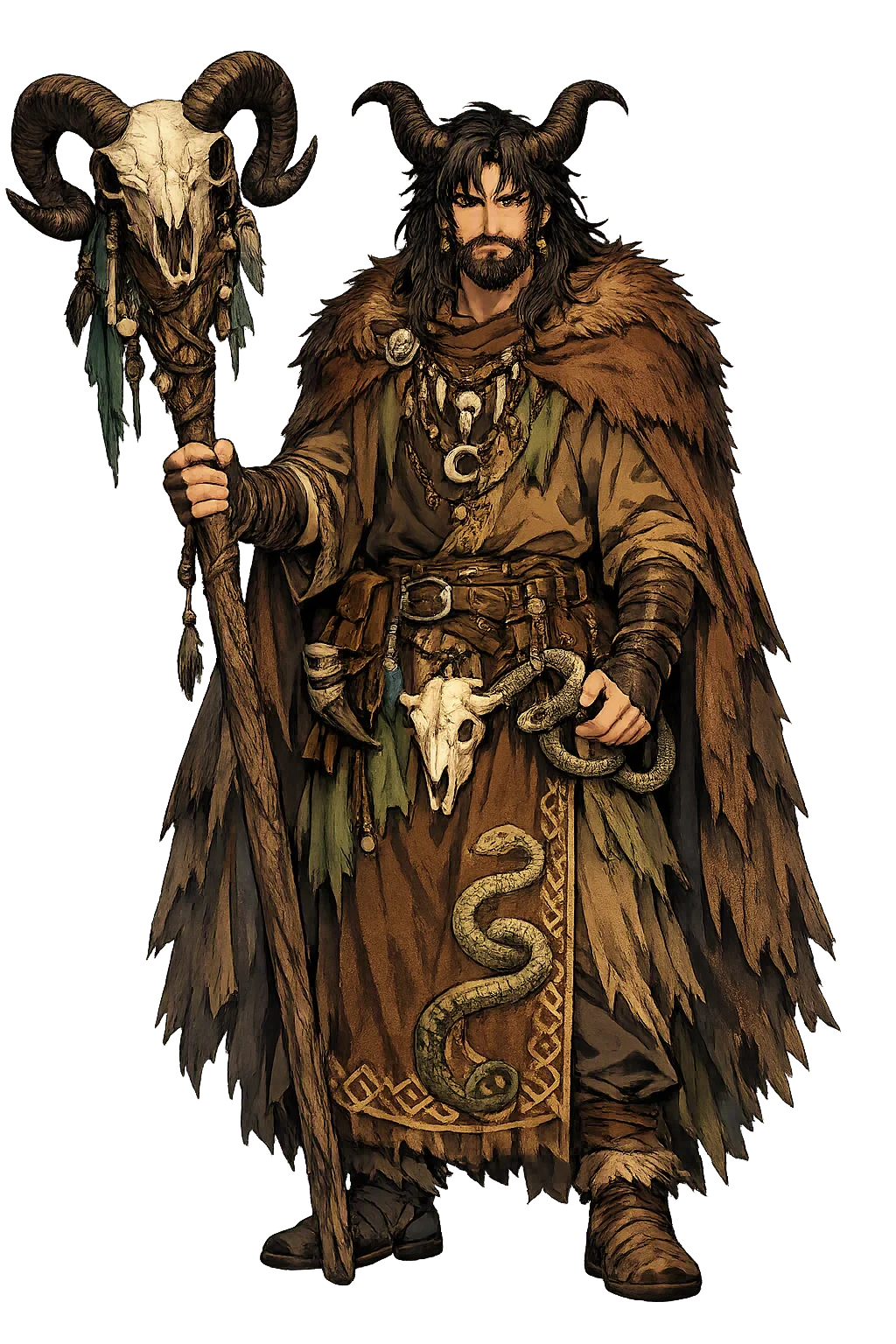
Veles — Volos to the East Slavs — is the god of cattle and wealth, of the underworld's moist depths, and, in the great reconstruction of Ivanov and Toporov, of poetry and magic. Where Perun strikes from above, Veles moves below: through herds, graves, bargains, and song.
The chronicles gloss him explicitly: Volos, 'the cattle god' — herders swore their oaths by him alone.
He rules the wet, root-filled depths beneath the world-tree: the realm of the dead and of hidden treasure.
In the reconstructed mythology he is patron of singers and sorcerers; the wandering volkhvy acted in his name.
The eternal enemy in the myth-cycle: thief of cattle, storm of wealth, struck down each spring by the thunderer's bolt.
From the original script to the living URL
Veles
The name survives in scholarly transliteration. Veles is the standard Slavic romanisation, documented in academic sources — “Cattle god, possibly wool”. Because the spelling uses only Latin letters, the form is the same in both ASCII and Unicode.
No indigenous writing system is securely attested for individual slavic names. The form shown is a modern scholarly transliteration.
veles
The plain veles form is identical to the Unicode restoration. Because this name is already written in Latin letters, no diacritics, stress, or script information were lost — only capitalization differs.
Veles
The Unicode restoration does not need to recover lost marks for Veles. Its value is canonical spelling and consistent cataloguing, not the reconstruction of erased orthography. The domain is readable as-is to both DNS and humanity.
Veles.com
This restoration is written entirely in ASCII letters — no Punycode encoding stands between Veles and the DNS. The domain reads identically to machines and to human eyes.
Owned, ideal, and ASCII forms of Veles
Veles
The full Unicode restoration. veles.com is not in the PuniCodex collection — it is watched for release; if it drops, this temple upgrades to an owned flagship.
How Veles was spoken
How Veles is preserved in writing
No indigenous writing system is securely attested for individual slavic names. The form shown is a modern scholarly transliteration.
Contribute scholarly provenance →The lore you have read is the living myth. Extended Lore opens the scholarly vault beneath it: the cult and its material remains, a history of the image, the name after antiquity, a meditation on what the name still means, and the full scholarly apparatus — etymology, orthography, sources.
Enter Extended Lore