PuniCodex

Extended Lore

वसुबन्धु Vasubandhu

Etymology · Orthography · Cult · Iconography · Reception · Sources

Tier 2 Vasubandhu
Vasubandhu — Abhidharma, Yogacara
01

Quick Facts

Essential information about Vasubandhu, Abhidharma, Yogacara

Original Scriptवसुबन्धु
Unicode RestorationVasubandhu
Reconstructed Pronunciation/vasubandhu/
PantheonBuddhist
DomainAbhidharma, Yogacara
MeaningThe celebrated Buddhist scholar — author of the Abhidharmakośa, co-founder of the Yogācāra school
ClassificationTier 2
Primary DomainVasubandhu
Sacred SymbolsThe Kośa stanza, The begging bowl, The letter from Asaṅga, Treasury (kośa)
02

Etymology & Word Family

From original script to Unicode restoration

Original Script वसुबन्धु Vasubandhu — "The celebrated Buddhist scholar — author of the Abhidharmakośa, co-founder of the Yogācāra school"
Unicode Restoration Vasubandhu Canonical scholarly spelling — ASCII-identical
Modern ASCII vasubandhu Plain-ASCII fallback

The name Vasubandhu reaches the modern world through scholarly transliteration of the buddhist tradition. Because the conventional spelling uses only Latin letters, its Unicode and ASCII forms coincide — the tradition it carries is in the name itself, not in diacritics.

03

Unicode Character Breakdown

Character-by-character philological analysis

CharacterUnicodeNameBlockPhonetic Role
VU+0056Latin Capital Letter VBasic LatinSame, capitalized
aU+0061Latin Small Letter ABasic LatinSame
sU+0073Latin Small Letter SBasic LatinSame
uU+0075Latin Small Letter UBasic LatinSame
bU+0062Latin Small Letter BBasic LatinSame
aU+0061Latin Small Letter ABasic LatinSame
nU+006ELatin Small Letter NBasic LatinSame
dU+0064Latin Small Letter DBasic LatinSame
hU+0068Latin Small Letter HBasic LatinSame
uU+0075Latin Small Letter UBasic LatinSame

The Tier 2 classification here reflects fidelity to the attested tradition, not recovered diacritics: every character of Vasubandhu already survives in ASCII. What the restoration preserves is the canonical spelling itself — the form scholarship standardised.

04

Cult & Worship

How the sacred was kept — rites, sanctuaries, remains

The Cult

Vasubandhu is not worshipped; he is venerated — and the distinction is the cult. Buddhist communities honor him as a patriarch: in East Asia his image stands in the lineages of the Yogācāra transmission, and in Japan's Hossō school the devotion became concrete at Kōfukuji in Nara, where Kamakura-period masters of the Kei school carved the great patriarchs of the sect — among them Vasubandhu — as standing monks in formal robes, images now counted among the treasures of Japanese Buddhist sculpture. In Tibet he is invoked by name: the scholastic curriculum opens with his verses, and colophons and opening prayers hail the lord Vasubandhu (dbyig gnyen) before the debate begins. Tradition makes him a son of Gandhāra, the monastery country around Puruṣapura (Peshawar), and sends his passing toward the Pure Land of Amitābha. No shrine dedicated solely to him survives; his living cult is the daily recitation of the Kośa — fifteen centuries of monks memorizing a book the way other traditions light lamps.

In the Earth

Vasubandhu left no shrine — his witnesses are manuscripts. Fragments of the Abhidharmakośa survive in Central Asian Sanskrit finds, and the complete tradition rides on Xuanzang's Chinese translation (Taishō 1558) and the later Tibetan canon (Toh. 4089–90). Gandhāra, his homeland, is one of the richest archaeological regions of the Buddhist world: the monastery and stupa complexes around Peshawar — where the biographies place his birth — have yielded the oldest datable Buddha images (c. 1st–3rd c. CE). At Nālandā, the university whose ruins still stand in Bihar, his Kośa was a founding text; the debate-court culture his legend describes is the same institution archaeology reveals. The colophons of the Dunhuang and Gilgit manuscript finds carry his name as authority across the Silk Road.

05

Iconography

How Vasubandhu was imaged across the ages

The Image

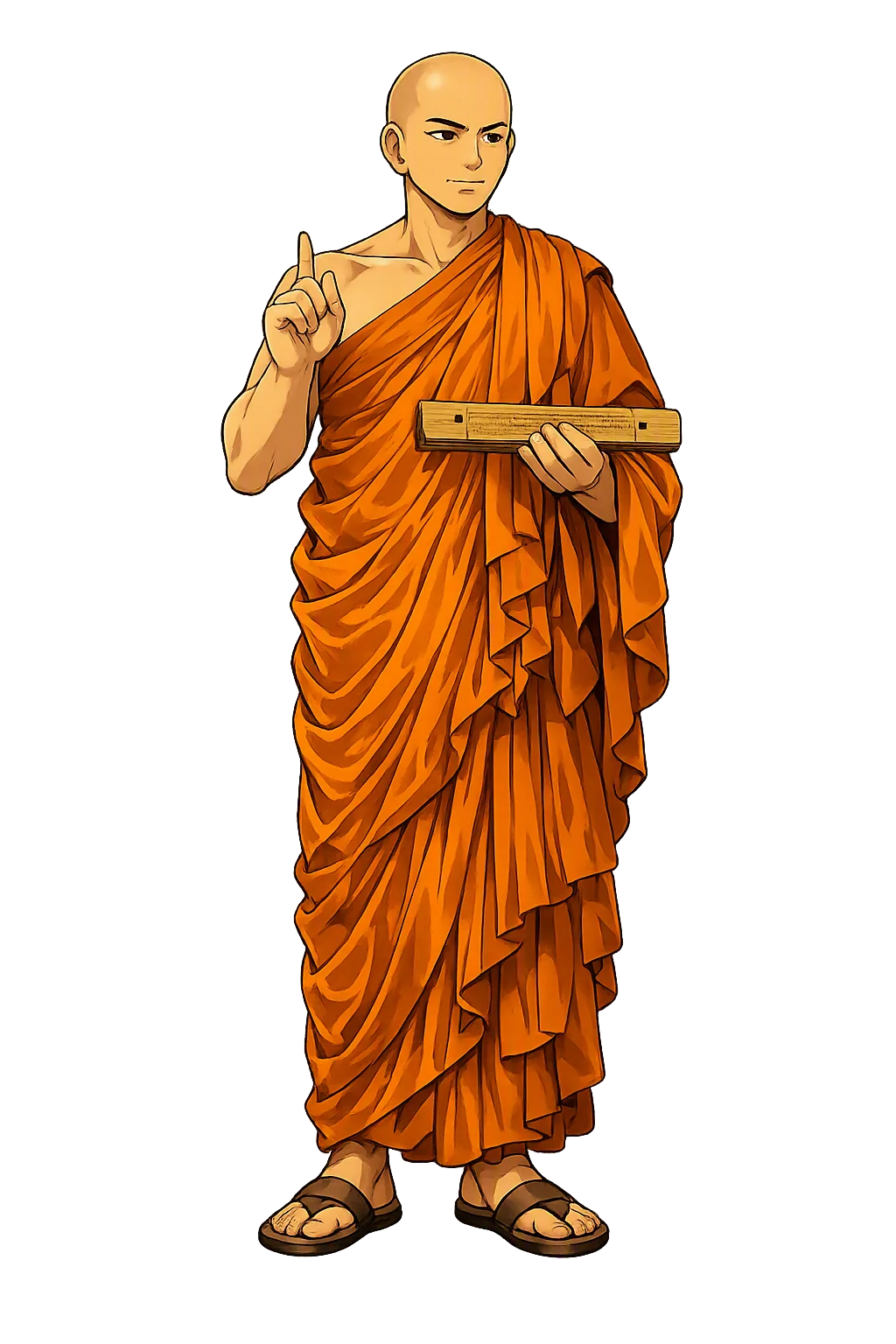
No contemporary portrait of Vasubandhu exists — a monk of the fifth century left his face to the imagination — so his iconography is a genealogy of types. East Asia fixed the earliest images in wood and lacquer: the Kōfukuji patriarch figures show him as a standing monk, shaved, robed, a sutra scroll in hand, indistinguishable in dress from the Chinese and Japanese masters beside him — the point being transmission, not personality. Tibet's tradition draws him instead as an Indian paṇḍita, in the red-fringed scholar's cap and monastic shawl, a volume in his lap, seated in the lineage trees of thangka painting where Asaṅga stands above him and his works cascade below. The bowl appears when artists want biography: the begging bowl of the bhikṣu he remained through every court and school, and, in illustrated hagiography, the letter from the dying Asaṅga. Every image agrees on the essentials — monastic, bookish, unidealized — because the tradition insisted that its greatest mind was also its most ordinary mendicant.

06

Reception & Transformation

The name after its own age — transmission, translation, survival

Afterlives

Vasubandhu's transmission is the largest in this lexicon: his books walked the whole Silk Road. The Chinese leg was a pilgrimage: Xuanzang set out for India in 629 in part over disputes about the Kośa, studied the text at Nālandā, and between 649 and 651 translated it whole — the version, Taishō 1558, on which all East Asian Vasubandhu still rests; his disciple Kuiji founded the Faxiang school on it, and the Japanese monk Dōshō carried the line to Nara, where Hossō made Vasubandhu its patriarch and Kōfukuji's statues made the patriarchy visible. Sanskrit nearly lost him: the Kośa survives complete only in the Tibetan canon (Toh. 4089–90) and in fragments from Central Asian finds, while Yaśomitra's great Sanskrit commentary waited in Nepalese libraries until the manuscript hunters of the late nineteenth century brought it to light. Tibet built a curriculum on him — the Kośa opens the scholastic course in every great monastery — and Sthiramati's mind-only commentaries carried the other half of his oeuvre through India. Modern scholarship then made him a contemporary: Erich Frauwallner's 1951 study re-dated his life and launched the still-running debate over one Vasubandhu or two; Stefan Anacker's 1984 translations put the Viṁśikā into English philosophy seminars; and philosophers of mind now cite his dream arguments beside Descartes. A brahmin of Gandhāra became, in stages — Chinese pilgrim, Tibetan textbook, modern citation — the most widely read author Buddhism ever produced.

Identifications Across Traditions

Vasubandhu's legacy is the creation of a pan-Asian scholastic commons. In China, Xuanzang's pilgrimage was undertaken substantially to resolve disputes over the Kośa, and his massive translation of 649–660 CE made Vasubandhu the doctrinal backbone of the Faxiang (Consciousness-Only) school. In Japan the Hossō school of Nara claimed him as its patriarch, while the Kyoto lineages of the future would read his Viṁśikā as the foundation of 'mind-only' meditations. In Tibet every monastery curriculum begins with the Kośa. Modern comparative philosophy — from Thich Nhat Hanh's engaged Buddhism to analytic treatments of idealism — still frames its questions in his vocabulary. He is perhaps the only ancient philosopher whose works are simultaneously a living liturgy, a graduate textbook, and a modern research programme.

Modern Legacy

The Abhidharmakośa never went out of use: it has been memorized, commented, and debated continuously for some fifteen centuries, from Nālandā to the great Tibetan commentarial traditions (Prajñākaramati's and Yaśomitra's subcommentaries in Sanskrit; Sthiramati's in the mind-only line). Its author is honored as a patriarch in China and Japan, and Tibetan debate courtyards still open with his verses. In the modern academy Vasubandhu anchors the study of Buddhist philosophy — his Viṁśikā is a standard text in courses on philosophy of mind, cited in debates about idealism and representation. A brahmin-born monk of Gandhāra thus became one of the most-read authors in human history, his name a byword for the possibility that analysis itself can be a path to compassion.

07

The Meditation

What Vasubandhu means — beyond the dictionary

Vasubandhu is the scholar as religious figure — proof that in the Buddhist world, thinking carefully was itself a sacred practice. His two careers look like a contradiction: the great classifier of the mind's parts, then the teacher who said the parts and the world they compose are 'mind-only'. Read together, they form one argument: you must take the world apart completely before you can see what holds it together. His legend conversion turns not on a vision but on a letter from a dying brother — intellect bending at last to love. Modern philosophy of mind still returns to his Viṁśikā, where a dream, a reflection, and the waking world are made to trade places in a few pages. Few ancient authors remain so contemporary: the question of what the world is made of, and whether mind is on the list, is still his question.

08

Frequently Asked Questions

Common questions about Vasubandhu, Abhidharma, Yogacara, and Unicode restoration

01How do you pronounce Vasubandhu?

In reconstructed pronunciation, Vasubandhu is /vasubandhu/ — approximately Say "vasubandhu" with the stress and length implied by the scholarly restoration "Vasubandhu".

02What does Vasubandhu mean?

Vasubandhu means The celebrated Buddhist scholar — author of the Abhidharmakośa, co-founder of the Yogācāra school in the buddhist tradition.

03What are the symbols of Vasubandhu?

Vasubandhu is associated with The Kośa stanza (A verse (kārikā) whose eight-syllable lines hold whole Abhidharma treatises — scholarship compressed into memorable sound), The begging bowl (The monk's only equipment; Vasubandhu remained a bhikṣu all his life even while moving courts and schools), The letter from Asaṅga (In the Tibetan biographies, the note that converted him — affection and mortality doing what doctrine could not), Treasury (kośa) (The storehouse metaphor of the Abhidharmakośa: every dharma catalogued like treasure in a vault, each with its own nature).

04Why restore Vasubandhu in Unicode?

Vasubandhu is written entirely in ASCII letters, so its restoration is about canonical fidelity rather than recovered diacritics: the temple fixes the name in its scholarly standard spelling, attested in the source tradition, instead of leaving it to drift.

05What is the most important myth about Vasubandhu?

“Three Years in Seclusion” — the The Kośa story that anchors the mythology of Vasubandhu, told in full on the lore page.

09

Scholarly Sources

The philological foundations of this restoration

Every claim on this page is grounded in established scholarship. The orthographic restorations follow disciplinary convention. The etymological chain follows the best available reference works. This is not invention — it is resurrection through scholarship.

◈

Lexicography & Philology

  • Abhidharmakośa
  • Buddhist texts
◎

Primary Texts

  • The Larger Sukhāvatī-vyūha Sūtra; the Smaller Sukhāvatī-vyūha Sūtra; the Amitāyurdhyāna Sūtra; the Lotus Sūtra.
◉

Archaeology & Art History

  • Material evidence — iconography, inscriptions, and temple archaeology — for Vasubandhu and related cults.
✦

Religious Studies

  • Frauwallner, Erich, 'On the Date of the Buddhist Master of the Law Vasubandhu', Serie Orientale Roma 3 (1951)
  • Anacker, Stefan, Seven Works of Vasubandhu (Motilal Banarsidass, 1984) — translations of the Viṁśikā, Triṁśikā, Kośa verses and more
  • Buswell, Robert E., and Donald S. Lopez Jr., The Princeton Dictionary of Buddhism (2014), s.v. Vasubandhu
  • Williams, Paul, Mahāyāna Buddhism: The Doctrinal Foundations, 2nd ed. (Routledge, 2009)
  • Conze, Edward, Buddhist Texts Through the Ages (1954)
  • Xuanzang's Chinese translation of the Abhidharmakośa (Taishō 1558, 651 CE)
Return

The Surface Awaits

You have traced the name from its earliest attestation to its Unicode restoration. Now return to the myth. The story is where the name lives.

Back to Lore
Vasubandhu mascot