Stories of Ullr
Ullr's dossier is a paradox: among the best-attested gods in the Scandinavian place-name record and among the least narrated in the literature. The Poetic Edda gives him a stanza and a half; Snorri gives him a paragraph and a list of kennings; Saxo gives him a throne for ten years. What the myths withhold, the map supplies — a god whose story was carved into the landscape of Norway and Sweden long before anyone wrote an Edda.
In Grímnismál's numbered survey of the gods' dwellings, the fifth hall belongs to Ullr: Ýdalir heita þar er Ullr hefir sér of görva sali — 'Yew-Dales is the name of the place where Ullr has made himself a hall.' The poem gives him no lineage, no wife, no adventure — only an address. But what an address: the yew is the bow-wood of the North, and a god who halls himself in its dales declares his office in the naming.
Grímnismál touches him once more at its close, when the tortured Geirrøðr's son is blessed at the fire: Ullar hylli hefr ok allra goða — 'the favor of Ullr and of all the gods shall he have.' In a poem where Odin alone speaks, Ullr's name stands first among the gods whose goodwill is invoked — a small, unexplained precedence that commentators have never stopped noticing.
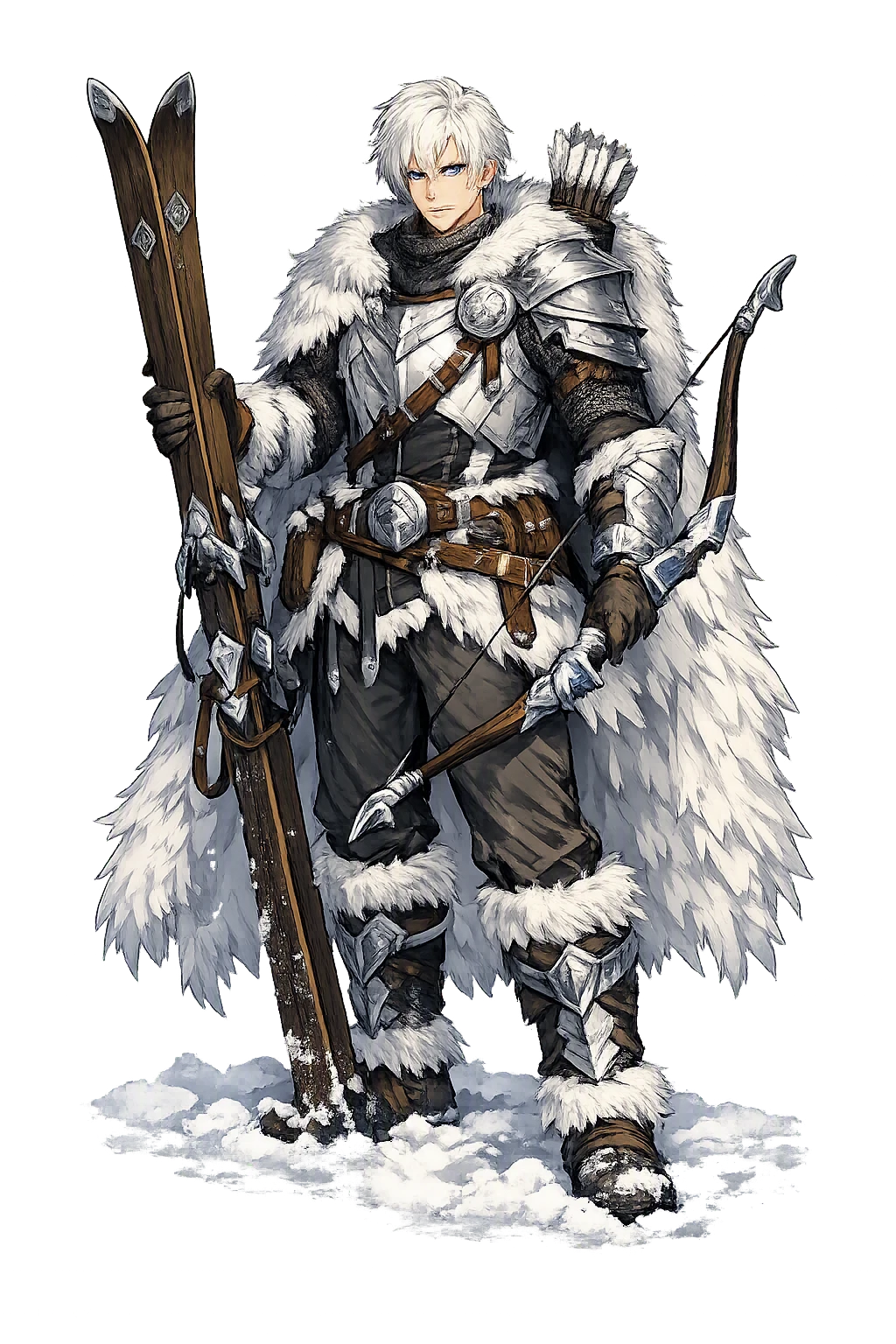
Snorri's whole account of Ullr is one packed sentence: 'One is called Ullr, son of Sif and stepson of Thor. He is such a good bowman and so fast on skis that no one can compete with him. He is also fair of face and has a warrior's accomplishments. It is good to call on him in single combat.' Son of Sif, raised in Thor's household of Thrúðheimr, the god of the bow, the ski, and the duel — Snorri compresses a cult into a catalogue.
Skáldskaparmál keeps the poets' shorthand: Ullr may be called son of Sif, kinsman of Thor, the Snowshoe God, the Bow God, the Hunting God, the Shield God. And the shield, the skalds agreed, is 'Ullr's ship' — a kenning Snorri preserves without its story. Somewhere behind the verse stands a lost myth in which the god travelled on his shield as on a vessel; the words survived the tale.
When Atli has betrayed the Burgundian kings and Guðrún turns on him, she recalls the oaths he swore long before: by the sun and the south-facing sun-hall, by Sigtyr's mount — and at Ullar hringi, 'by the ring of Ullr'. The oath-ring, the holy arm-ring of the temple on which the deepest vows were sworn, is here named as Ullr's own.
Nothing else in the corpus explains the attribution. A bow-god with a cult-ring suggests something the myths never spell out: a god of the thing, the assembly, the sworn word — a legal weight that matches the strange priority Grímnismál gives him. The line is one stanza long, and it has carried whole theories of Ullr as an ancient god of law and sky, older than the family of gods the Edda finally recorded.
Saxo Grammaticus, euhemerizing the gods as ancient kings and wizards, keeps the one adventure the Icelanders forgot. When Othinus was driven into exile for dishonoring the public cult, the gods 'not wishing Odin to drive public religion into exile with him' put one Ollerus — the Latin form of Ullr — in his place. For ten years Ollerus bore the name and the rites of Odin and ruled at Uppsala; when the true Odin returned, the usurper was driven out, fled to Sweden, and was slain by the Danes as he tried to rebuild his glory in a new land.
Saxo adds the rumor (fama est) that Ollerus was such a cunning wizard that he could cross the seas on a bone he had marked with terrible spells — a detail readers have long recognized as the winter-god's equipment refracted through a Danish chronicler's Latin: the enchanted bone is the ski or skate, and the sea it crosses is the snowfield. A god who can wear Odin's name for a decade is no minor figure; Saxo's fable reads like the last echo of an age when Ullr stood nearer the center of heaven than the Edda dares admit.
The Snowshoe God of the Yew-Dales
Ullr, son of Sif and stepson of Thor, dwells in Ýdalir — the Yew-Dales — and is everything the address promises: a bowman so good and a skier so swift that no one can compete with him, fair of face, with a warrior's skill, the god it is good to call on in single combat. The Edda gives him a paragraph; the map gives him a province — Ullensaker, Ullevi, Ullensvang and their dozens of kin keep his cult's fossil record.
The bow of Ýdalir timber — Snorri calls Ullr a bowman so good that no one can compete with him, and his hall's own name advertises the wood of northern bows.
Öndurr, the snowshoe or ski: the skalds knew Ullr as öndur-Áss, the Snowshoe God, and Saxo remembered Ollerus gliding across the sea on a spell-marked bone.
Skaldic verse calls the shield 'Ullr's ship', and Snorri lists shield-god among his heiti — behind the kenning stands a lost story of the god travelling on his shield.
In Atlakviða, Guðrún reminds Atli of oaths once sworn 'by the ring of Ullr' — the god's name stamped on the holiest metal in the hall, proof of a legal weight the myths no longer explain.
From the original script to the living URL
ᚢᛚᛚᚱ
The name in its original Norse form. Ullr (ᚢᛚᛚᚱ) is attested in the source tradition — “Glory, splendor”. Its original diacritics and script distinctions carry the full phonetic and orthographic weight of the source tradition.
ullr
The plain ullr form is identical to the Unicode restoration. Because this name is already written in Latin letters, no diacritics, stress, or script information were lost — only capitalization differs.
Ullr
The Unicode restoration does not need to recover lost marks for Ullr. Its value is canonical spelling and consistent cataloguing, not the reconstruction of erased orthography. The domain is readable as-is to both DNS and humanity.
Ullr.com
This restoration is written entirely in ASCII letters — no Punycode encoding stands between Ullr and the DNS. The domain reads identically to machines and to human eyes.
Owned, ideal, and ASCII forms of Ullr
Ullr
Restores ᚢᛚᛚᚱ. The full Unicode restoration. ullr.com is not in the PuniCodex collection — it is watched for release; if it drops, this temple upgrades to an owned flagship.
How Ullr was spoken
How Ullr travels from ancient script to the modern URL
The lore you have read is the living myth. Extended Lore opens the scholarly vault beneath it: the cult and its material remains, a history of the image, the name after antiquity, a meditation on what the name still means, and the full scholarly apparatus — etymology, orthography, sources.
Enter Extended Lore