PuniCodex

Extended Lore

ᚢᛚᛚᚱ Ullr

Etymology · Orthography · Cult · Iconography · Reception · Sources

Tier 2 Ullr
Ullr — Archery, Hunting, Skiing
01

Quick Facts

Essential information about Ullr, Archery, Hunting, Skiing

Original Scriptᚢᛚᛚᚱ
Unicode RestorationUllr
Reconstructed Pronunciation/ˈulːr/
PantheonNorse
DomainArchery, Hunting, Skiing
MeaningGlory, splendor
ClassificationTier 2
Primary DomainUllr
Sacred SymbolsThe yew bow, The snowshoes, The shield, 'Ullr's ship', The oath-ring, Ýdalir
02

Etymology & Word Family

From original script to Unicode restoration

Original Script ᚢᛚᛚᚱ Ullr — "Glory, splendor"
Unicode Restoration Ullr Canonical scholarly spelling — ASCII-identical
Modern ASCII ullr Plain-ASCII fallback

The name Ullr reaches the modern world through scholarly transliteration of the norse tradition. Because the conventional spelling uses only Latin letters, its Unicode and ASCII forms coincide — the tradition it carries is in the name itself, not in diacritics.

03

Unicode Character Breakdown

Character-by-character philological analysis

CharacterUnicodeNameBlockPhonetic Role
UU+0055Latin Capital Letter UBasic LatinSame, capitalized
lU+006CLatin Small Letter LBasic LatinSame
rU+0072Latin Small Letter RBasic LatinSame

The Tier 2 classification here reflects fidelity to the attested tradition, not recovered diacritics: every character of Ullr already survives in ASCII. What the restoration preserves is the canonical spelling itself — the form scholarship standardised.

04

Cult & Worship

How the sacred was kept — rites, sanctuaries, remains

The Cult

Direct evidence for Ullr's cult is thin but suggestive. No ritual text describes his festivals, yet the density of Scandinavian place-names — Ullensaker, Ullern, Ullensvang in Norway and Ullevi, Lilla Ullevi in Sweden — indicates localized veneration across a wide area. The oath sworn by the ring of Ullr in Atlakviða shows that his name carried juridical weight. Archaeology has not produced a certain sanctuary or priesthood, but the toponymic footprint is the strongest outside the great three gods and points to a god invoked at assemblies, on skis, and at the hunt.

In the Earth

Ullr's archaeology is written across two countries rather than buried in any one of them: no image and no votive hoard can be securely assigned to him, but the Scandinavian place-name record is the densest of any god outside the great three. Norway keeps Ullensaker ('Ullr's field'), Ullern ('Ullr's meadow' or from Ullarvin), Ullensvang, and the lost Ullarhof; Sweden keeps Ullevi and Lilla Ullevi ('Ullr's sanctuary'), Ulleråker ('Ullr's field'), Ullvi and their kin — a cult landscape spread across south-eastern Norway and eastern middle Sweden, with not one secure Ullr-name in Denmark or Iceland. At Lilla Ullevi in Bro parish, Uppland, excavations in the 2000s uncovered an Iron Age cult building rich in amulet rings — a rare look at the kind of site the name advertises, though the identification with the god rests on the place-name alone. The oldest possible attestation is runic and continental: the third-century Thorsberg shield-chape (Schleswig) reads owlþuþewaz, whose first element is the *wulþu- 'glory' that became the name Ullr — whether theonym or personal name is disputed, but it proves the name's antiquity. Later antiquarian tradition supplied the familiar image: seventeenth- and eighteenth-century Icelandic paper manuscripts (the 'Edda oblongata' type) picture Ullr on skis with his bow — an early modern reconstruction, not a medieval witness.

05

Iconography

How Ullr was imaged across the ages

The Image

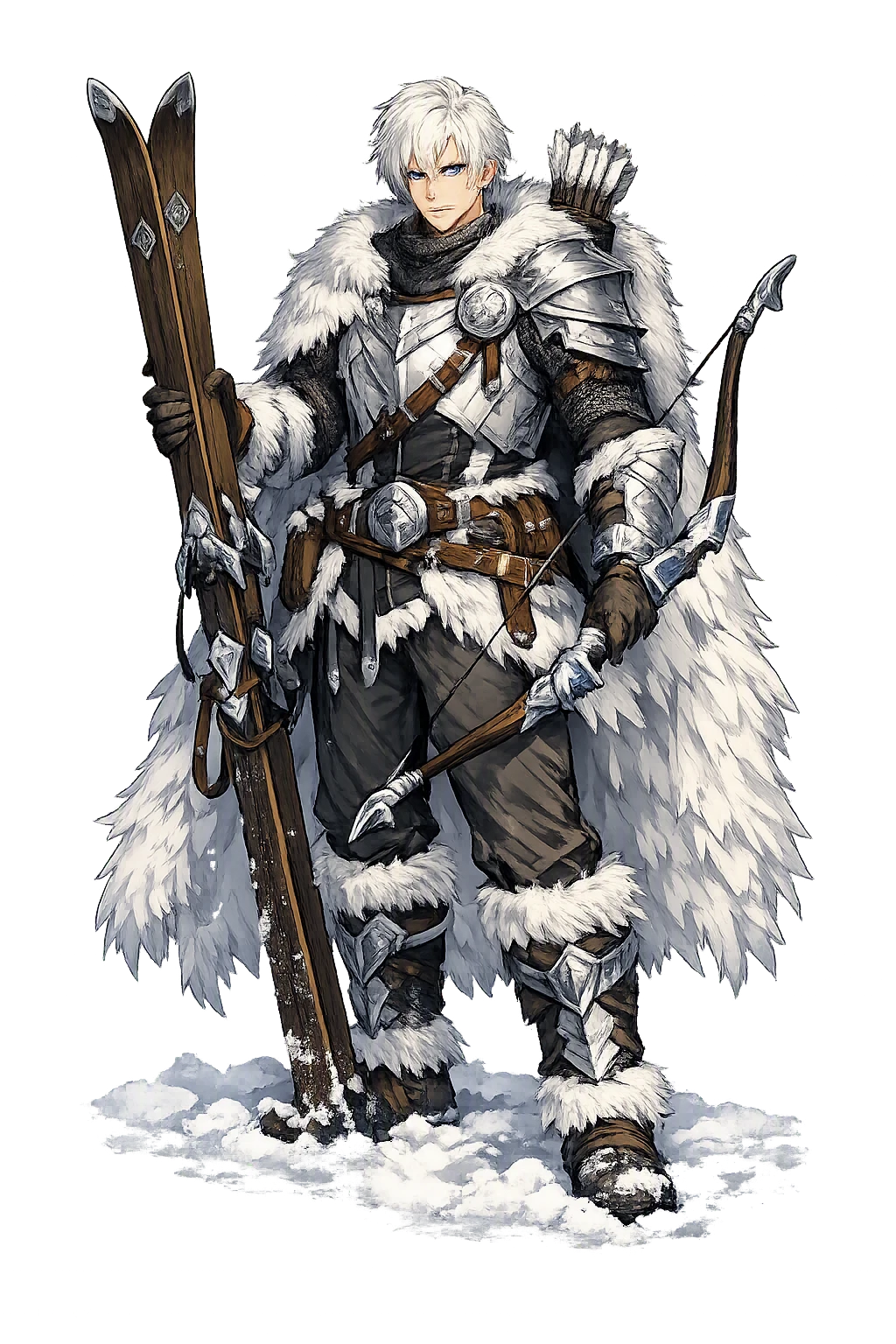
No ancient image can be securely identified as Ullr. Medieval Icelandic manuscripts preserve him through kennings — the Snowshoe God, the Bow God, the Hunting God, the Shield God — rather than pictures. The famous phrase "Ullr's ship" for a shield hints at a lost visual tradition of shields shaped or painted like boats. Scandinavian Bronze Age rock art shows skiers and archers, though none can be labelled divine. In modern Sweden the name lives on in Ullevi stadium and sports culture, while Heathen artists usually depict him as a bowman on skis or snowshoes.

06

Reception & Transformation

The name after its own age — transmission, translation, survival

Afterlives

Ullr was preserved by Snorri's Gylfaginning and by the skaldic kennings of Skáldskaparmál, while Saxo Grammaticus gave him a euhemerized double as the Danish usurper Ollerus. His name, however, never died: it survives in Norwegian and Swedish place-names and was revived in the nineteenth-century Scandinavian nationalist and Romantic recovery of the Old North. Modern Heathenry celebrates him as a god of winter sports, archery, and single combat, and his name brands stadiums, ski clubs, and outdoor organizations. His comparative obscurity in the medieval textual record, contrasted with his broad toponymic footprint, has made him a central example in debates about how much of pre-Christian Scandinavian religion was lost or distorted by Snorri and his Christian sources. Archaeologists and philologists continue to argue over whether his once-widespread veneration was downgraded by Christian compilers or simply never generated the myths that Snorri preferred.

Identifications Across Traditions

Ullr's true comparison class is not another mythology's gods but his own name's reach. Inside the corpus his nearest kin is [[skadi|Skaði]], the other ski-going hunter of the northern corpus, and the skalds' pairing of bow, snowshoe, and shield makes him the Æsir's winter counterpart to the Vanir she married into. His mythic position — son of [[sif|Sif]], stepson of [[thor|Thor]] — seats him in the one household of the gods Snorri trusted with a family tree, and Saxo's Ollerus, ruling in [[odinn|Óðinn]]'s place at Uppsala, keeps a memory that this 'minor' god once carried major authority. Beyond the corpus, the old etymological tie to Proto-Germanic *wulþuz, 'glory' — Gothic wulþus, Old English wuldor — led generations of scholars to see in Ullr a faded sky- or splendor-god, and the third-century Thorsberg chape inscription owlþuþewaz may carry his name-element centuries before the Eddas. Nineteenth-century comparatists reached for bow-bearing Apollo and other Indo-European hunters; current handbooks are cooler. Simek and Lindow emphasize what can actually be shown: a cult dense in Norway and Sweden, absent from Denmark and Iceland, a ring-oath and a hall, and a name meaning 'Glory' — the profile of a god whose importance peaked before our sources were written.

Modern Legacy

Ullr's afterlife is the snow itself. When Scandinavia reinvented skiing in the nineteenth century as sport and national emblem, the old snowshoe god was waiting: Norwegian ski culture embraced Ull as its patron, and his name has crowned winter festivals, ski clubs, and slopes ever since — the only Norse god whose modern cult is conducted on mountains with equipment. The name lives on as a Scandinavian given name and, far more densely, in the map: Ullensaker, Ullern, Ullensvang, Ullevi and their kin keep his sanctuaries' names long after the sanctuaries fell. Modern Heathen and Ásatrú communities call on him for winter sport and for the sworn word, reading the oath-ring of Atlakviða as seriously as the bow. And in the broader reception he stands as the textbook case of a great god the literature lost — the figure every handbook uses to prove that the Edda's silence is not a cult's measure.

07

The Meditation

What Ullr means — beyond the dictionary

Every tradition in the lexicon has its quiet god, the one the myths barely use and cannot forget. Ullr is the North's. Grímnismál names his hall among the first of heaven's addresses and puts his favor first among the gods' blessings; the poets swear by his ring; the map of two countries is salted with his holy places — and Snorri, who can spend pages on a fishing trip, gives him one sentence. The discrepancy is itself the record. Whatever Ullr was at the height of his worship — bow-god, sky-god, lord of the sworn oath, the Glory his name still means — it belonged to an older layer of the religion than the Eddas preserve, and by the thirteenth century only the specialists kept the tokens: a stanza, a kenning, a rumor from Denmark that he once sat in Odin's seat. Ullr teaches the reader of myth a hard and useful lesson: the silence of a source is evidence about the source, never about the god. The yew-dales are still on the map.

08

Frequently Asked Questions

Common questions about Ullr, Archery, Hunting, Skiing, and Unicode restoration

01How do you pronounce Ullr?

In reconstructed pronunciation, Ullr is /ˈulːr/ — approximately 'ULL-r' — one firm beat, the vowel short and rounded as in 'pull', the double l held a fraction long, and the final r sounded; as in modern Icelandic Ullur.

02What does Ullr mean?

Ullr means Glory, splendor in the norse tradition.

03What are the symbols of Ullr?

Ullr is associated with The yew bow (The weapon of Ýdalir timber — archery as divine craft, and the hall's name as the god's own advertisement), The snowshoes (Öndurr, the ski or snowshoe — winter travel raised to godhead; the kenning öndur-Áss, Snowshoe God), The shield, 'Ullr's ship' (The skaldic kenning that makes his shield a vessel — a fragment of a lost voyage myth), The oath-ring (The holy ring of Atlakviða by which the deepest oaths were sworn — Ullr as guarantor of sworn speech), Ýdalir (The Yew-Dales, his hall in Grímnismál's survey of heaven — one of the few divine addresses the poems give).

04Why restore Ullr in Unicode?

Ullr is written entirely in ASCII letters, so its restoration is about canonical fidelity rather than recovered diacritics: the temple fixes the name in its scholarly standard spelling, attested in the source tradition, instead of leaving it to drift.

05What is the most important myth about Ullr?

“The Yew-Dales” — the Grímnismál 5 story that anchors the mythology of Ullr, told in full on the lore page.

09

Scholarly Sources

The philological foundations of this restoration

Every claim on this page is grounded in established scholarship. The orthographic restorations follow disciplinary convention. The etymological chain follows the best available reference works. This is not invention — it is resurrection through scholarship.

◈

Lexicography & Philology

  • Cleasby-Vigfusson
◎

Primary Texts

  • Poetic Edda
  • Poetic Edda: Grímnismál 5 (Ýdalir, the hall Ullr made for himself) and 42 (Ullar hylli, the favor of Ullr invoked first among the gods); Atlakviða 30 (the oath sworn 'by the ring of Ullr'), trans. Carolyne Larrington
  • Snorri Sturluson, Prose Edda: Gylfaginning 31 (Ullr son of Sif, stepson of Thor; the bowman, the skier, the god of single combat); Skáldskaparmál (kennings: the Snowshoe God, the Bow God, the Hunting God, the Shield God; the shield as 'Ullr's ship'), trans. Anthony Faulkes
  • Saxo Grammaticus, Gesta Danorum, Book 3 (Ollerus rules in Othinus's place for ten years; the spell-marked bone; driven out and slain in Sweden), trans. Peter Fisher, ed. Hilda Ellis Davidson
  • de Vries, Altnordisches etymologisches Wörterbuch, s.v. Ullr (from Proto-Germanic *wulþuz, 'glory'; Gothic wulþus, Old English wuldor)
◉

Archaeology & Art History

  • Material evidence — iconography, inscriptions, and temple archaeology — for Ullr and related cults.
✦

Religious Studies

  • Cleasby–Vigfusson, An Icelandic-English Dictionary, s.v. Ullr; Zoëga, A Concise Dictionary of Old Icelandic, s.v. Ullr
  • Simek, Dictionary of Northern Mythology; Orchard, Dictionary of Norse Myth and Legend; Lindow, Norse Mythology: A Guide — s.v. Ullr (attestation, the place-name record, the Thorsberg chape)
  • Turville-Petre, E. O. G., Myth and Religion of the North (London: Weidenfeld & Nicolson, 1964), on Ullr's place-name cult and early importance
Return

The Surface Awaits

You have traced the name from its earliest attestation to its Unicode restoration. Now return to the myth. The story is where the name lives.

Back to Lore
Ullr mascot