The Living Myth
Monster, Father of Monsters, Storms · The Smoke-and-Fire Titan · Father of Monstrous Things
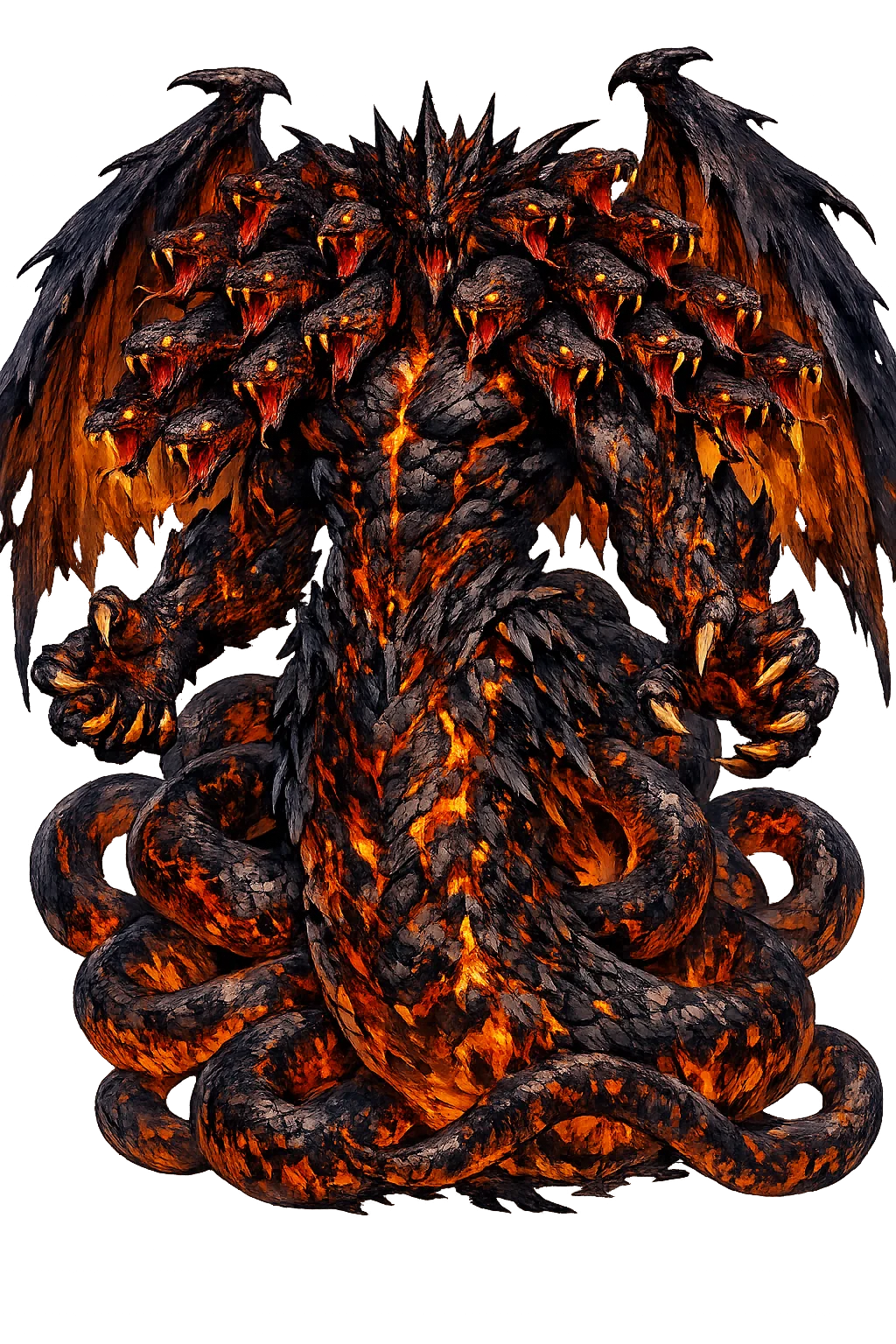
Stories of Typhōn
Typhōn is the final adversary in the Greek succession myth, the storm born when the earth has no gods left to raise against heaven. After the Titans fall, Gaia produces one last monster to challenge the new king of the gods — and this time, Hesiod admits, the gods themselves run.
Hesiod writes that after Zeus drove the Titans from heaven, Gaia lay with Tártaros — 'through golden Aphrodité', the Theogony says — and bore her last and most terrible child: Typhōn, 'the mind-baffling' monster 'who would have ruled over mortals and immortals' had Zeus not acted first (Hesiod, Theogony 820–835). Apollodorus adds the motive: Gaia conceived him in anger at the destruction of her other brood, the Giants, so that the final challenger of the new order is literally the earth's revenge (Apollodorus, Library 1.6.3). Everything about the birth reverses the usual pattern of the succession myth. Where Kronos and Zeus were gods who became kings, Typhōn is a force that would unmake kingship; where the earlier wars pitted generation against generation, this one pits order against the chthonic storm itself. The Theogony's meaning is plain: Zeus's cosmos was won, not given — and the earth keeps one more child in reserve against every heaven.
The battle shook the cosmos. Hesiod piles up the horror: a hundred serpent heads grew from Typhōn's shoulders, each speaking with a different voice — the speech of gods, the bellowing of bulls, the roars of lions, the baying of hounds, the hissing of serpents — while fire blazed from his eyes and 'a flaming monster' boiled the sea and scorched the earth beneath the thunder of Zeus's reply (Theogony 820–868). The whole arsenal of Olympus — thunderbolts forged by the Cyclopes, winds sealed in Tartarus — went into the storm, until the monster, his hundred heads broken and his strength consumed, was hurled down crippled into the pit. Later poets measured the terror by the gods' flight: in Ovid's version the Olympians fled to Egypt and hid in animal shapes, Zeus himself a ram, until the danger passed (Ovid, Metamorphoses 5.319–331). The myth means that heaven survived this time — but only just, and the smoke never fully cleared.
Apollodorus preserves the more perilous version of the war, in which Olympus nearly lost. In the first engagement Typhōn won: he cut the sinews from Zeus's hands and feet, hid them in a bearskin, and stowed them in a Cilician cave guarded by the she-serpent Delphine, leaving the king of the gods a helpless trunk (Apollodorus 1.6.3). Rescue came from the margins of the pantheon — Hermes and Aegipan stole the sinews back and refitted them to Zeus, and the war resumed. Now it was pursuit across the whole map: Typhōn fled to Mount Nysa, where the Moirai tricked him with ephemeral fruits; to Thrace, spattering the Haemus range with blood; and at last to Sicily, where Zeus crushed him under Mount Etna or hurled him back into Tartarus — the sources differ, and both prisons stuck. The myth's quiet lesson is the one mythology rarely admits: sovereignty depends on coalition, and the king of the gods rules only because the trickster and the goat-god once went into the cave for him.
With Echidna — 'the mother of gods' adversaries', half nymph and half snake — Typhōn produced the great monsters of Greek myth. Hesiod names Orthrus, the two-headed hound; Cerberus, the hound of Hades; the Lernaean Hydra; and the fire-breathing Chimera, lion before, serpent behind, goat between (Theogony 306–319). Apollodorus extends the family to the Sphinx, the Nemean Lion, the Crommyonian Sow, the eagle that tormented Prometheus, and the sleepless dragon that guarded the Golden Fleece (Library 2–3, passim); the Homeric Hymn to Apollo makes the she-dragon of Delphi their daughter as well (Hymn to Apollo 300 ff.). The catalogue is the point: nearly every labor imposed on Heracles, every ordeal of Jason or Oedipus, belongs to this one marriage. The war of order against chaos is not an episode but an inheritance — Typhōn's children keep the rebellion going generation after generation, so that every hero's victory is, in the long genealogy, one more battle in the Typhonomachy.
The last great telling of the war is also the strangest, and it comes half a millennium after Hesiod. In Nonnus's Dionysiaca (1.481–2.620, fifth century CE), Typhōn rises again and once more steals the sinews of Zeus, hiding them in the Corycian cave; the god of gods lies helpless, and the monster bargains for the scepter of heaven and the bride Harmonia. The rescue falls to a mortal wanderer: Cadmus of Thebes, still searching the seas for his abducted sister Europa, takes up his pipes and plays a music so beguiling that the hundred heads of Typhōn nod and sleep one by one, while the sinews are lifted from under him. Zeus wakes, hurls his bolts, and pins the monster under a Sicilian crag. Nonnus knew he was amplifying — his epic calls back to Hesiod by name — and he makes the old myth new by changing its hero: where Apollodorus needed Hermes and a goat-god, late antiquity sends a musician. The late myth says what the early ones imply: chaos is never killed, only ever lulled, and the instrument that lulls it is art.
Storms, Fire, Rebellion
Typhōn is the last thing the Olympians feared. Born from Gaia and the abyss, he is a serpentine giant with a hundred heads, voices of gods and beasts, and fire blazing from his eyes. He is the cosmic rebel who nearly unmade Zeus's order.
Each head speaks a different tongue — bull, lion, god, snake — a cacophony of chaos.
Buried beneath Mount Etna, his breath becomes volcanic eruption; Sicily trembles at his struggles.
From him spring the destructive storm winds — the whirlwinds that wreck ships and harvests.
With Echidna he fathers Cerberus, Hydra, Chimera, Sphinx, Nemean Lion — the adversaries of heroes.
From the original script to the living URL
Τυφῶν
The name in its original Greek form. Typhōn (Τυφῶν) is attested in the source tradition — “Whirlwind, smoke”. Its aspirated consonants, long vowels, and acute accents carry the full phonetic and orthographic weight of the source tradition.
typhon
Reduced to plain typhon, the name loses everything that made it specific: aspirated consonants, long vowels, and acute accents. What remains is an ASCII string that machines can parse but that no longer speaks with its original voice.
Typhōn
The Unicode restoration recovers what ASCII flattened. Typhōn restores aspirated consonants, long vowels, and acute accents, returning the name to its original written dignity. The domain encodes to Punycode, but the browser displays the truth.
Typhōn.com → xn--typhn-j9a.com
The non-ASCII characters in Typhōn are encoded while the ASCII remains visible. To the DNS, it is Punycode. To humanity, it is Typhōn.
Owned, ideal, and ASCII forms of Typhōn
Typhōn
Restores Τυφῶν. The live temple domain — typhōn.com.
typhon
Flattens Τυφῶν. The plain ASCII fallback — what DNS and legacy systems see.
How Typhōn was spoken
How Typhōn travels from ancient script to the modern URL
Greek Τυφῶν; from τύφω "to smoke". Typhon is the monstrous storm-giant who challenged Zeus for supremacy and was buried beneath Mount Etna; his name evokes smoke, wind, and volcanic fury.
Monster, Father of Monsters, Storms
The Unicode restoration Typhōn preserves Greek stress and length; the ASCII form typhon loses these features.
The lore you have read is the living myth. Extended Lore opens the scholarly vault beneath it: the cult and its material remains, a history of the image, the name after antiquity, a meditation on what the name still means, and the full scholarly apparatus — etymology, orthography, sources.
Enter Extended Lore