PuniCodex

Extended Lore

Tōnatiuh — The Deeper Record

Etymology · Orthography · Cult · Iconography · Reception · Sources

Preserves vowel length Tōnatiuh.com
Tōnatiuh — Sun, Heat, Fifth Age
01

At a Glance

Tōnatiuh — every fact links to its home

PantheonNahuatl
DomainSun, Heat, Fifth Age
Original ScriptTōnatiuh →
Cited Works8 cited →
02

Etymology & Word Family

From original script to Unicode restoration — the full etymology page →

Original Script Tōnatiuh Tōnatiuh — "He who goes forth shining; the Nahuatl sun god"
Unicode Restoration Tōnatiuh Restored stress, length, and script
Modern ASCII tonatiuh Plain-ASCII fallback

Classical Nahuatl Tōnatiuh, the sun; the fifth sun of the Aztec cosmos, born from the sacrifice of Nanahuatzin.

03

Unicode Character Breakdown

Character-by-character philological analysis

CharacterUnicodeNameBlockPhonetic Role
TU+0054Latin Capital Letter TBasic LatinSame, capitalized
ōU+014DLatin Small Letter O with MacronLatin Extended-AMacron: long vowel
nU+006ELatin Small Letter NBasic LatinSame
aU+0061Latin Small Letter ABasic LatinSame
tU+0074Latin Small Letter TBasic LatinSame
iU+0069Latin Small Letter IBasic LatinSame
uU+0075Latin Small Letter UBasic LatinSame
hU+0068Latin Small Letter HBasic LatinSame

The restoration of Tōnatiuh preserves what it can of the original phonology — stress and vowel length for Greek names, distinctive letters and diacritics for every other tradition.

04

Cult & Worship

How the sacred was kept — rites, sanctuaries, remains

The Cult

Tōnatiuh was fed daily, and that fact organized an empire. The daily offering — the hearts of sacrificial victims lifted to the rising sun on the temple summits — was the Mexica state's central liturgy, performed above all at the Templo Mayor, where Huitzilopochtli's shrine shared the pyramid with Tlaloc's, and at every major temple at its own cuauhxicalli, the 'eagle vessel' of carved stone that received the offering. The victims were above all war captives, and the xochiyaoyotl, the Flowery War, was in part a procurement system engineered to keep the sun moving; the theology named this nextlahualli, 'the debt payment.' Around the disk ran the calendar: he was enthroned in the trecena 13-Olin in the tonalamatl, as the Codex Borbonicus shows, and at the equinoxes the sun climbs between the Templo Mayor's twin shrines in a planned alignment. At the fifty-two-year binding, the New Fire rite addressed the terror that he might not rise. This was cult in its most literal form: the god is maintained, or the world ends.

In the Earth

The Great Temple (Templo Mayor) of Tenochtitlan, excavated from 1978 onward, was the engine-house of the sun cult: its building phases and offering caches — including the great Tlaltecuhtli earth-monolith and sacrificed warriors — anchor the theology in material practice. The Piedra del Sol, found in 1790 and now the centerpiece of the Museo Nacional de Antropología, bears the frontal face usually identified as Tōnatiuh (though the earth-monster and the night-lord have their defenders). The Codex Borbonicus (Bibliothèque de l'Assemblée nationale, Paris) shows his enthronement in the trecena 13-Olin. Teotihuacan — the pyramids named in the legend as the sun's birthplace — preserves an older, different solar cult a thousand years before the Aztecs, and its Pyramid of the Sun shows how deep the nameless reverence for this site ran.

05

Iconography

How Tōnatiuh was imaged across the ages

The Image

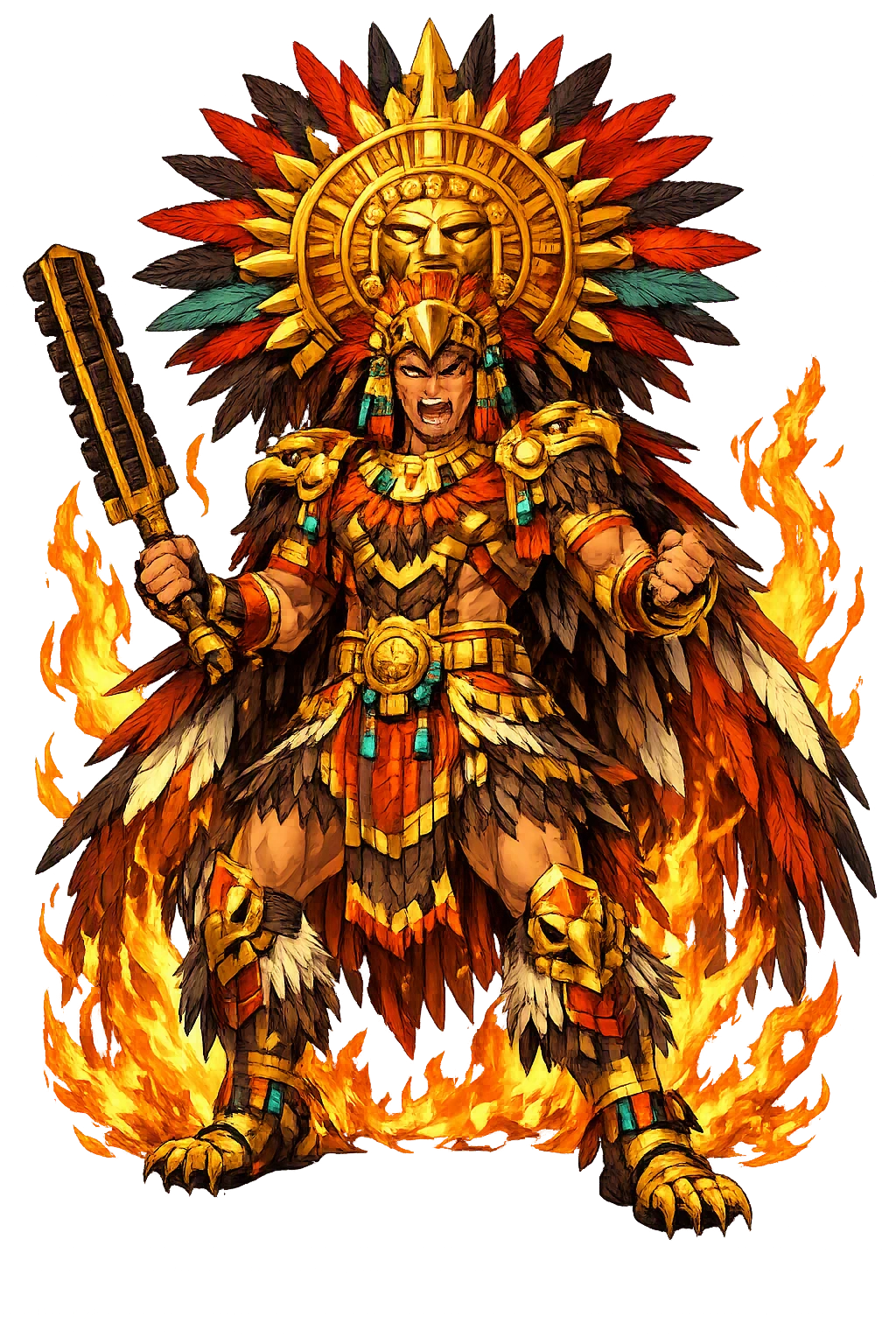
Tōnatiuh's image is the most famous face in Mesoamerican art, and it is a frontal mask with a knife for a tongue. On the Piedra del Sol — carved at Tenochtitlan not long before the conquest and excavated beside the cathedral in 1790 — the solar face stares out with an obsidian blade protruding from its mouth: the sun feeding on sacrifice, ringed by quadrants holding the four dead suns, then the twenty day-signs, then the fire-serpents. In the codices he is a red disk or an enthroned lord: the Codex Borbonicus enthrones him in his trecena, while the colonial Codex Vaticanus A draws the successive suns as disks each carrying its fated date. The long debate over the Stone's central face — Tōnatiuh, the earth monster, or the night sun — is itself part of the iconography, warning that Aztec solar images fuse disk, earth, and underworld sun into one cosmology. Teotihuacan's sun imagery a thousand years earlier has no name attached; the named god is the Aztecs' late crystallization of nameless solar reverence.

06

Reception & Transformation

The name after its own age — transmission, translation, survival

Afterlives

Tōnatiuh's survival ran underground for three centuries and returned through scholarship. The conquest broke the cult — the Templo Mayor razed, the codices burned — but the theology escaped in the great colonial salvage projects: the Franciscan Bernardino de Sahagún's bilingual Florentine Codex (compiled 1540s–1570s), which carried the legend of the suns to Florence and into the Medici library; Diego Durán's histories; and the anonymous Anales de Cuauhtitlan with its calendar of doomed suns. European custody nearly lost the record — the Florentine Codex sat unheralded in the Laurentian Library until its late-eighteenth-century cataloguing — while in Mexico the 1790 cathedral-works excavations unearthed the Sun Stone and the Coatlicue and the solar face entered national memory. Nineteenth-century transatlantic scholarship made the material readable: Lord Kingsborough's vast Antiquities of Mexico, then Brasseur de Bourbourg's and Eduard Seler's foundational decipherments of the calendar imagery. The twentieth century settled into synthesis — Alfonso Caso's authoritative reading of the Sun Stone, Miguel León-Portilla's reconstruction of Nahuatl thought — and modern lexicography restored the long first vowel that colonial orthography usually dropped, so the god's name is spoken again, as Karttunen's dictionary records it, with two full beats on the first syllable.

Identifications Across Traditions

In the colonial centuries Tōnatiuh was mapped onto Christ — the rising sun read as the risen Son, an equation early missionaries exploited from both sides and Nahua communities adapted, so that reverence for the dawn survived inside Christian liturgy (Durán, Book of the Gods; Ricard, The Spiritual Conquest of Mexico). The old calendar lived on under saints' days while the tonalpohualli was driven into the villages. In the twentieth century the figure returned as a national one: the so-called Aztec Sun Stone, excavated in 1790, became the emblem of Mexico, its central frontal face usually identified as Tōnatiuh — though some scholars read the earth-monster or the night-lord there instead. Unlike the Greek Helios, who dissolved into allegory, Tōnatiuh never stopped being worshipped; he changed altars, and then changed back.

Modern Legacy

The Piedra del Sol — the Aztec Sun Stone excavated beside Mexico City's cathedral in 1790 — hangs in the National Museum of Anthropology as the single most reproduced image of ancient Mexico, its solar face on coins, textbooks, and murals. The muralists of the revolutionary decades, Diego Rivera foremost, drew the Aztec cosmos as the deep past of the modern nation, and the sun's face entered the vocabulary of twentieth-century art. The name Tōnatiuh has returned as a given name in Mexico and in Nahuatl-language revitalization; it names schools, cultural groups, and festivals — a deity's rebirth as civic memory, and proof that a language's oldest word for the sun still knows how to shine in new mouths.

08

The Original Script Note

What the written record preserves — and what it does not

Original Script

Tōnatiuh reaches us in Latin letters: the Nahua kept pictographic and glyphic codices, not a full alphabet, so the temple shows a scholarly transliteration rather than an indigenous hand. Colonial Nahuatl was first written down by Spanish friars in the 16th century (Molina's vocabulary of 1571; the Florentine Codex), whose orthography used u and o interchangeably and marked no vowel length. The macron on ō in Tōnatiuh is a modern philological marker — the first vowel was long, from the root tōna-, 'to shine, to be hot.' The name simply means 'sun, day'; the god is the word, which is why the codices paint his face inside the solar disk.

09

The Meditation

What Tōnatiuh means — beyond the dictionary

Other traditions gave the sun a chariot and a serene arc; the Nahuatl tradition gave it an appetite. Tōnatiuh is the rare sun-god whose defining trait is need — he is the engine of the world and the world's greatest debtor, and every human institution of the Aztec state answers to his hunger. There is a terrible clarity in this theology: the universe is not maintained by goodwill but by payment, and the most precious coin is life itself. The legend does not flatter the payer and does not apologize for the price; it simply refuses the illusion that anything shines for free. To meditate on Tōnatiuh is to ask what keeps one's own sky moving — what daily sacrifice, great or small, feeds the light we live by.

10

Frequently Asked Questions

Deep-dives into the cult, attestation, reception, and sources of Tōnatiuh

01How do we know how Tōnatiuh was worshipped?

The Great Temple (Templo Mayor) of Tenochtitlan, excavated from 1978 onward, was the engine-house of the sun cult: its building phases and offering caches — including the great Tlaltecuhtli earth-monolith and sacrificed warriors — anchor the theology in material practice. The full cult record →

02Where do the earliest attestations of Tōnatiuh come from?

The record rests on Bernardino de Sahagún, Florentine Codex, Book VII (the suns) and Book IV (the tonalamatl), Anales de Cuauhtitlan (Leyenda de los Soles), in John Bierhorst, History and Mythology of the Aztecs, Codex Borbonicus (trecena 13-Olin), among 6 cited works. The full source apparatus →

03How did later traditions reinterpret Tōnatiuh?

Tōnatiuh's survival ran underground for three centuries and returned through scholarship. Reception & transformation →

04What do the surviving images of Tōnatiuh actually show?

Tōnatiuh's image is the most famous face in Mesoamerican art, and it is a frontal mask with a knife for a tongue. The iconography →

05What does the written record of Tōnatiuh actually preserve?

Tōnatiuh reaches us in Latin letters: the Nahua kept pictographic and glyphic codices, not a full alphabet, so the temple shows a scholarly transliteration rather than an indigenous hand. The Original Script note →

11

Scholarly Sources

The philological foundations of this restoration

Every claim on this page is grounded in established scholarship. The orthographic restorations follow disciplinary convention. The etymological chain follows the best available reference works. This is not invention — it is resurrection through scholarship.

◈

Lexicography & Philology

  • Florentine Codex
  • Sahagún
◎

Primary Texts

  • The Florentine Codex (Sahagún); the Anales de Cuauhtitlan; colonial Nahuatl testimonies and pictorial manuscripts.
◉

Archaeology & Art History

  • Pasztory, E. Aztec Art; Umberger, E. The Antiques of the Mexica.
✦

Religious Studies

  • Bernardino de Sahagún, Florentine Codex, Book VII (the suns) and Book IV (the tonalamatl)
  • Anales de Cuauhtitlan (Leyenda de los Soles), in John Bierhorst, History and Mythology of the Aztecs
  • Codex Borbonicus (trecena 13-Olin)
  • Codex Vaticanus A (Ríos)
  • Diego Durán, The History of the Indies of New Spain
  • Frances Karttunen, Analytical Dictionary of Nahuatl
Return

The Surface Awaits

You have traced the name from its earliest attestation to its Unicode restoration. Now return to the myth. The story is where the name lives.

Back to Lore
Tōnatiuh mascot