PuniCodex

Extended Lore

Tjinimin

Etymology · Orthography · Cult · Iconography · Reception · Sources

Tier 2 Tjinimin
Tjinimin — Trickster, Moth Man
01

Quick Facts

Essential information about Tjinimin, Trickster, Moth Man

Scholarly TransliterationTjinimin
Unicode RestorationTjinimin
Reconstructed Pronunciation/tʃɪnɪmɪn/
PantheonAboriginal
DomainTrickster, Moth Man
MeaningThe moth man
ClassificationTier 2
Primary DomainTjinimin
Sacred SymbolsBat or flying fox, Rainbow Serpent (Kunmanggur), The upside-down tree, Stars
02

Etymology & Word Family

From original script to Unicode restoration

Scholarly Transliteration Tjinimin Tjinimin — "The moth man"
Unicode Restoration Tjinimin Canonical scholarly spelling — ASCII-identical
Modern ASCII tjinimin Plain-ASCII fallback

The name Tjinimin reaches the modern world through scholarly transliteration of the aboriginal tradition. Because the conventional spelling uses only Latin letters, its Unicode and ASCII forms coincide — the tradition it carries is in the name itself, not in diacritics.

03

Unicode Character Breakdown

Character-by-character philological analysis

CharacterUnicodeNameBlockPhonetic Role
TU+0054Latin Capital Letter TBasic LatinSame, capitalized
jU+006ALatin Small Letter JBasic LatinSame
iU+0069Latin Small Letter IBasic LatinSame
nU+006ELatin Small Letter NBasic LatinSame
iU+0069Latin Small Letter IBasic LatinSame
mU+006DLatin Small Letter MBasic LatinSame
iU+0069Latin Small Letter IBasic LatinSame
nU+006ELatin Small Letter NBasic LatinSame

The Tier 2 classification here reflects fidelity to the attested tradition, not recovered diacritics: every character of Tjinimin already survives in ASCII. What the restoration preserves is the canonical spelling itself — the form scholarship standardised.

04

Cult & Worship

How the sacred was kept — rites, sanctuaries, remains

The Cult

No sanctuary, festival, or priesthood of Tjinimin is documented, and honesty requires saying so first: any account that claimed them would be inventing them. What the record shows is a story kept in trust. W. E. H. Stanner recorded the Tjinimin cycle among the Murrinh-Patha of the Daly River in the mid-twentieth century, and the senior men who taught it made plain that its fuller ritual meanings belong to initiated custodians — the published narrative is only the speakable layer. His 'cult' is therefore transmission itself: the teaching of the narrative in initiation, the custodianship of the country it encodes, and the presence of the bat at dusk as its daily reminder. There are no votive objects, no cult buildings, no calendar rites to describe, and the sacred geography the myth maps is held, not published. For the Murrinh-Patha the story is lived law, not liturgy.

In the Earth

No fixed archaeological site is publicly identified with Tjinimin. Murrinh-Patha sacred geography is held by custodians and is not published in open scholarly form. The primary 'site' of the narrative is the Daly River country of the Northern Territory, where the story is maintained through initiation, ceremony, and oral transmission; Stanner's field records and the AIATSIS sound archive are the documentary witnesses.

05

Iconography

How Tjinimin was imaged across the ages

The Image

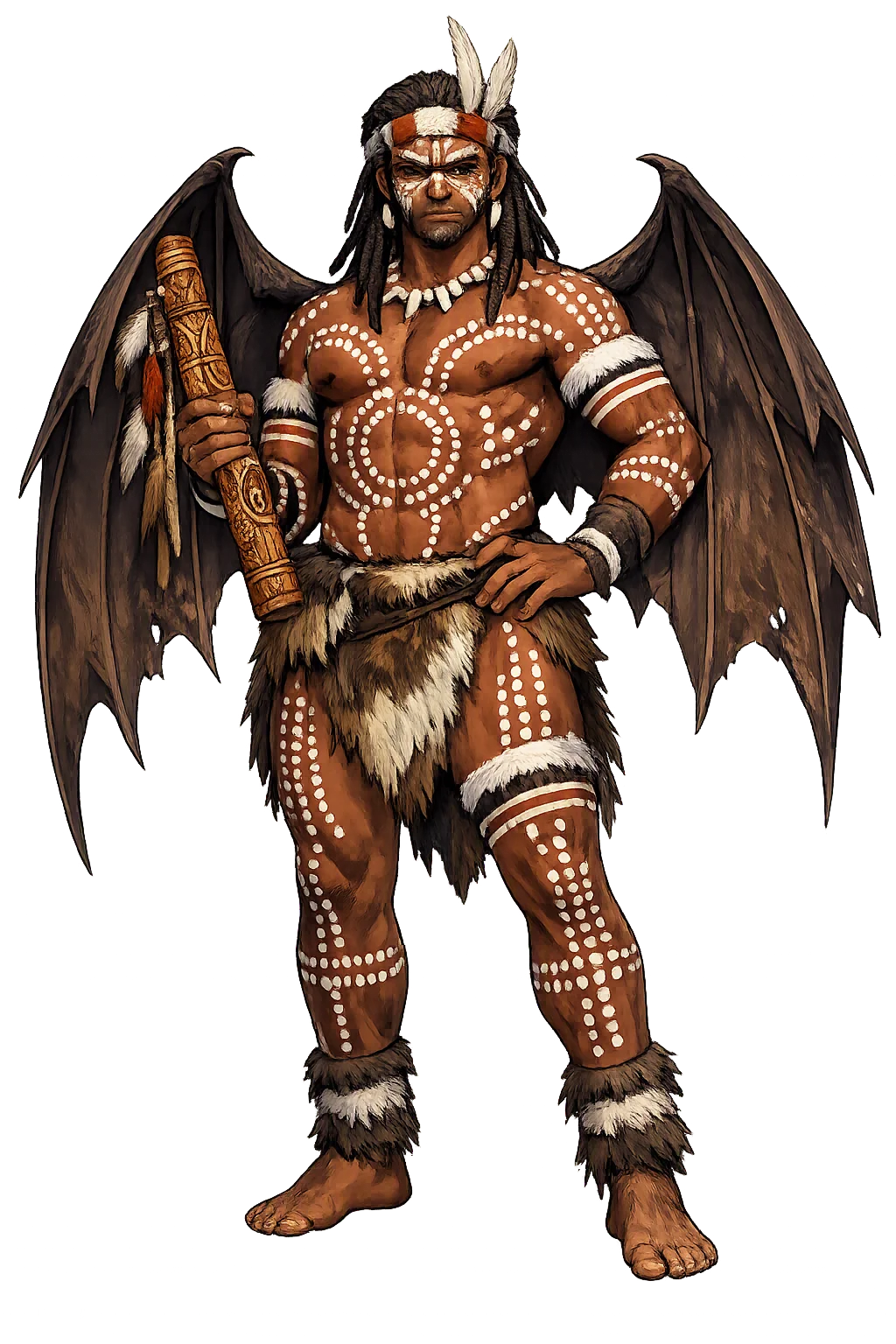
No published image of Tjinimin exists, and the absence is deliberate. Where the Wandjina of the Kimberley fill rock-shelter walls along a visitor circuit, Murrinh-Patha sacred narratives such as his are not reproduced as open visual art; custodianship, not the gallery, is where this figure lives. The texts supply the attributes instead: the short-nosed face of the bat, in which the ancestor's transformed body is read every evening as the flying foxes rise; the upside-down tree, from which he hung between earth and stars; and the night sky itself, witness to a vow spoken once and never retracted. The bat of the Daly country is, in effect, his image — not a representation of the ancestor but the ancestor's body: permanent, unpainted, and unownable. Image evidence in the archaeological or art-historical sense is lacking by design.

06

Reception & Transformation

The name after its own age — transmission, translation, survival

Afterlives

Tjinimin reached the wider world almost entirely through one scholar. W. E. H. Stanner worked among the Murrinh-Patha of the Daly River — at Port Keats, now Wadeye — from the 1930s, and set the figure down in his Oceania essays of 1959–63, collected in On Aboriginal Religion (1964), the study that made Murrinh-Patha metaphysics a classic of Australian anthropology. Stanner's framing — the Dreaming as 'a complex of meanings', the 'metaphysical pity' he said such traditions evoke — carried figures like Tjinimin into the anthropological canon, and his later essays in White Man Got No Dreaming (1979) carried them to a general readership. Ronald and Catherine Berndt's compilations further disseminated the cycle. The modern afterlife is custodial and corrective at once: recordings rest with AIATSIS in Canberra as the people's own archive, Wadeye elders still teach the story on their own authority, and current scholarship — this catalog included — treats even its labels as provisional where the record is silent. The figure's survival is a case study in how much, and how little, ethnography may carry of a story whose authors never surrendered it.

Identifications Across Traditions

Tjinimin belongs specifically to Murrinh-Patha tradition rather than to the wider cross-cultural networks of the Kimberley Wandjina or Arnhem Land Rainbow Serpent complexes. Within Murrinh-Patha cosmology he is grouped with the ancestor-figures whose stories encode law, kinship, and the origins of animal species. Comparative scholarship sometimes links him to the broader Australian theme of the Moon-Man or to nocturnal transformation myths, but these connections remain speculative; the primary attested context is the Daly River region, and responsible scholarship says no more than the record allows.

Modern Legacy

Tjinimin survives in Murrinh-Patha oral tradition, initiation teaching, and the ethnographic record compiled by W. E. H. Stanner and later scholars. The story is used in initiation contexts to instruct young men in ancestral law, social restraint, and the consequences of transgression, and the bat of the Daly country remains its daily reminder. Unlike the widely commercialised Wandjina imagery of the Kimberley, Murrinh-Patha sacred narratives such as that of Tjinimin are generally restricted to initiated custodians and are not reproduced as open visual art — a form of protection that has kept the story intact but also largely invisible to the wider world. For Murrinh-Patha communities themselves, Tjinimin is family: an ancestor whose face rises with the flying foxes every dusk.

07

The Meditation

What Tjinimin means — beyond the dictionary

Tjinimin is a difficult ancestor because his story turns on failure rather than triumph. He desires what is not his, loses, withdraws, and is transformed. The myth does not celebrate his ambition; it records the cost of transgression and the permanent mark it leaves on the body. In this he is close to the trickster type, but he is also a cautionary figure: the ancestor whose own choice limits him.

For contemporary readers, Tjinimin raises questions about the relationship between desire and law. What does it mean to make a vow that cannot be undone? How does a community remember the one who overreached and was changed? The bat's short nose is not merely an etiological detail; it is a material reminder that ancestral actions continue to shape the living world.

08

Frequently Asked Questions

Common questions about Tjinimin, Trickster, Moth Man, and Unicode restoration

01How do you pronounce Tjinimin?

In reconstructed pronunciation, Tjinimin is /tʃɪnɪmɪn/ — approximately 'CHIN-ih-min' — stress the first syllable, keep the vowels short and clear, and pronounce the initial 'tj' as English 'ch'.

02What does Tjinimin mean?

Tjinimin means The moth man in the aboriginal tradition.

03What are the symbols of Tjinimin?

Tjinimin is associated with Bat or flying fox (The animal form and kinship emblem linked to Tjinimin; the myth of the short nose explains the bat's distinctive face.), Rainbow Serpent (Kunmanggur) (The great water-spirit and law-giver whose authority Tjinimin challenges; the serpent marks the boundary between acceptable and forbidden desire.), The upside-down tree (The place where Tjinimin hung after his defeat, looking at the stars and making his vow of abstinence.), Stars (The night sky that Tjinimin contemplated while suspended; a symbol of reflection, withdrawal, and transformation.).

04Why restore Tjinimin in Unicode?

Tjinimin is written entirely in ASCII letters, so its restoration is about canonical fidelity rather than recovered diacritics: the temple fixes the name in its scholarly standard spelling, attested in the source tradition, instead of leaving it to drift.

05What is the most important myth about Tjinimin?

“The Quarrel with Kunmanggur” — the Murrinh-Patha Dreaming story that anchors the mythology of Tjinimin, told in full on the lore page.

09

Scholarly Sources

The philological foundations of this restoration

Every claim on this page is grounded in established scholarship. The orthographic restorations follow disciplinary convention. The etymological chain follows the best available reference works. This is not invention — it is resurrection through scholarship.

◈

Lexicography & Philology

  • AIATSIS
  • Berndt
◎

Primary Texts

  • Primary sources in the aboriginal tradition for Tjinimin.
◉

Archaeology & Art History

  • Material evidence — iconography, inscriptions, and temple archaeology — for Tjinimin and related cults.
✦

Religious Studies

  • Stanner, W. E. H., On Aboriginal Religion (Sydney University Press, 1964), 98–104
  • Berndt, Ronald M. and Catherine H. Berndt, The World of the First Australians (Aboriginal Studies Press, 1964)
  • Australian Institute of Aboriginal and Torres Strait Islander Studies (AIATSIS), authority files and cultural-resources collection
Return

The Surface Awaits

You have traced the name from its earliest attestation to its Unicode restoration. Now return to the myth. The story is where the name lives.

Back to Lore
Tjinimin mascot