Stories of Þrúðr
Þrúðr's mythology is sparse but charged: every mention of her name is a mention of power — in a god-list, in a valkyrie-roster, in one full comic tale, and cut in runes at the head of a chieftain's grave.
In the Prose Edda, Snorri's chapter on kennings tells the skalds how to name Þórr: son of Óðinn and Jǫrð, husband of Sif — and, in a single catalogue line, faðir Magni ok Móða ok Þrúðar, “father of Magni and Móði and Þrúðr” (Skáldskaparmál 4). That line is her whole dossier in the family mythology: no story tells of her childhood, no poem gives her a deed among the gods. Later tradition names Sif as her mother, and the pairing is natural — Sif's hair of gold is the most famous description of female beauty in the Eddas — but the sources themselves are silent on the point. What they insist on is the name: Þrúðr, “strength,” is the only one of Þórr's children whose name is the abstraction of his own domain, as if the thunder-god's defining quality had been given a daughter and sent into the world wearing it.
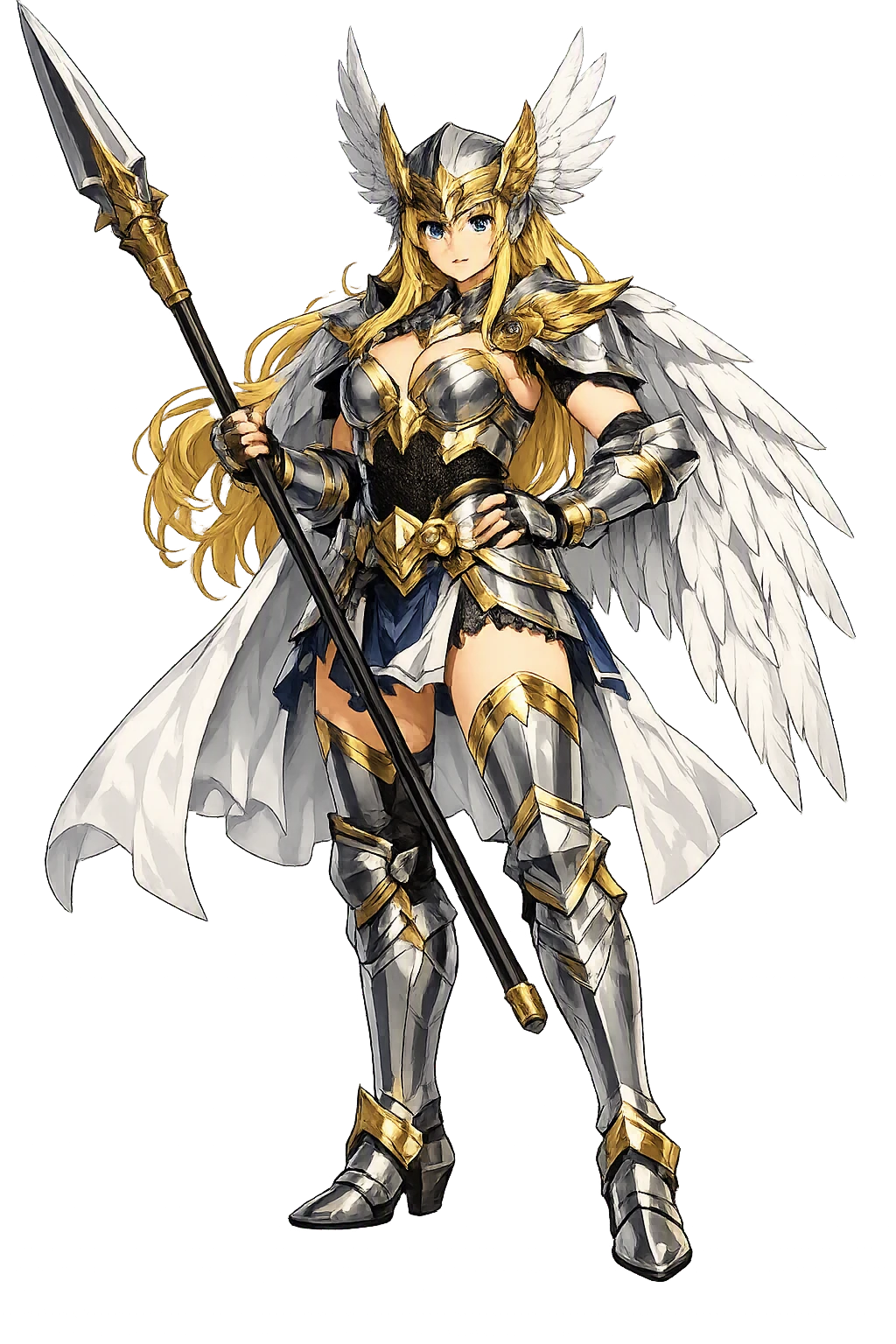
The Poetic Edda lists her again among the Valkyries. In Grímnismál, Óðinn — racked between two fires in the hall of King Geirrǫðr — names the maidens who serve the warriors of Valhǫll: “Hrist and Mist I would have bear me the horn; Skeggjǫld and Skǫgul; Hildr and Þrúðr; Hlǫkk and Herfjǫtur; Gunnr and Gǫndul” (Grímnismál 36). The þulur, the mnemonic name-lists of the manuscripts, count Þrúðr among the Valkyries too. Her placement is exact: like her brothers Magni and Móði, who survive Ragnarǫk to inherit the hammer, she carries her father's might into Óðinn's service — the storm's daughter posted at the gates where the brave are chosen, strength itself keeping the roster of the slain. The two attestations, family list and battle roster, never meet in the corpus; the reader is left to hold both at once.
The one full story the Eddas give her is a comedy of delay. While Þórr was away in the east, the dwarf Alvíss — “All-Wise” — came to Ásgarðr to claim the bride who had been promised him: Þórr's daughter. The prose headnote of Alvíssmál says the gods had pledged her, and Þórr, discovering the betrothal, chose not brute force but interrogation. He received the dwarf courteously and questioned him through the night: what is the earth, the sky, the moon, the sea called among gods, giants, elves, dwarfs, and men? Alvíss knew every synonym — a catalogue of the world's names in six tongues fills the poem — but the knowledge was the trap. When dawn broke and sunlight struck the threshold, the dwarf turned to stone where he stood. Þrúðr never appears and never speaks; her rescue is performed entirely by her father's patience and the sunrise — the myth's quiet joke that the strongest of the gods saves his daughter by simply out-talking a specialist.
On the Swedish island of Öland stands the Karlevi runestone — raised about 1000 CE for a dead chieftain, its carved dróttkvætt stanza among the finest poetry set in stone in Scandinavia — and the stanza closes with a kenning that names her: the buried man is Þrúðar þegn, “a thane of Þrúðr,” a warrior in the sworn service of Strength (Öl 1). The stone is the one material witness the goddess has: no image, no temple, but her word cut in runes at the head of an aristocrat's grave, where a Christian cross stands beside the old name. The kenning was available to any Viking-Age poet — to be Þrúðr's thane was a ready-made boast — but its choice here shows the name doing live work: to die well was to be enrolled in her household, and the inscription enrolls its chieftain forever, the servant of strength outlasting the flesh that served it.
Valkyrie and Daughter of Thor
Þrúðr is the very idea of strength made into a goddess. Her name means "power" or "force," and in the Norse sources she is both the daughter of Þórr and Sif and one of the Valkyries who serve in Valhǫll. She embodies the inheritance of the thunder-god — not merely muscle, but the indomitable will that does not break.
Skáldskaparmál names Þrúðr among the children of Þórr — the inheritors of storm and strength.
She is counted among the Valkyries in Grímnismál's roster, one of the choosers of the slain who serve in Óðinn's hall.
Her name is a common noun for might; she is the abstraction of force raised to divine personhood.
A runestone on Öland calls a dead chieftain a "thane of Þrúðr" — her name carved on a Viking-Age grave.
From the original script to the living URL
ᚦᚱᚢᚦᚱ
The name in its original Norse form. Þrúðr (ᚦᚱᚢᚦᚱ) is attested in the source tradition — “Strength, power”. Its acute stress marks carry the full phonetic and orthographic weight of the source tradition.
thrudr
Reduced to plain thrudr, the name loses everything that made it specific: acute stress marks. What remains is an ASCII string that machines can parse but that no longer speaks with its original voice.
Þrúðr
The Unicode restoration recovers what ASCII flattened. Þrúðr restores acute stress marks, returning the name to its original written dignity. The domain encodes to Punycode, but the browser displays the truth.
Þrúðr.com → xn--rr-wja3bs.com
The non-ASCII characters in Þrúðr are encoded while the ASCII remains visible. To the DNS, it is Punycode. To humanity, it is Þrúðr.
Owned, ideal, and ASCII forms of Þrúðr
Þrúðr
Restores ᚦᚱᚢᚦᚱ. The live temple domain — þrúðr.com.
thrudr
Flattens ᚦᚱᚢᚦᚱ. The plain ASCII fallback — what DNS and legacy systems see.
How Þrúðr was spoken
How Þrúðr travels from ancient script to the modern URL
The lore you have read is the living myth. Extended Lore opens the scholarly vault beneath it: the cult and its material remains, a history of the image, the name after antiquity, a meditation on what the name still means, and the full scholarly apparatus — etymology, orthography, sources.
Enter Extended Lore