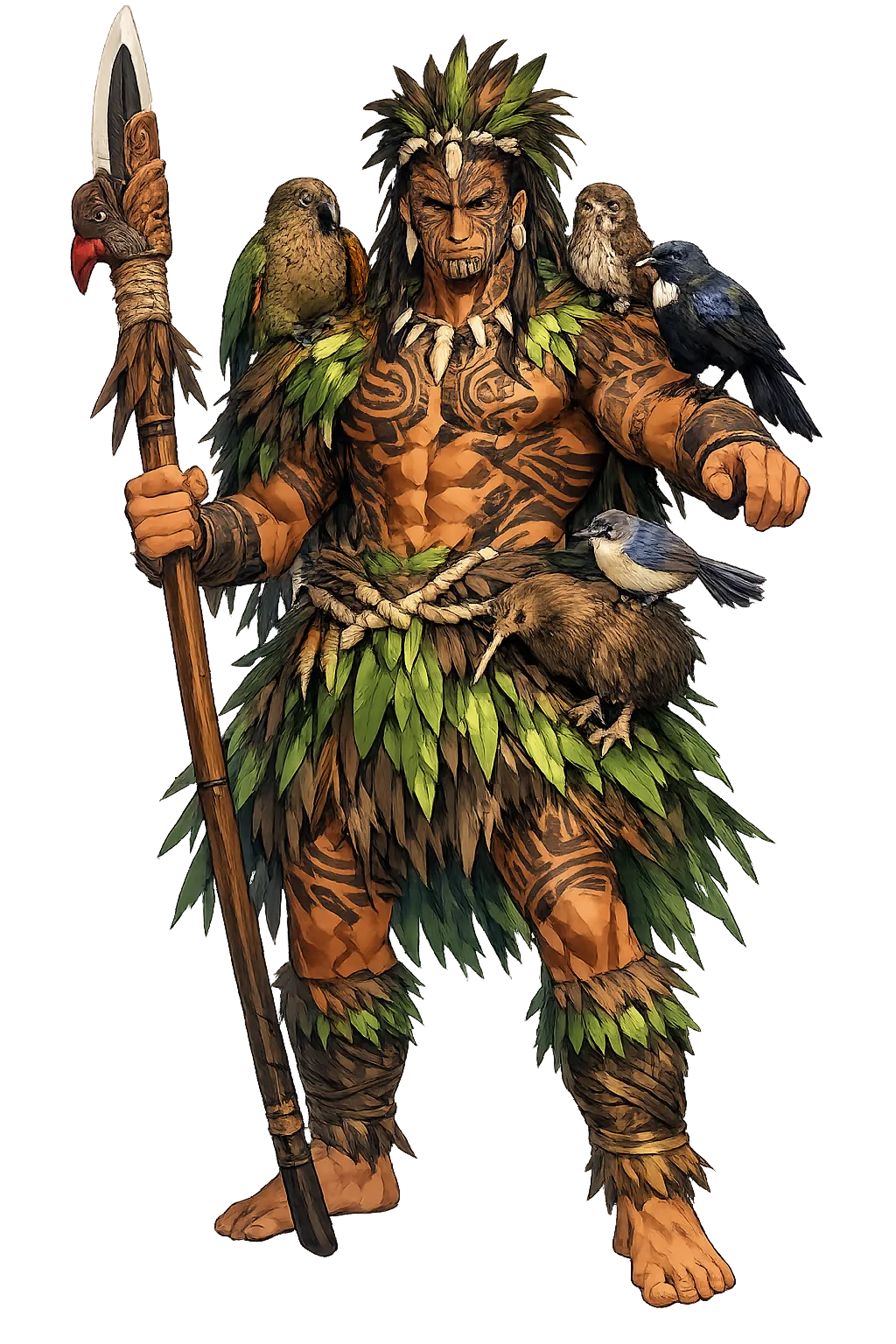
Stories of Tāne
Tāne's myths are central to Māori cosmogony. He is the active principle of separation, the ancestor of humankind, and the culture hero who brings knowledge from the sky. The narratives are preserved in nineteenth-century written versions of oral tradition.
Tāne was born in the darkness between Ranginui and Papatūānuku, and it was he who ended it. His brother Tūmatauenga urged killing their parents; Rongo, Tangaroa, and Haumia-tiketike tried and failed to force them apart. Then Tāne lay on his back between the two great bodies and pressed upward with his legs — and Ranginui rose into the sky, and the space between became the world, and light came in. The recitations linger on the aftermath: Rangi's tears falling as rain, Papa's mist rising to meet him, and the new order's first casualty — the broken embrace. Tāwhirimātea, refusing the separation, made war from the sky; it was Tāne who had to live with what his success cost. (Grey, Polynesian Mythology, ch. 1.) The myth's insight is that creation is violent even when no one is killed: to make room is to amputate an embrace.
Tāne sought a companion and found none among the gods, so he made one from the earth. At Kurawaka — the place where Papatūānuku's female essence was understood to be concentrated — he took the red ochre clay and shaped it into the form of a woman: Hineahuone, 'Earth-formed woman.' Then he pressed his nose to hers in the hongi and breathed his own breath into her nostrils, and she woke, and the first couple stood together in the new world. Their daughter was Hinetītama, the dawn-maiden, and from her the whole human line descends. (Grey, Polynesian Mythology; Best, Māori Religion and Mythology.) The myth makes humanity a collaboration of body and breath — clay from the mother, spirit from the father — and locates the first birth at the earth's most emphatically female place.
Hinetītama grew and married the great provider of the world — and then learned, from the murmuring of the forest creatures, that her husband was her own father, Tāne. Shattered, she fled the world of light and went down into the darkness, becoming Hine-nui-te-pō, 'Great woman of the night,' the guardian of the dead. Tāne followed her to the underworld's edge and pleaded for her return; her answer — that she would keep the dead, and that her descendants would come to her one by one — is the myth's explanation of mortality. (Grey, Polynesian Mythology; White, The Ancient History of the Māori I.) It is among the starkest incest-and-exile narratives in world myth, and its result is the kindest possible death: a goddess who was wronged keeps the door, and every mortal goes home to her.
To make human life more than survival, Tāne climbed through the layered heavens — the whare-wānanga teachings count them variously, and their pre-contact antiquity is honestly debated — passing the guardian of each sky until he reached the hidden realm of Io. From Io's court he descended with the three baskets of knowledge: one holding ritual and incantation, one the memory of the ancestors and tribal tradition, one spiritual understanding; the priestly schools preserved variant names for each basket, faithfully recorded by Smith from different teaching lines. His return made learning possible and founded the authority of those who keep it. (Smith, The Lore of the Whare-wānanga; Best, The Māori School of Learning.) Knowledge, on this charter, is not discovered but fetched — a perilous ascent whose fruit is communal, carried down in baskets, by a god who climbed.
Creator, Separator, and Ancestor
Tāne is the forest made conscious, the bird made ancestor, and the man made god. In Māori cosmology he is the child who separated earth and sky, the father of humankind who shaped the first woman from clay, and the lord of every tree and winged thing. He stands at the axis of nature and culture, the one who makes space for life by pushing upward.
He pushed Ranginui upward with his legs, creating the space in which the world exists.
Tāne-mahuta rules the trees and all creatures that live among them, especially birds.
He formed the first woman, Hineahuone, from red clay at Kurawaka and breathed life into her nostrils.
He climbed through the layered heavens to obtain the three baskets of knowledge for humankind.
From the original script to the living URL
Tāne
The name survives only in scholarly transliteration. Tāne is the standard Polynesian romanisation, documented in academic sources — “Man (from Proto-Polynesian *tane)”. Its macron-length vowels preserve distinctions lost in plain ASCII.
No indigenous writing system is securely attested for individual polynesian names. The form shown is a modern scholarly transliteration.
tane
Reduced to plain tane, the name loses everything that made it specific: macron-length vowels. What remains is an ASCII string that machines can parse but that no longer speaks with its original voice.
Tāne
The Unicode restoration recovers what ASCII flattened. Tāne restores macron-length vowels, returning the name to its original written dignity. The domain encodes to Punycode, but the browser displays the truth.
Tāne.com → xn--tne-1oa.com
The non-ASCII characters in Tāne are encoded while the ASCII remains visible. To the DNS, it is Punycode. To humanity, it is Tāne.
Owned, ideal, and ASCII forms of Tāne
Tāne
The live temple domain — tāne.com.
tane
The plain ASCII fallback — what DNS and legacy systems see.
How Tāne was spoken
How Tāne is preserved in writing
No indigenous writing system is securely attested for individual polynesian names. The form shown is a modern scholarly transliteration.
Contribute scholarly provenance →The lore you have read is the living myth. Extended Lore opens the scholarly vault beneath it: the cult and its material remains, a history of the image, the name after antiquity, a meditation on what the name still means, and the full scholarly apparatus — etymology, orthography, sources.
Enter Extended Lore