
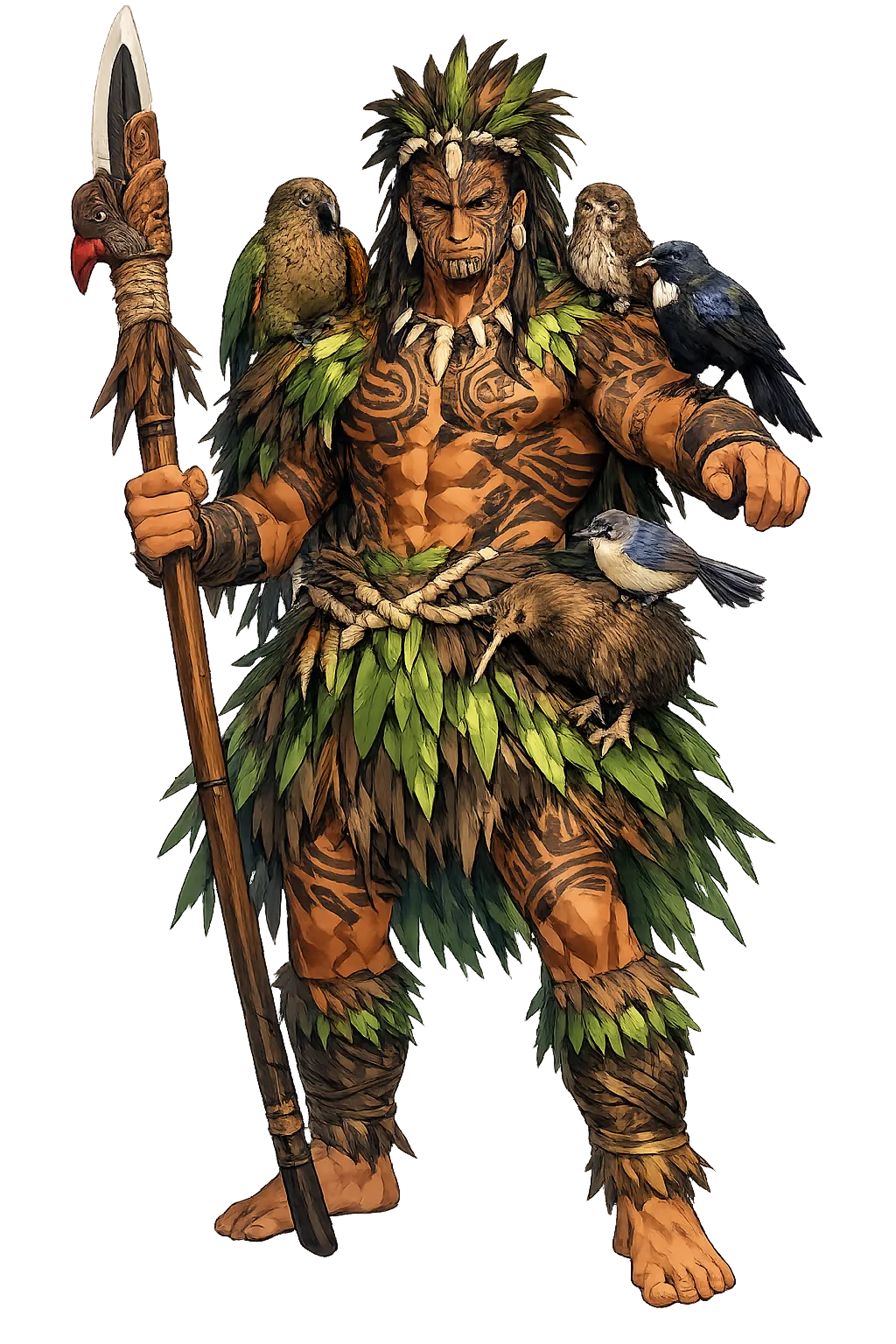
The provenance file on Tāne
The provenance file for Tāne. Nothing here is unsourced; that is what the file is for.
Provenance
1. The attestation. —, from the tradition's own record. On record: Grey, Polynesian Mythology, Tregear, The Maori-Polynesian Comparative Dictionary, Best, Maori Religion and Mythology, Smith, The Lore of the Whare-wananga.
2. The preserved evidence. a → ā (Macron: long /aː/) — absent from the ASCII form tane, present in the restoration, verifiable against the sources above.
3. The narrative record. The One Who Pushed the Sky — Tāne was born in the darkness between Ranginui and Papatūānuku, and it was he who ended it. His brother Tūmatauenga urged killing their parents; Rongo, Tangaroa, and Haumia-tiketike tried and failed to force them apart. The Making of Hineahuone — Tāne sought a companion and found none among the gods, so he made one from the earth. At Kurawaka — the place where Papatūānuku's female essence was understood to be concentrated — he took the red ochre clay and shaped it into the form of a woman: Hineahuone, 'Earth-formed woman.
4. The physical record. As with Papatūānuku, Tāne's primary preservation is oral and environmental rather than monumental — no temple was built to him, because the forest was the temple. The Waipoua kauri forest in Northland contains the tree named Tāne Mahuta, one of the largest and oldest living kauri, a natural shrine; the rātā and tōtara forests of the islands were managed as his body under customary regimes that fused religion and conservation. Māori wharenui, waka taua (war canoes), and carving invoke him through tree and bird imagery — the house itself is his standing form, ridge-beam as spine, posts as limbs. The nineteenth-century records of Grey, Best, White, and Smith remain the principal textual witnesses, taken down while the whare-wānanga schools still taught the full cycle.
5. The current holding. The temple at /tane/, classified Tier 1. Tier-1 is not a compliment; it is a measurement. This restoration keeps something the ASCII form provably loses, and the measurement is repeatable.
6. The documented resonances. Forestry, Conservation & Outdoor Industries, Education, Research & Knowledge, Environmental & Climate Services — seats argued and weighted in the pattern atlas, read through the myths in this temple's Resonance File.
7. The primary sources. Kumulipo, Polynesian Mythology — the library this file answers to, open at the Sacred Texts collection.
8. The continuing record. Tāne is one of the most widely known Māori deities, especially through the famous kauri tree named Tāne Mahuta in Waipoua Forest, a major spiritual site visited by thousands each year. His image appears in carving, painting, dance, and environmental advocacy throughout Aotearoa.
At a Glance
- Restored name: Tāne
- ASCII form: tane
- Meaning: "Man (from Proto-Polynesian *tane)"
- Domain of influence: Forests, Birds, First Man
- Pantheon: Polynesian
- Classification: Tier 1
- Original script: —
- Series: The Restoration Files, No. 474 of 546
The File Continues
Read the founding dispatch for the name's full story, the Resonance File for the archetype at work — or the whole archive in one sitting.
Continue the series — previous file: Taliesin (read it here) · next file: Tangaroa (read it here).
The Restoration Files are written from the same canonical record as the temples themselves: the lexicon, the lore catalog, the pattern atlas, and the cited scholarly sources. If a file ever disagrees with its temple, the temple is right — tell us, and the file will be corrected.