
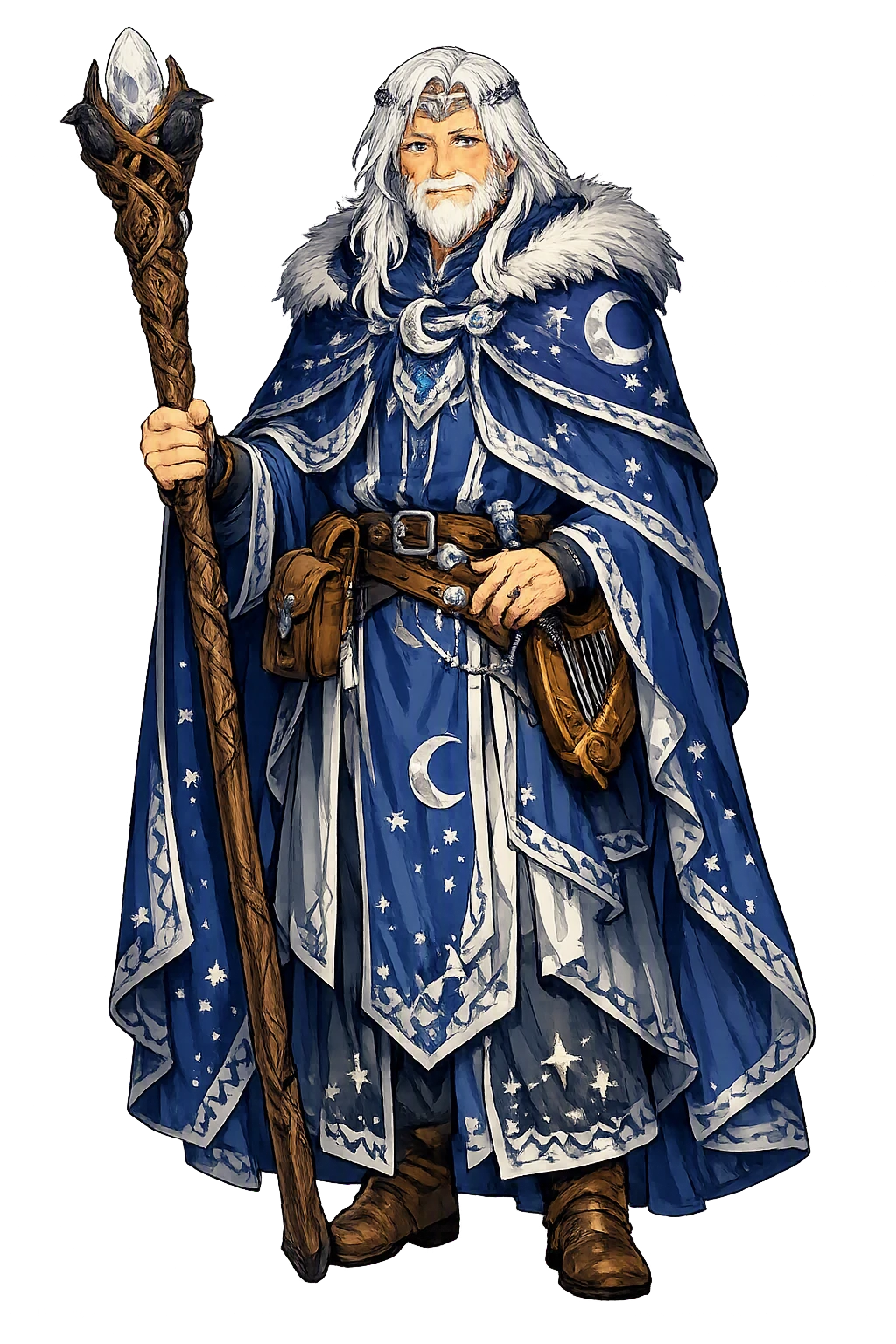
Recording Taliesin
Long before it became a digital address, this name travelled through scripts. Taliesin reaches us through scholarly transliteration, and arrives in a Latin form that needs no special encoding. Each stage preserves some information and requires some judgment. This post follows that journey: the original evidence, the reconstructed pronunciation, the mythological record, the material remains, and the reviewed spelling used by the temple.
At a Glance
- Canonical name: Taliesin
- ASCII form: taliesin
- Meaning: "Welsh bard"
- Domain of influence: Poet, Shapeshifter
- Pantheon: Celtic
- Restoration: ASCII-equivalent form
Overview
Taliesin (taliesin) — Poet, Shapeshifter · Welsh bard — is the supreme bard of Welsh tradition and the recipient of the fullest legendary biography any Celtic poet ever got: twice-born master of the awen, the flowing spirit of poetic inspiration. As the boy Gwion Bach he stirred Ceridwen's cauldron for a year and a day, caught on his thumb the three drops of inspiration meant for her son Afagddu, and fled her through four shapes — hare, fish, bird, grain — before she swallowed him as a black hen and bore him again; cast into the sea in a skin coracle, he was drawn from the salmon weir of Gwyddno Garanhir by the luckless Elffin, who named him for his radiant brow.
Before the court of Maelgwn Gwynedd the child-bard silenced the assembled poets with a puff of breath, exposed the false proof laid against Elffin's wife, and sang his foster-father out of thirteen locks. Behind the legend stands a historical poet of sixth-century Rheged: the Historia Brittonum (§62) names Taliesin among the five poets famed in the time of Ida of Bernicia, and the Book of Taliesin preserves a core of praise-poetry to Urien of Rheged that modern scholarship accepts as plausibly his.
PuniCodex restores the name as Taliesin — identical to the ASCII input, because medieval Welsh writes the name in plain Latin letters. The mechanical rule therefore leaves it a plain form: nothing distinctive is lost in transit, a statement about orthography and never about the bard. No domain is claimed: the plain-ASCII taliesin.com is registered to a third party outside the collection and is watched for release.
The Name
The name is attested in Middle Welsh as Taliesin, unchanged into the modern language — the spelling of the Book of Taliesin and of the Historia Brittonum's ninth-century notice alike. The tradition's own etymology is staged inside the legend: when Elffin opens the coracle and sees the child's forehead shining from the folds of the skin, he cries 'behold a radiant brow' — tal iesin — and names him for it.
The medieval gloss survives scholarly scrutiny. Welsh tal means 'forehead, brow', and the second element iesin is related to a root meaning 'radiant, shining'; Ifor Williams discussed the compound as the traditional analysis, and the etymological dictionaries still print essentially that reading: 'radiant brow'. His standing style in the Welsh Triads is Taliesin Ben Beirdd, 'Taliesin Chief of Bards', head of the Primary Chief Bards of the Isle of Britain.
The ASCII form taliesin loses nothing, because the medieval Welsh spelling is already plain Latin letters; the restoration is therefore a matter of canonical reference, not rescued diacritics, and the name is a plain restoration by the project's mechanical rule.
The letter-by-letter transformation runs:
- t → T — Same, capitalized
- a → a — Same
- l → l — Same
- i → i — Same
- e → e — Same
- s → s — Same
- i → i — Same
- n → n — Same
The project holds no domain for this name: taliesin.com is registered to a third party outside the PuniCodex collection and is watched for release. The temple lives at its canonical lexicon address.
The Original Script
The name is preserved in medieval Welsh manuscripts in the Latin alphabet as Taliesin — Middle Welsh in Insular script, with the poetry attested in the early fourteenth-century Book of Taliesin (NLW Peniarth MS 2) and the historical notice in the ninth-century recensions of the Historia Brittonum. The full legendary biography survives in the sixteenth-century chronicle of Elis Gruffydd; the manuscript forms are the primary witnesses, and they agree on the spelling.
The scholarly rendering proceeds step by step:
- Medieval Welsh was written in the Latin alphabet using Insular minuscule; the spelling Taliesin requires no diacritic.
- The tradition's own etymology is staged in the legend itself — Elffin's cry at the weir, 'behold a radiant brow', tal iesin — and the modern dictionaries accept essentially the same compound: tal, 'forehead, brow', plus iesin, 'radiant, shining'.
- No earlier alphabet enters the record: ogham in Wales belongs to the Irish settlers of Dyfed and never carries this name; the manuscript form is the sole witness.
- The canonical restoration Taliesin is therefore identical to the ASCII form apart from the capital; the temple form is a canonical reference, not a rescued spelling.
One caution attaches to the record: the legend's persona-poems in the Book of Taliesin are medieval compositions under the great name, not the sixth-century poet's own work — Ifor Williams's separation of the Urien corpus from the legendary Book remains the standing framework, and the one this edition follows.
Pronunciation
The pronunciation of the name is /talˈjɛsɪn/ — Modern Welsh.
Phoneme by phoneme:
- Ta- — Voiceless alveolar stop [t], plain and unaspirated as Welsh stops are, and short open [a]; the first syllable is light
- -l- — Voiced alveolar lateral [l]: the ordinary Welsh l, not the voiceless fricative ll [ɬ] — Taliesin keeps the soft single lateral
- -ies- — The stressed penult [jɛs]: a palatal glide into open-mid [ɛ], sounding exactly like English 'yes'; Welsh accent falls on the penultimate syllable
- -in — Short close [ɪ] and a final alveolar nasal [n], lightly sounded; Welsh final syllables are never swallowed
For the modern speaker, the closest approximation is: 'tal-YES-in' — three syllables, the weight squarely on the middle one, the first a soft tap.
Kindred and historical forms of the name:
- Middle Welsh — Taliesin, the spelling of the Book of Taliesin (NLW Peniarth MS 2), unchanged into modern Welsh
- Historia Brittonum — Taliesin, among the five poets famed in the time of Ida of Bernicia, the name's oldest surviving notice
- Welsh Triads — Taliesin Ben Beirdd, 'Taliesin Chief of Bards'
- Etymology — tal, 'forehead, brow' + iesin, 'radiant, shining': 'radiant brow'
Taliesin is a simpler restoration because the restoration preserves nothing ASCII loses: the letters of the manuscript form are the letters of the keyboard. The capital alone marks the temple form.
Mythology
Taliesin's mythology divides into two figures the Welsh tradition never quite separated: the historical poet of sixth-century Rheged, and the wonder-child of the cauldron whose story is medieval in conception but survives whole only in sixteenth-century manuscripts.
The Poet of Urien (Historia Brittonum §62; Book of Taliesin)
The Historia Brittonum (c. 829) names five poets famed in the days of Ida of Bernicia, in the mid-sixth century: Talhaearn Tad Awen, Aneirin, Cian, Blwchfardd — 'and Taliesin, who is renowned in British poetry'. The Book of Taliesin preserves the substance behind the notice: a core of praise-poems to Urien of Rheged and his son Owain, court verse of the Old North singing the wars of Rheged against the Bernician Angles. Ifor Williams's scholarship established the canon: a dozen poems of the Book stand as plausibly the work of a real Taliesin, court bard of Urien in the generation before Rheged fell. The legend did not invent him; it annexed him.
The Cauldron and the Chase (Hanes Taliesin)
Ceridwen, dwelling by Lake Tegid, had two children: Creirwy the fairest of maidens and Afagddu, called Morfran, the most ill-favored of men. To compensate her dark son she set a cauldron of inspiration and science to boil for a year and a day, put blind Morda to the fire, and set the boy Gwion Bach to stir. On the last day three drops flew onto Gwion's thumb; scalded, he put it in his mouth, and at once knew all things past and to come; the cauldron split, and all its virtue was spent on the wrong child.
What follows is the great transformation chase of Celtic literature: Gwion as a hare, Ceridwen as a greyhound; he a fish in the river, she an otter; he a bird, she a hawk; at last he a single grain on the winnowing floor, and she a black hen who swallowed him. Nine months she bore him, could not kill so fair a child when he was born, and cast him into the sea in a skin coracle on the eve of May Day.
The Weir and the Court of Maelgwn (Hanes Taliesin)
The coracle drifted into the salmon weir of Gwyddno Garanhir at the mouth of the Dyfi, where Gwyddno's luckless son Elffin drew it from the water, saw the child's forehead shining from the folds, and cried 'behold a radiant brow!' — and so named him. The infant answered with his first poem, the Consolation of Elffin, and from that day Elffin's luck turned.
Years later Elffin boasted at Maelgwn Gwynedd's court that he had a wife more virtuous and a bard more skilled than any there; Maelgwn cast him into prison under thirteen locks and sent Rhun to test the wife, and Rhun returned with a drugged servant-maid's finger and ring as false proof of her fall. Taliesin came to court, put a finger to his lips and blew 'blerwm blerwm' until all the king's bards could do the same and no more, save Heinin their chief; then the child stood and sang, summoned a wind that shook the court, exposed the false finger, vindicated Elffin's wife, and sang the thirteen locks open.
I Have Been in Many Shapes (Cad Goddeu; Preiddeu Annwfn)
The legendary poems of the Book give Taliesin the widest voice in Celtic literature. In Cad Goddeu, the Battle of the Trees, he boasts of a hundred existences — sword in hand, rain in the sky, string of a harp, word among letters, eagle on the tide — while Gwydion enchants the trees of the wood to march for the sons of Dôn. In Preiddeu Annwfn, the Spoils of Annwn, he is the one survivor who can tell of Arthur's raid on the Otherworld for the cauldron of the Head of Annwn — kindled by the breath of nine maidens, rimmed with pearls, that will not boil a coward's food; three full shiploads went in, and save seven, none returned.
Symbols & Iconography
Taliesin's attributes are one vessel, one accident, and a sequence of shapes — the most kinetic regalia in the Welsh corpus:
- The cauldron of inspiration — The vessel Ceridwen set to boil for a year and a day beside Lake Tegid: the awen made material, the source from which all poetry in the legend flows
- The three drops — The sum of the cauldron's virtue, caught on a boy's scalded thumb: inspiration as a finite, transferable grace
- The black hen — Ceridwen's final shape in the chase: the goddess as the mother who must swallow to give birth
- The coracle in the weir — The skin boat Elffin found among the salmon of Gwyddno's weir: the poet's second arrival, from the water like every gift of Annwn
- The silenced bards — Maelgwn's court poets reduced to droning 'blerwm blerwm' by a child's breath: the power of true song over mere office
Archaeology & Evidence
Taliesin is a wholly textual figure: no inscription names him, no ogham stone or cross-slab invokes him, and the Welsh epigraphic record — Romano-British memorial stones and the ogham stones of the Irish settlers in Dyfed — belongs to other names entirely. His witnesses are manuscripts of unusually late but exact pedigree.
The Book of Taliesin (NLW Peniarth MS 2, early fourteenth century) preserves both the sixth-century praise-poems to Urien of Rheged and the legendary cycle in a single hand. The Black Book of Carmarthen (mid-thirteenth century) holds the Ymddiddan Myrddin a Thaliesin. The Historia Brittonum's notice travels in its ninth-century recensions, Harley MS 3859 chief among them. And the full legendary biography, the Hanes Taliesin, survives entire only in the sixteenth-century chronicle of Elis Gruffydd — a late witness to a story whose own materials, the Triads and the Book's persona-poems, prove medieval.
Realm & Domain
Taliesin is catalogued under the domain 'Poet, Shapeshifter' — two words that are the two halves of the Hanes Taliesin itself.
Poet
Chief of Bards: the infant who answers his naming with the Consolation of Elffin; the child who drones down Maelgwn's court poets with 'blerwm blerwm' and then sings; the adult voice of the Urien praise-poems, of Cad Goddeu, and of Preiddeu Annwfn. Poetry in this dossier is not an ornament but the central power — it consoles, accuses, vindicates, and opens locks.
Shapeshifter
Hare, fish, bird, grain: the four shapes of the flight before Ceridwen, and then the fifth and strangest shape of all — the child in the coracle, reborn. The legendary poems extend the grammar indefinitely: 'I have been in many shapes before I attained a congenial form' — sword, rain, harp-string, eagle, word.
Chief of Bards
The Welsh Triads give him the title outright — Taliesin Ben Beirdd — and rank him at the head of the Primary Chief Bards of the Isle of Britain: the tradition's own domain-statement.
Across Cultures
Taliesin's closest kin is Irish. The Song of Amairgen — 'I am the wind on the sea, I am the wave of the sea, I am the stag of seven tines' — speaks in the same grammar of self-predication as Cad Goddeu, and Sjoestedt set the two side by side as the Celtic poet's native form: the boast that is a cosmology, the claim that the inspired singer has been all things and so may speak of all. The awen itself has its Irish counterpart in imbas, the 'great knowledge' of the filid, and the transformation chase of the Hanes belongs to the international tale-type of the flight in shifting shapes.
Within Wales, Taliesin was paired from early on with Myrddin: the Black Book of Carmarthen's Ymddiddan Myrddin a Thaliesin stages the two prophets in dialogue over the battle of Arfderydd — the two great names of Welsh poetry reading each other's grief. The Christian scribes needed no euhemerism for him: a poet, however marvelous, was safe to keep, and they kept him whole.
Cultural Legacy
Taliesin entered the modern world with Lady Charlotte Guest's Mabinogion (1838–49), which first printed the Hanes Taliesin from Elis Gruffydd's sixteenth-century chronicle and made the cauldron story a classic far beyond Wales. Twentieth-century scholarship restored the historical poet: Ifor Williams's Canu Taliesin (1960) separated the Urien corpus from the legendary Book and set the standard for all later work.
Robert Graves's The White Goddess (1948) built a famous and much-contested mythology on Cad Goddeu — scholars reject his tree-alphabet, but he carried the poem to a vast new readership. Modern Druidry took the awen for its own: the three rays are its emblem and the word its name for inspiration. The name itself passed into architecture — Frank Lloyd Wright named his Wisconsin home and school Taliesin — and in Wales it never needed reviving: Taliesin remains a living given name, and Swansea's arts centre bears it. Few figures in the lexicon bridge a sixth-century court and a modern concert hall so completely.
The Scholarly Record
The account of Taliesin given in this edition rests on the witnesses and reference works listed below. The Hanes Taliesin supplies the legendary biography; the Book of Taliesin the poetry, both courtly and legendary; the Historia Brittonum the historical notice; the Triads the bardic standing; the Black Book of Carmarthen the prophetic pairing with Myrddin; the dictionaries and handbooks secure the name and its comparisons.
- Ford, Patrick K., ed. and trans., Ystoria Taliesin (Cardiff: University of Wales Press, 1992).
- Evans, J. Gwenogvryn, ed., Facsimile and Text of the Book of Taliesin (Llanbedrog: privately printed, 1910).
- Williams, Ifor, Canu Taliesin (Cardiff: University of Wales Press, 1960), trans. J. E. Caerwyn Williams as The Poems of Taliesin (Dublin: Dublin Institute for Advanced Studies, 1968).
- Morris, John, ed. and trans., Nennius: British History and the Welsh Annals (London: Phillimore, 1980), §62.
- Bromwich, Rachel, ed. and trans., Trioedd Ynys Prydein: The Triads of the Island of Britain, 3rd ed. (Cardiff: University of Wales Press, 2006).
- Jarman, A. O. H., ed. and trans., Ymddiddan Myrddin a Thaliesin (Cardiff: University of Wales Press, 1951).
- Guest, Lady Charlotte, trans., The Mabinogion, 3 vols. (London and Llandovery, 1838–49).
- Geiriadur Prifysgol Cymru: A Dictionary of the Welsh Language (Cardiff: University of Wales Press, 1950–2002), s.v. Taliesin.
- Sjoestedt, Marie-Louise, Gods and Heroes of the Celts, trans. Myles Dillon (London: Methuen, 1949).
- MacKillop, James, A Dictionary of Celtic Mythology (Oxford: Oxford University Press, 1998), s.v. Taliesin.
- Koch, John T., ed., Celtic Culture: A Historical Encyclopedia, 5 vols. (Santa Barbara: ABC-CLIO, 2006), s.v. Taliesin.
- Nash-Williams, V. E., The Early Christian Monuments of Wales (Cardiff: University of Wales Press, 1950).
A Meditation
Taliesin is the one figure in the Celtic dossier whose myth is a complete theory of art. Inspiration exists: it is real, finite, and brewable — a cauldron's worth, a year and a day in the making. It is unjust: meant for the ill-favored son of a goddess, it lands on the thumb of a hired boy, and no pursuit, however divine, can win it back. And it is total: once swallowed, it remakes both the swallower and the swallowed, and what is reborn is not a boy with a gift but a poet who has been everything — sword and rain, eagle and grain — because poetry is exactly the faculty of having been everything.
The name keeps the whole doctrine in two words: radiant brow, the visible mark where the three drops passed through. Taliesin asks the question every bard answers nightly: not whether the gift is deserved, but what it costs to carry a light on the forehead that anyone can see.
The Canonical Spelling
Taliesin is the canonical spelling used by this temple. The plain ASCII form taliesin contains the same letters, so there are no lost diacritics to recover and no special encoding transition to explain. What the temple preserves is the reviewed reference form: capitalization, conventional romanization, original evidence, and a stable place to inspect them. The value here is not added decoration; it is fidelity to the attested record.
Why This Record Matters
Every stage from the tradition's original language to the canonical Latin spelling was an act of care: the scribe who first recorded the name, the lexicographer who glossed it, the editor who fixed the convention, and the scholar who documented the reconstruction. The temple is the latest stage, not the last word. Its principle remains simple: a name deserves to be written in the form its evidence supports. Taliesin is that principle made accessible.
Explore Further
This post is one doorway into the temple. The home page carries the full character breakdown and the ambient canvas; the lore page tells the myths in long form; the Scholarly Edition preserves the sources, pronunciation data, and revision history; and the patron wall supports the restoration directly. For the wider map, browse the Lexicon, explore the Pantheon, or return to the PuniCodex blog.
Related Names
Sources
The full scholarly apparatus — every citation, revision, and review — lives in the Scholarly Edition. Key references for this post:
- Ford, Patrick K., ed. and trans., Ystoria Taliesin (Cardiff: University of Wales Press, 1992).
- Morris, John, ed. and trans., Nennius: British History and the Welsh Annals (London: Phillimore, 1980), §62; Williams, Ifor, Canu Taliesin (Cardiff: University of Wales Press, 1960), trans. J. E. Caerwyn Williams as The Poems of Taliesin (Dublin: Dublin Institute for Advanced Studies, 1968).
- Koch, John T., ed., Celtic Culture: A Historical Encyclopedia, 5 vols. (Santa Barbara: ABC-CLIO, 2006), s.v. Taliesin.
- Geiriadur Prifysgol Cymru: A Dictionary of the Welsh Language (Cardiff: University of Wales Press, 1950–2002), s.v. Taliesin.
- Lexicon authorities for this entry: Mabinogion, MacKillop.